

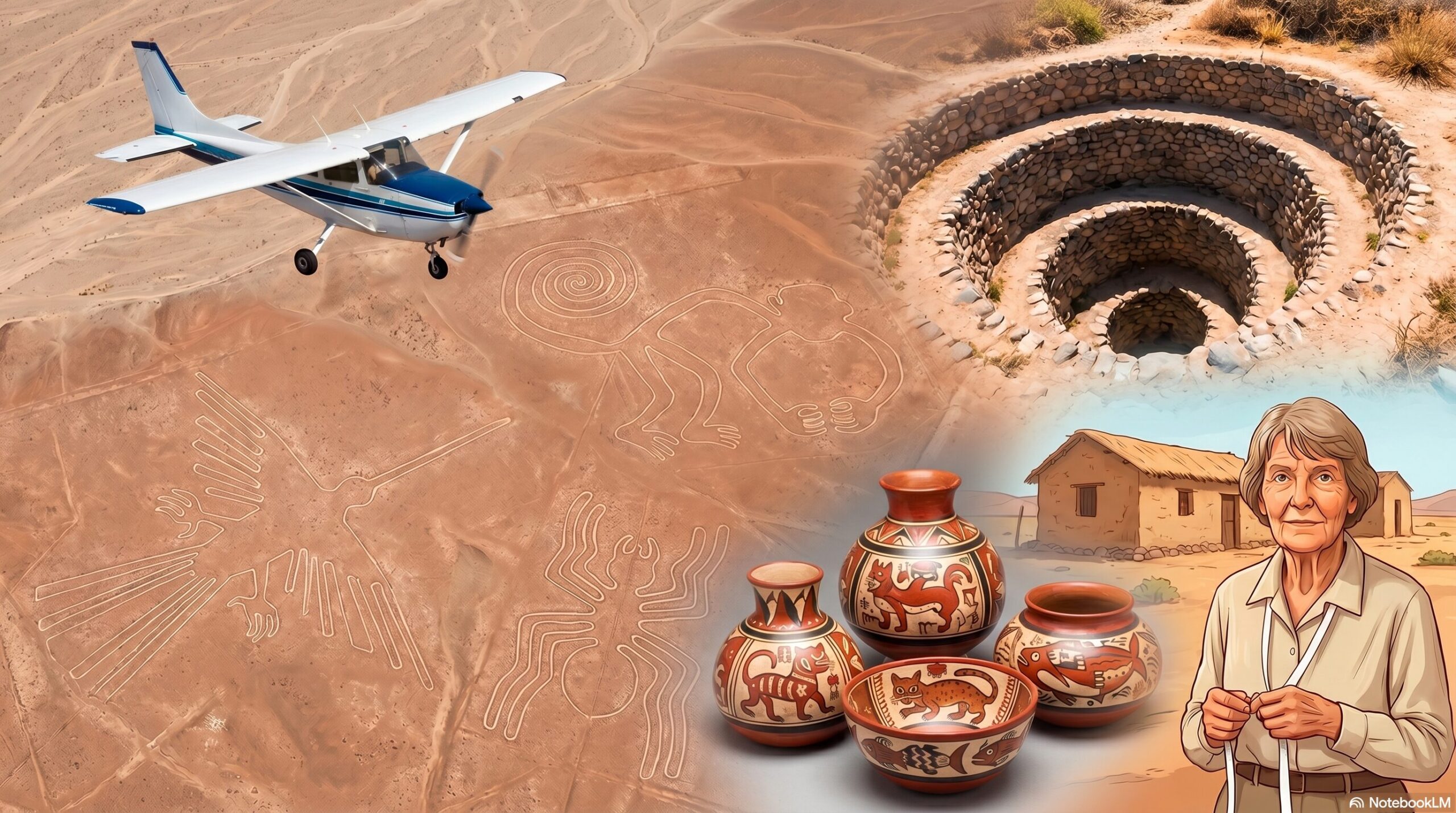
Giant geoglyphs drawn 2,000 years ago in the world's most arid desert, figures up to 370 meters long that can only be seen from the sky, and which continue to defy modern science.
In the most arid coastal desert on the planet, the Nazca culture, between 200 BC and 700 AD, traced one of humanity's most enigmatic legacies: more than 70 giant figures and thousands of geometric lines visible only from the air, perfectly preserved for two millennia thanks to the extreme desert climate.
The city of Nazca, nestled in the valley of the river bearing the same name, is the departure point for flying over the lines in a small plane, the most iconic experience in Peru after Machu Picchu. But Nazca is far more than its geoglyphs: underground aqueducts of extraordinary engineering, pre-Columbian cemeteries, first-rate ceramic craftsmanship and the still-open scientific debate about their meaning.
The answer to why they exist is still debated, an astronomical calendar? Ritual paths for processions? Messages to the gods of water? What is indisputable is that the Nazca culture created something unique in human history, and that the desert preserved it intact to this day.
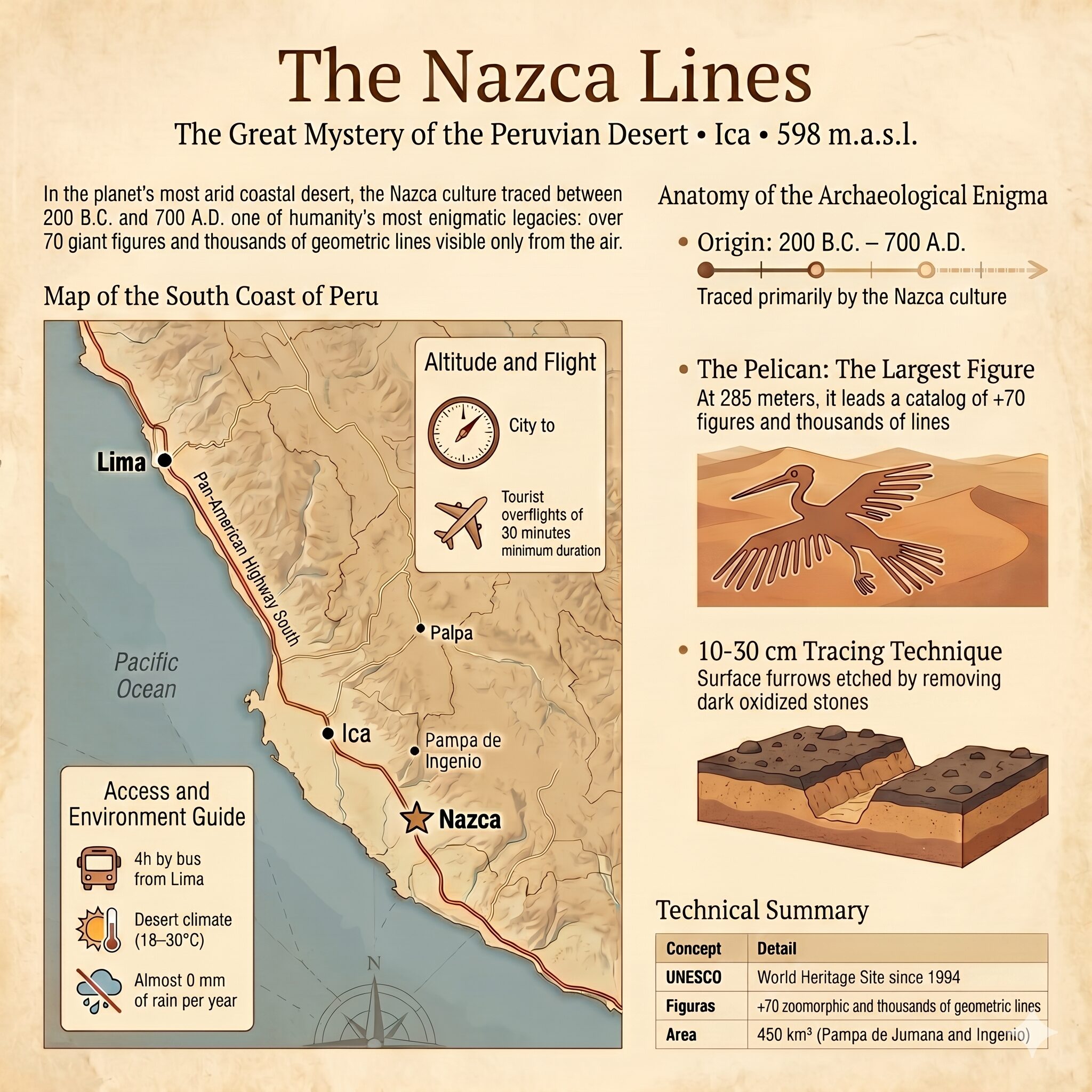
Nazca sits in one of the driest deserts on the planet, the Humboldt Current cools the sea and blocks rainfall, creating the perfect climate that preserved the lines for 2,000 years without them fading.
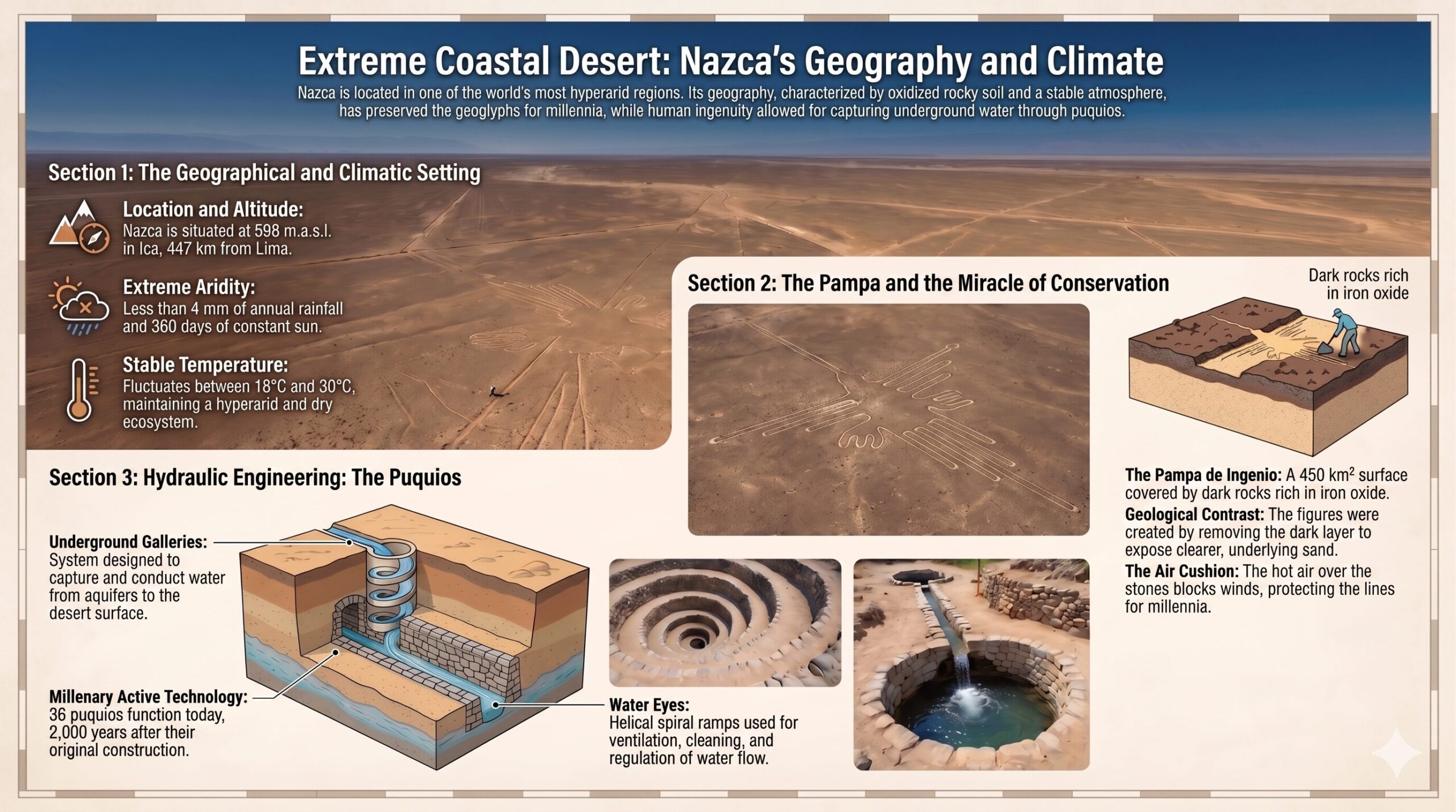
Ica coastal desert · 447 km south of Lima
Nazca sits in a river valley surrounded by the dark-stone desert pampa on which the lines were drawn. The city lies at 598 m above sea level, connected by the Pan-American South Highway, one of Peru's most spectacular roads, cutting through the coastal desert beside the Pacific.
0 mm rain/year · Sunny 360 days
Nazca has one of the driest and sunniest climates on the planet, less than 4 mm of rainfall per year on average. This extreme aridity allows the lines to be perfectly preserved: no rain, no vegetation, no erosion. Temperatures range from 18°C at night to 30°C during the day, with clear skies that guarantee flights almost year-round.
Flat surface of oxidised stone
The Nazca pampa is a desert flatland covered with iron-oxide stones (dark in colour) that contrast with the lighter yellowish soil beneath. The Nazca people simply removed the surface stones to create the figures, a seemingly simple technique that would be impossible to execute with such precision without advanced knowledge of geometry.
Underground water engineering
In a desert with almost no rainfall, the Nazca built a system of underground aqueducts called puquios to transport water from the mountains to the city. All 36 puquios still function today, 2,000 years later, and stand as a testament to the technical sophistication of this culture, just as impressive as the lines themselves.
The answer lies in the geography. The Humboldt Current, cold water from Antarctica rising along the South Pacific, cools the Peruvian coast and blocks the formation of clouds and rain. Nazca has almost zero precipitation. No rain, no vegetation, no strong winds: the perfect trio for preserving grooves just 10–30 cm deep in stone. Additionally, the low-skimming wind heats the ground and creates a warm-air layer that shields the lines from wind erosion. Nature preserved what humans created.
The Nazca culture flourished for nearly a thousand years on the arid coastal plains of southern Peru, leaving the lines, polychrome pottery and aqueducts as testament to a civilisation that solved the desert's challenge with genius.
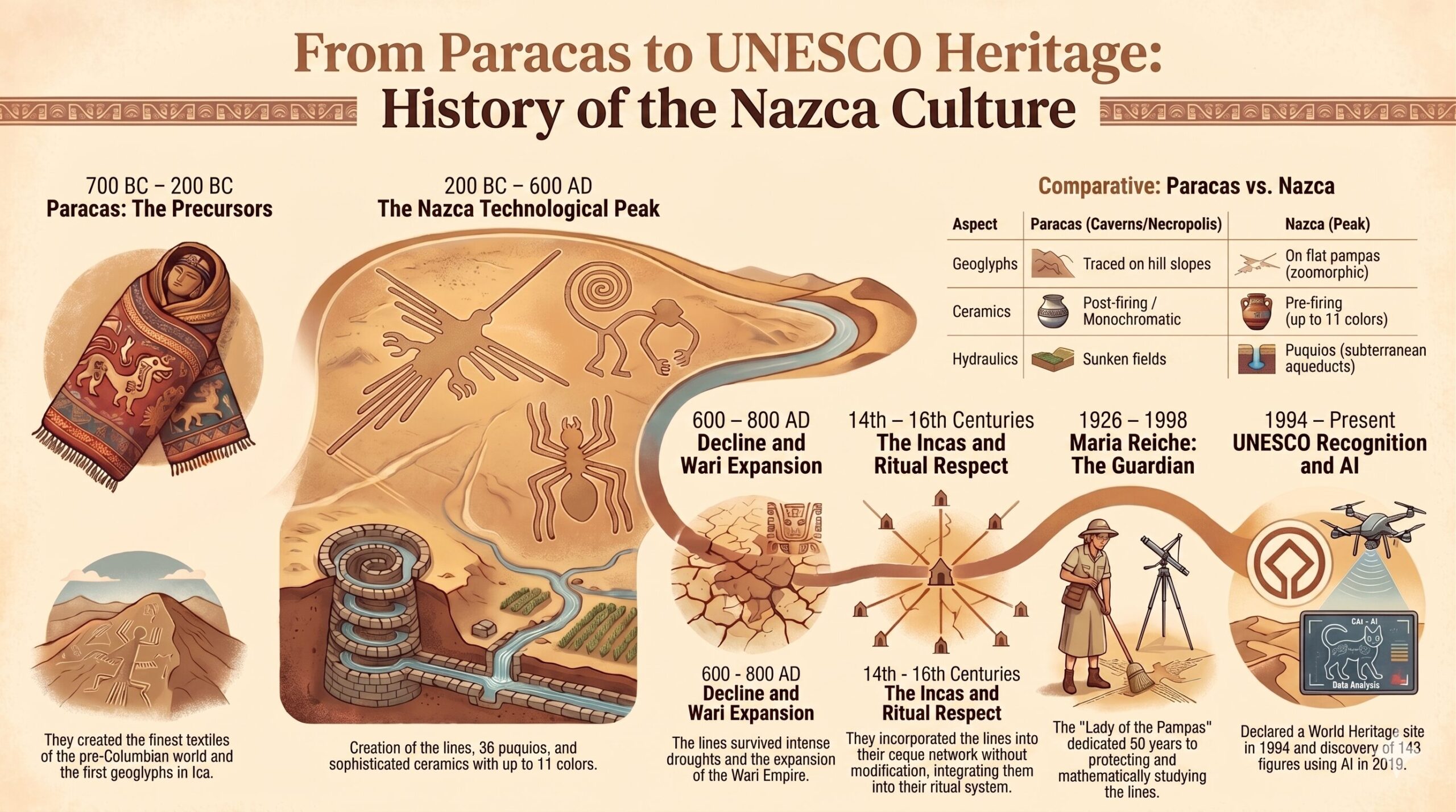
The Paracas culture preceded and laid the foundations for the Nazca, their simple geoglyphs on the Ica coast are the first signs of desert rock art. The famous Paracas textiles, with their mummies wrapped in embroidered mantles of extraordinary colour, display the same mastery of colour and geometry that would later define the lines.
The classical period of the Nazca culture is when most of the figures and lines were created. At the same time, the Nazca built the puquios, the underground aqueduct system that solved the water problem in the world's most arid desert. Nazca pottery of this period is considered the most sophisticated in the pre-Columbian southern hemisphere, up to 11 colours applied to clay without the use of a wheel.
A combination of severe droughts, environmental deterioration from deforestation and the expansion of the Wari Empire from Ayacucho accelerated the collapse of the classical Nazca culture. The Huari absorbed its territories around 800 AD. The lines, however, would survive every empire that followed, including the Incas themselves, who respected them without alteration.
When the Inca Empire extended its rule over southern Peru, the Nazca Lines had already existed for more than a thousand years. The Incas incorporated them into their network of ceques (sacred lines radiating from Cusco) and integrated them into their own ritual practices. The Inca reverence for these monumental structures is one of the reasons they reached the 20th century intact.
German mathematician María Reiche dedicated 50 years of her life to studying and protecting the Nazca Lines. She arrived in Peru in 1932 and from the 1940s lived permanently in the desert, cataloguing the figures, fighting against road construction that crossed them and developing her astronomical theory, the lines as a celestial calendar. Her work was instrumental in the UNESCO declaration. She died in 1998 and is buried in Nazca.
In 1994 UNESCO declared the Lines and Geoglyphs of Nazca and the Pampas de Jumana a World Heritage Site. In 2019 the team from Yamagata University (Japan) used artificial intelligence to discover 143 new figures not previously catalogued, proving that Nazca's mystery still has chapters to be written. Today the main challenge is protecting the lines from uncontrolled tourism and urban expansion.
The Nazca culture was not just the lines, it was an advanced civilisation that mastered pottery, water engineering, weaving and mathematics in one of the most hostile environments on Earth.
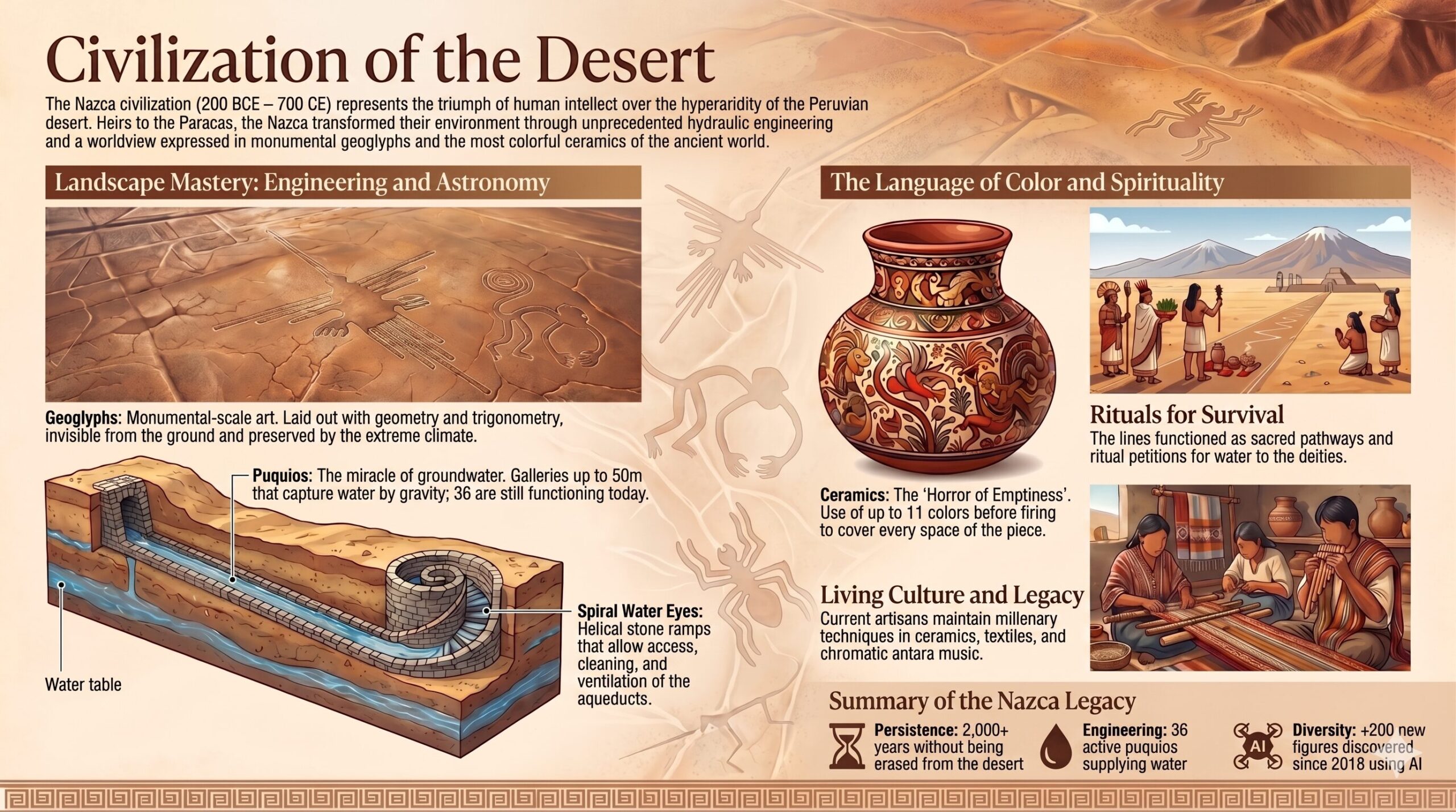
The Nazca Lines are the most monumental artistic achievement in pre-Columbian American history. Their creation required knowledge of geometry, trigonometry and unprecedented large-scale workforce coordination. The designs are mathematically perfect, no appreciable errors across kilometres of straight lines.
Nazca pottery is considered the most sophisticated in the southern hemisphere, pieces painted with up to 11 different colours before firing, depicting the same motifs as the lines (hummingbird, monkey, spider). Without a wheel, without glazing, using natural mineral pigments. The finest pieces are held at the Antonini Archaeological Museum in Nazca.
The puquios are underground galleries up to 50 metres deep that capture water from the water table and transport it without pumps, using only gravity and subsurface pressure. Built 1,500 years ago, 36 of them still function today to irrigate Nazca's fields, an engineering achievement that astonishes modern experts.
The most widely supported theory about the lines today links them to water-petition rituals, processions towards the centres of figures during drought periods, sacred paths to springs and mountains, or representations of the underground irrigation system as seen from the gods' sky. Water was the most precious resource in this desert.
Today's Nazca artisans maintain the ceramic tradition with replica and contemporary-design pieces, the carving of gourds (*mates burilados*) with pre-Columbian motifs, and textile manufacturing in native cotton. The craft workshops around the city centre are a direct window into this living cultural heritage.
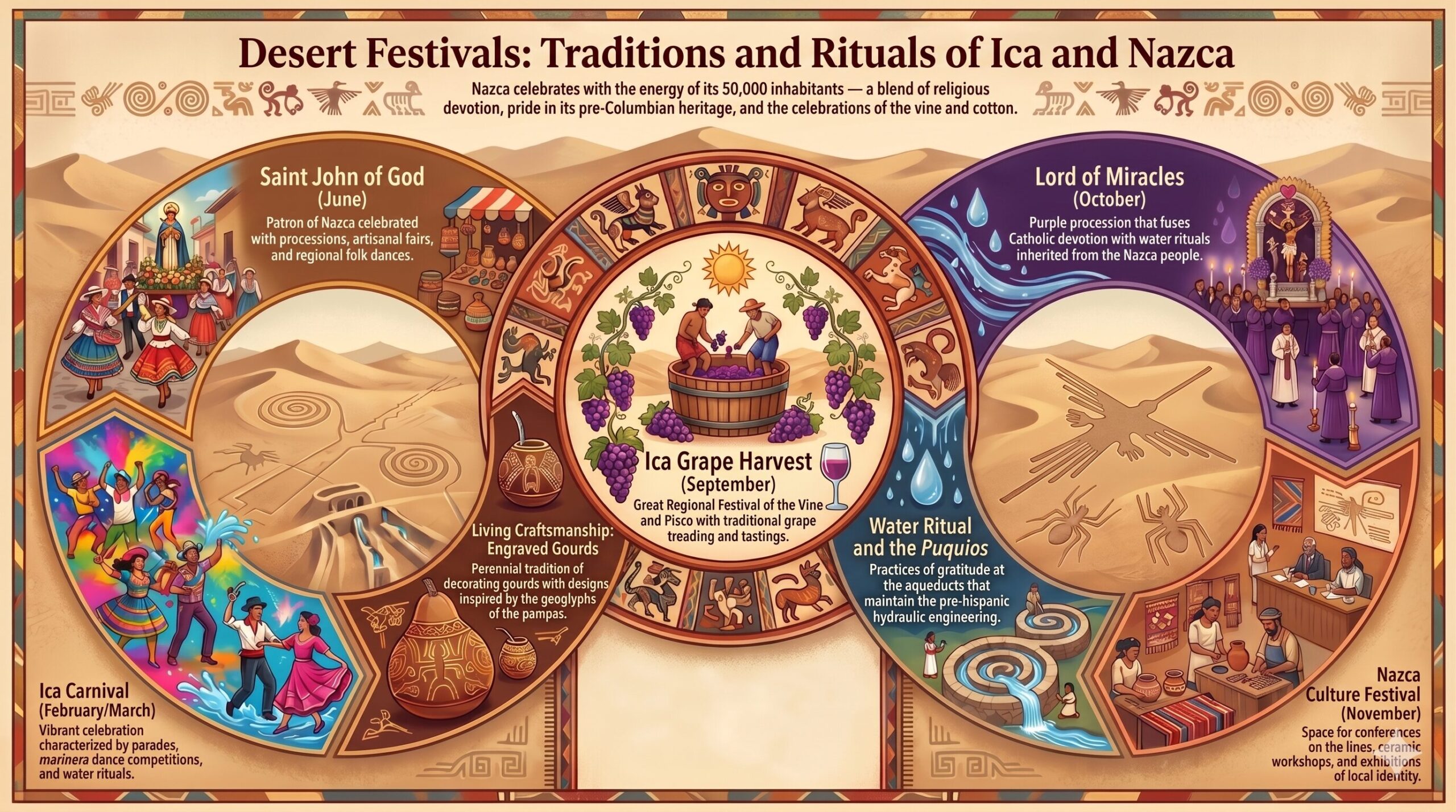
Nazca celebrates with the energy of its 50,000 inhabitants, a blend of religious devotion, pride in its pre-Columbian heritage and the vine and cotton festivals that define the Ica calendar.
Grape & Pisco Celebration
The Ica region, of which Nazca is part, is Peru's wine capital. The Vendimia (harvest festival) is the most important celebration on the southern coast: grape treading, election of the Harvest Queen, pisco and wine tastings, and parades with floats adorned with grape clusters. Nazca participates actively with its own local wineries.
Patron Saint of Nazca, 8 June
Nazca's patron saint festival honours San Juan de Dios with solemn masses, a procession through the city centre streets, a craft fair and folk dances. This is the moment when Nazca people living in Lima return to their city, a celebration of regional identity as important to its residents as the lines themselves.
The Purple Procession
As throughout the Peruvian coast, October turns Nazca into a sea of purple, thousands of devotees dressed in purple accompany the image of the Lord of Miracles in procession. The devotion is particularly intense in the valley's most traditional communities, where faith blends with the water rituals inherited from the Nazca culture.
UNESCO Heritage Celebration
An annual festival dedicated to pre-Columbian heritage, archaeological exhibitions, pottery workshops using Nazca techniques, talks on the theories behind the lines, and special tours with local archaeologists. The most important event for history students and cultural tourists visiting the city.
Water & Pisco in the Desert
The Ica region's carnivals have their own character, particularly enthusiastic water battles in a city where water has historically been scarce and precious, colourful costume parades, *marinera norteña* dance competitions, and the inevitable presence of local pisco as the star of the celebrations.
Nazca Heritage on Gourds
Mates burilados (engraved gourds) from Nazca are decorated with incisions reproducing the line designs, the hummingbird, the monkey, the spider. A craft tradition directly connected to pre-Columbian iconography. Workshops in the historic centre are open year-round and offer some of the best souvenirs you can buy in the city.
Peruvian Independence, 28 July
Independence celebrations are a major event throughout the Peruvian coast. Nazca celebrates with school parades, regional folk dance performances, concerts on the main square and, in recent years, special flights over the lines with discounts for local residents who have rarely had the chance to fly over them.
Living Pre-Hispanic Tradition
The farming communities of the Nazca valley maintain water-thanksgiving rituals linked to the puquios and to the start of each irrigation season. These small celebrations, held without tourist fanfare, are a direct continuation of the ritual practices that may have given rise to the lines two thousand years ago.
Nazca's cuisine is heir to the Ica tradition, Pacific seafood, shrimp from the Acarí river, Peru's finest bean desserts and, above all, the country's most awarded pisco and wine.
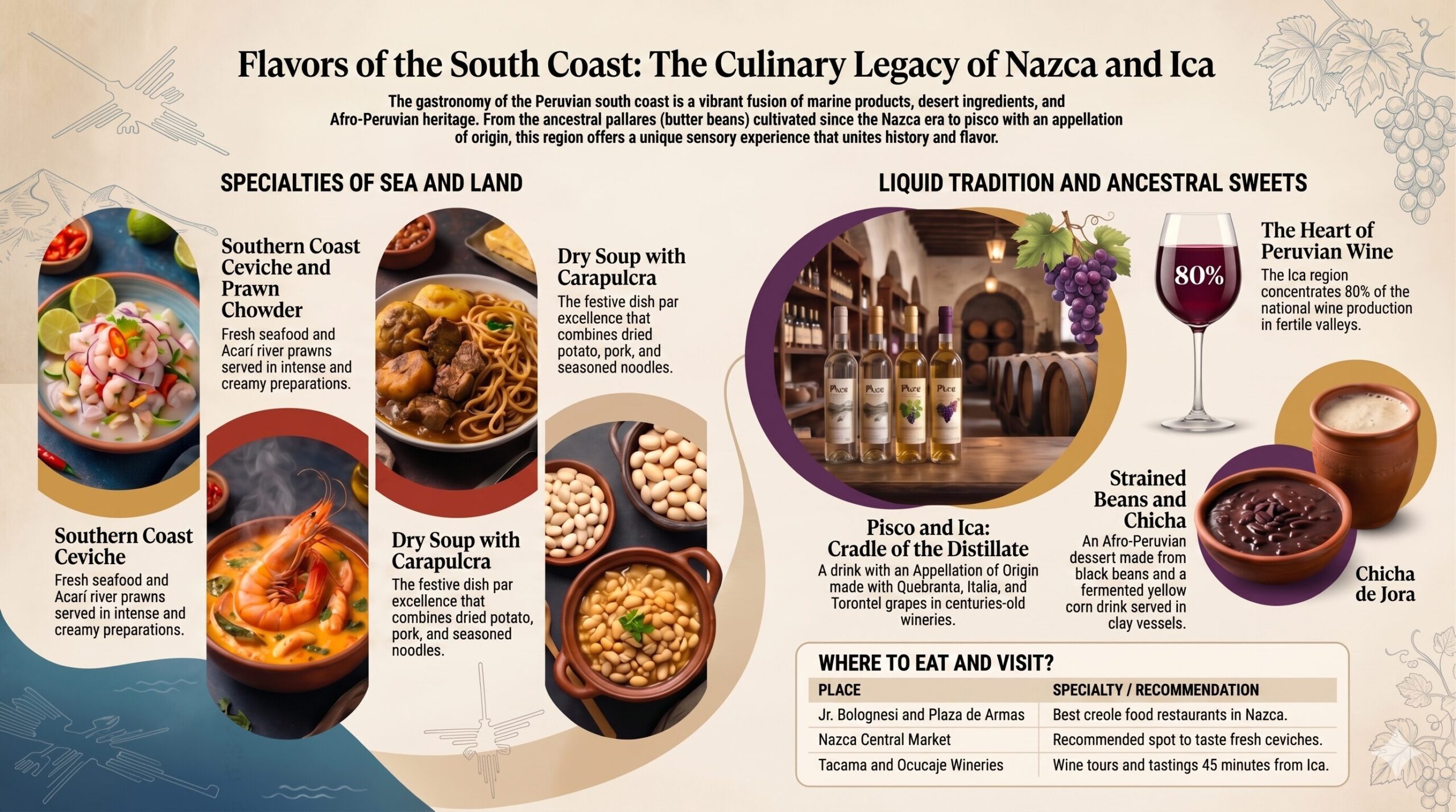
Nazca and the Ica coast ceviche uses fresh Pacific seafood from the nearby ocean, mussels, black clams, squid and the unbeatable tollo (small shark). The southern leche de tigre (tiger's milk marinade) is more intense, with more ají amarillo chilli and a touch of pisco not found in Lima.
Must TryThe shrimp from the Acarí river and the rivers of the Ica region are the largest and most flavourful in Peru. The chupe, a creamy soup with potato, milk, egg and ají amarillo, is the most emblematic dish of Arequipa and Ica cuisine. In Nazca it is at its very best from October to December.
Season Oct–DecThe Ica region produces Peru's most awarded pisco, quebranta, Italia, Torontel and Moscatel grapes in valleys with unique conditions of sun, sand and wind. A Pisco Sour made with Ica pisco has a different structure to Lima's, more complex and aromatic. Ica wineries offer tours with tastings.
Denomination of OriginIca's most emblematic dessert, cooked black bean paste, strained and mixed with sugar, roasted peanuts, sesame and shredded coconut. Dense in texture and intensely sweet in flavour, it is a legacy of the Afro-Peruvian cuisine of the southern coast. Sold in bars wrapped in banana leaves in Nazca and Ica markets.
Ica DessertThe ceremonial dish par excellence of the southern coast, carapulcra (dried potato stew with panca chilli and pork) served over sopa seca (dry pasta in a green sauce style). This unique combination, with Afro-Peruvian roots, is the essential dish at weddings, christenings and patron saint festivals throughout the southern Peruvian coast.
Festive DishIca's wineries, Tacama, Queirolo, Ocucaje and Vista Alegre, produce 80% of Peruvian wine. Peru is not internationally known as a wine country, but its Ica wines have a character of their own, influenced by the coastal desert, intense sun and the Humboldt Current. Winery tours from Nazca and Ica are not to be missed.
Century-Old WineriesThe pallar bean from Ica is the largest and creamiest legume in Peru, an exceptionally large white bean grown in the valleys of the southern coast. In a seafood stew, salad or soup, the pallar is a gastronomic pride of Ica as ancient as the Nazca culture itself, which cultivated it and painted it on its pottery.
Exclusive Ica ProductNazca's *chicha de jora* (fermented maize beer) has its own identity, fermented with local yellow maize, lighter and less acidic than the highland version, with a ripe-fruit flavour that makes it perfect for the desert heat. Traditional *chicherías* (chicha taverns) in Nazca's centre serve it in clay cups, following the pre-Columbian custom.
Pre-Columbian TraditionThe best restaurants are concentrated on Jr. Bolognesi and around the Plaza de Armas. For fresh seafood ceviche, Nazca's Central Market has the best traditional food stalls at lunchtime. The Tacama and Ocucaje wineries (45 min towards Ica) offer tours with lunch and pisco and wine tastings included. The desert's cuisine surprises, it is rich, generous and has a character of its own that goes far beyond the tourist restaurants in the centre.
The lines are the main reason to come, but Nazca holds an archaeological treasure that goes far beyond, aqueducts that defy modern engineering, cemeteries with intact textiles and geoglyphs that never cease to astonish.
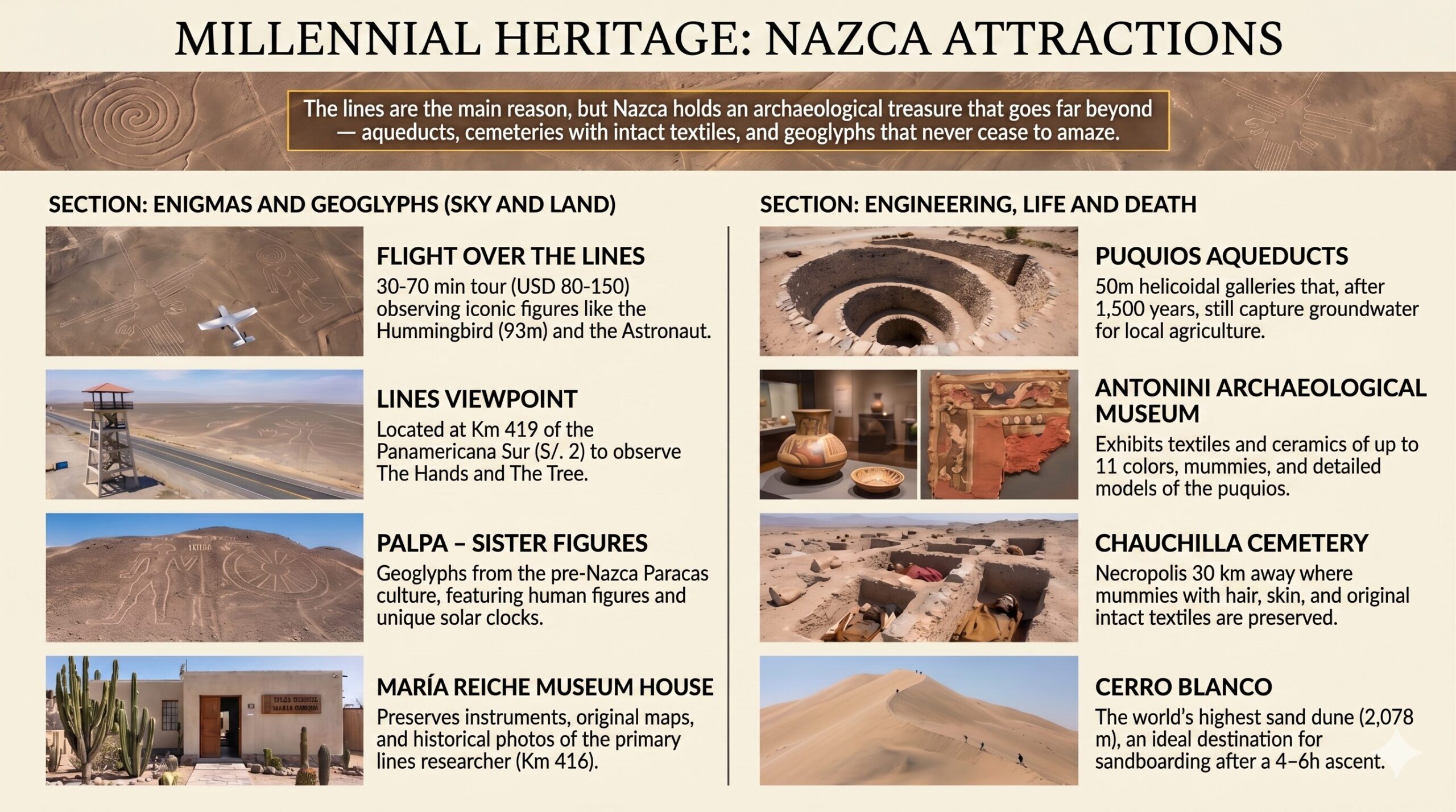
The ultimate experience, flying over the geoglyphs in a 4–12-seat light aircraft from Nazca aerodrome. A 30-minute flight takes in the Hummingbird (93 m), the Monkey (135 m), the Spider (46 m), the Astronaut and the Dog. The view from the air transforms your understanding of these monumental designs.
The Cantalloc puquios are the most impressive pre-Columbian aqueduct system in Peru, helical underground galleries up to 50 metres deep, still in use after 1,500 years. The spiral openings that emerge to the surface are as beautiful as the geoglyphs themselves.
For those who don't fly, the metal viewing tower on the Pan-American South Highway allows two of the most accessible figures to be seen from the ground, the Hands and the Tree, 20 km from Nazca. A different perspective but equally striking.
The finest museum of Nazca culture, polychrome ceramics with up to 11 colours, Paracas textiles, mummies, scale models of the puquios and the best scaled reproductions of the lines. Essential before or after your flight to understand the full cultural context.
30 km from Nazca, a pre-Columbian cemetery where Nazca mummies lie in their open tombs, perfectly preserved by the extreme desert climate, with hair, skin and textiles intact. One of the most striking archaeological experiences in Peru.
40 km north of Nazca, the Palpa plains hold geoglyphs of the Paracas culture, older than the Nazca, including human figures and astronomical sundials. Less visited than Nazca, they are ideal for archaeology enthusiasts looking to step off the standard circuit.
Cerro Blanco (2,078 m) is the world's tallest sand dune, a mountain of white sand rising from the Nazca desert. The most adventurous climb it in 4–6 hours and descend on sandboard in minutes, with panoramic views of the lines pampa from the summit.
The house where the "Guardian of the Lines" lived and worked for 50 years, now a museum. Her measuring instruments, original maps, historical photographs and the personal story of this scientist who dedicated her life to the Peruvian desert. An unmissable tribute to the woman who saved the lines from oblivion.
More than 70 catalogued figures, thousands of straight lines and trapezoidal shapes hundreds of metres wide, each with its own story, its mystery and its magic. Knowing them before your flight multiplies the experience.
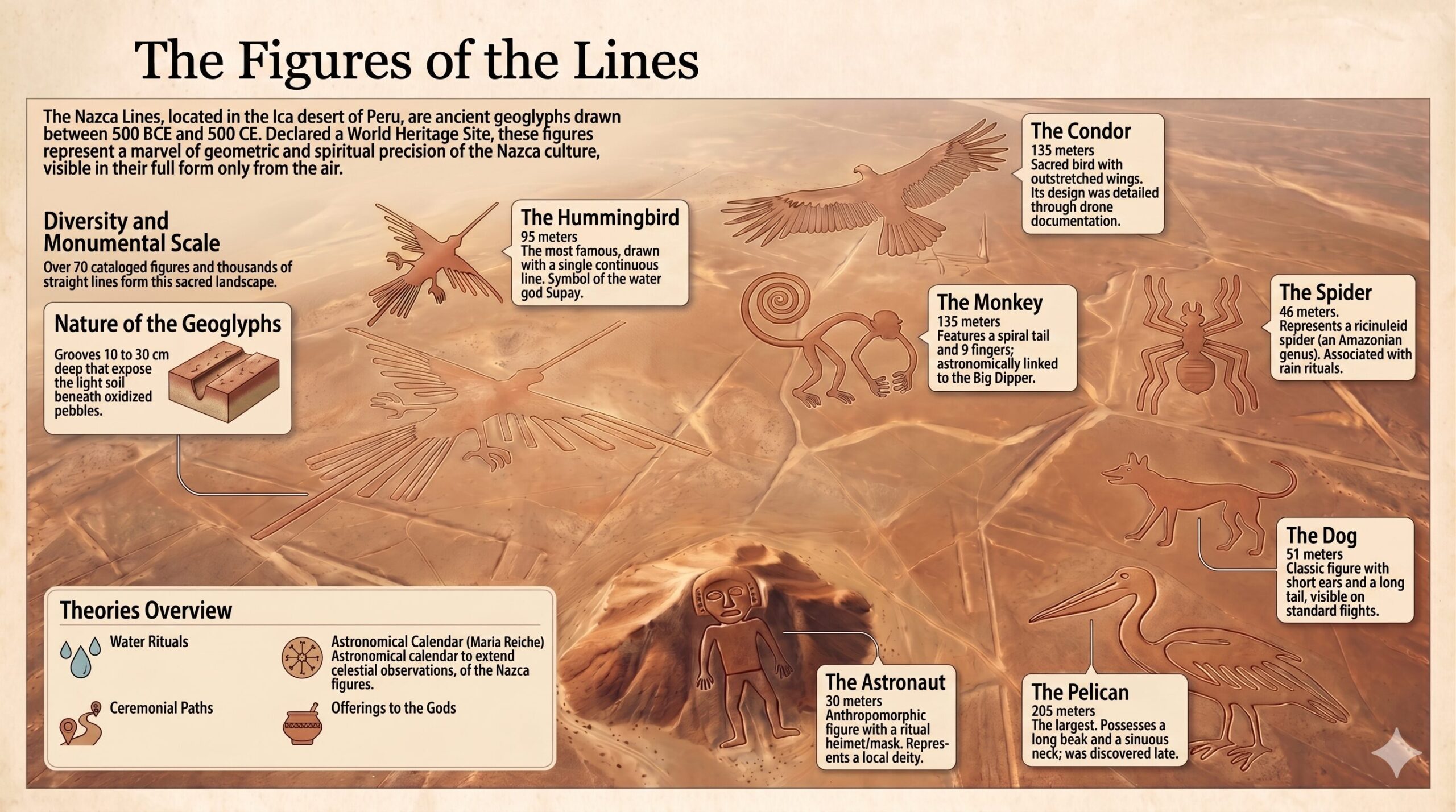
The most photographed figure of the lines, a hummingbird with a 93-metre wingspan drawn in a single continuous line, without the stroke ever crossing itself. The hummingbird was a symbol of the water god Supay for the Nazca culture. Its geometric precision astonishes modern mathematicians.
The largest animal in the lines, 135 metres with an elaborate spiral tail. It has only 9 fingers, which has generated diverse interpretations. Some astronomers link it to the constellation of the Great Bear. It was the first figure overflown by María Reiche in her studies.
A 46-metre spider drawn with zoological precision, it has been identified as a ricinulei spider, an extremely rare genus that lives only in the Amazon rainforest. How did the artists of the Nazca desert know of it?
The condor, the sacred bird of the Andes, appears with wings spread in a stroke 135 metres wide. One of the most recently discovered figures via drone analysis, with feather details of surprising naturalism.
Nazca's most controversial figure, a 30-metre anthropomorphic being that appears to be wearing a helmet. Popularised by Erich von Däniken as "proof" of extraterrestrial visitors. Archaeologists identify it as a local deity with a ritual mask, not unlike figures from other Andean cultures.
At 285 metres in length, the Pelican is the largest known figure in the lines. Discovered late because it lies away from standard flight routes, it is now included in longer-duration tours. The long bill and sinuous neck make it unmistakeable from the air.
The most widely supported theory, the lines are ritual paths towards underground water sources, processions to implore rain from the gods. The waterless desert was the greatest enemy of the Nazca culture.
María Reiche's theory, many lines point towards solstices, equinoxes and the rising of specific stars. An agricultural and ceremonial calendar written in the desert.
The straight lines as paths for ritual processions, ceques similar to those the Incas drew from Cusco towards the sacred sites of the Empire.
Figures created to be seen by the gods from the sky, a monumental offering that only celestial beings could contemplate. The human perspective was irrelevant.
The flight over the lines is the main activity, but Nazca also has sandboarding on the world's tallest sand dune, ancient aqueducts, pre-Hispanic cemeteries and the most spectacular stretch of the Pan-American Highway in Peru.
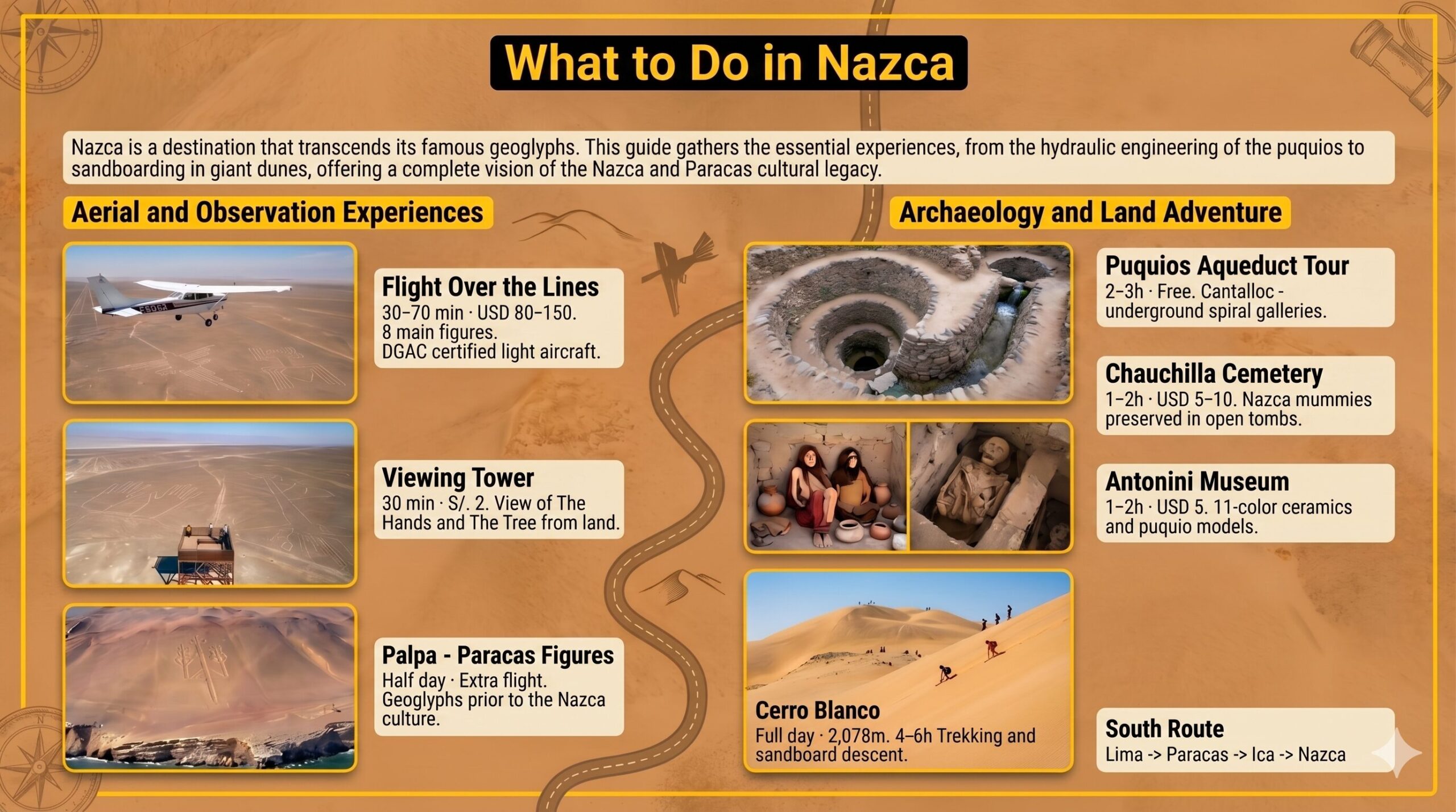
The 30-minute flight is Nazca's primary experience, 4–12-seat light aircraft from the city aerodrome. You see the Hummingbird, the Monkey, the Spider, the Condor, the Hands and the Tree. On 70-minute flights the Pelican and the Palpa figures are also included.
Cerro Blanco (2,078 m) is the world's tallest sand dune. The ascent takes 4–6 hours of trekking through sand, exhausting but with unique views of the lines pampa. The sandboard descent lasts 10 minutes of pure adrenaline. For people in good physical condition only.
Guided visit to the puquios, the stone spirals that have carried underground water from the Andes to the city for 1,500 years. Some are still used for irrigation today. The tour includes a walk among the puquios, an explanation of the hydraulic system and panoramic views of the valley.
30 km from Nazca, the pre-Columbian cemetery where Nazca mummies lie in their open tombs perfectly preserved, hair, skin and textiles intact thanks to the extreme desert climate. One of the most impressive and striking archaeological experiences in Peru.
Nazca's most complete archaeological museum includes a functional replica of the puquios and the world's largest collection of Nazca pottery. Many museums offer hands-on pottery workshops using the original technique, clay, mineral pigments and fire, without a wheel.
The pisco route from Nazca to Ica takes in the historic wineries of Tacama, Vista Alegre and Queirolo, some with over 300 years of history. Tours with guided tastings of pure pisco, infused piscos, wines and the artisanal distillation process using copper pot stills.
The most popular tour combines the flight over the lines (morning), visit to the Hands and Tree viewpoint, Chauchilla Cemetery, Cantalloc Aqueducts and the Antonini Museum, all in one day. Ideal for travellers passing through between Lima and Cusco on the Pan-American South Highway.
With 360 clear-sky days per year and zero light pollution on the pampa, Nazca has one of the world's finest night skies. Some operators offer astronomy tours on the pampa, the same stars the Nazca used to draw their lines, according to María Reiche.
Nazca is a quick-visit destination, 1 or 2 days are enough for the flight and the main sites. Here is everything you need to plan without surprises.
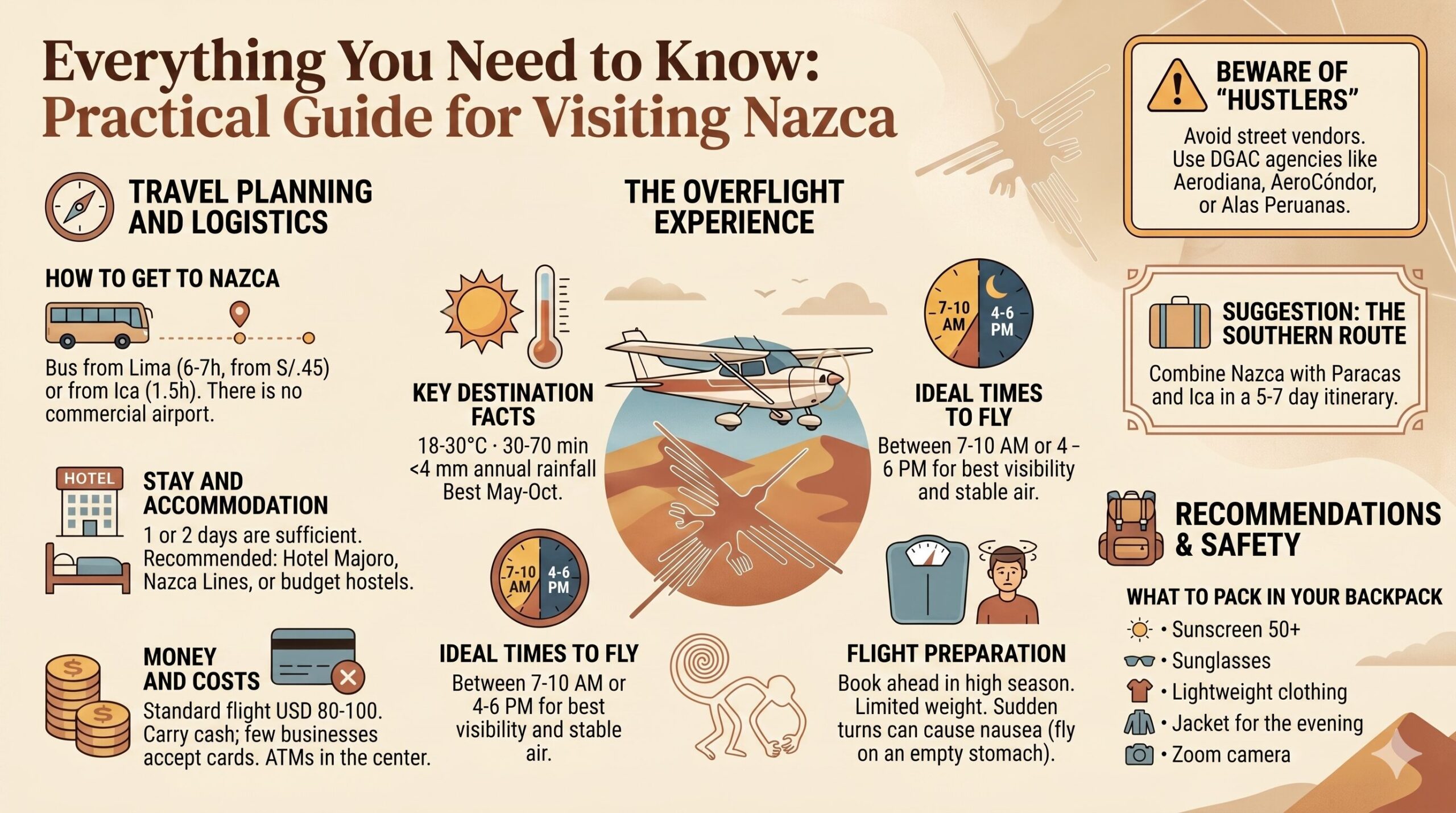
At Nazca's bus terminal there are aggressive sellers offering flights at very low prices, sometimes with poorly maintained aircraft or uncertified companies. Always book with recognised agencies such as Aerodiana, Alas Peruanas or AeroCóndor, verifying their DGAC (Peruvian Civil Aviation Authority) certification.
Nazca alone may feel short for several days, combine it with the Paracas National Reserve (2h north), the Ballestas Islands, the Huacachina sand dunes and Ica's pisco wineries. The Southern Route (Lima → Paracas → Ica → Nazca) is one of the best itineraries on the Peruvian coast and can be done comfortably in 5–7 days.