

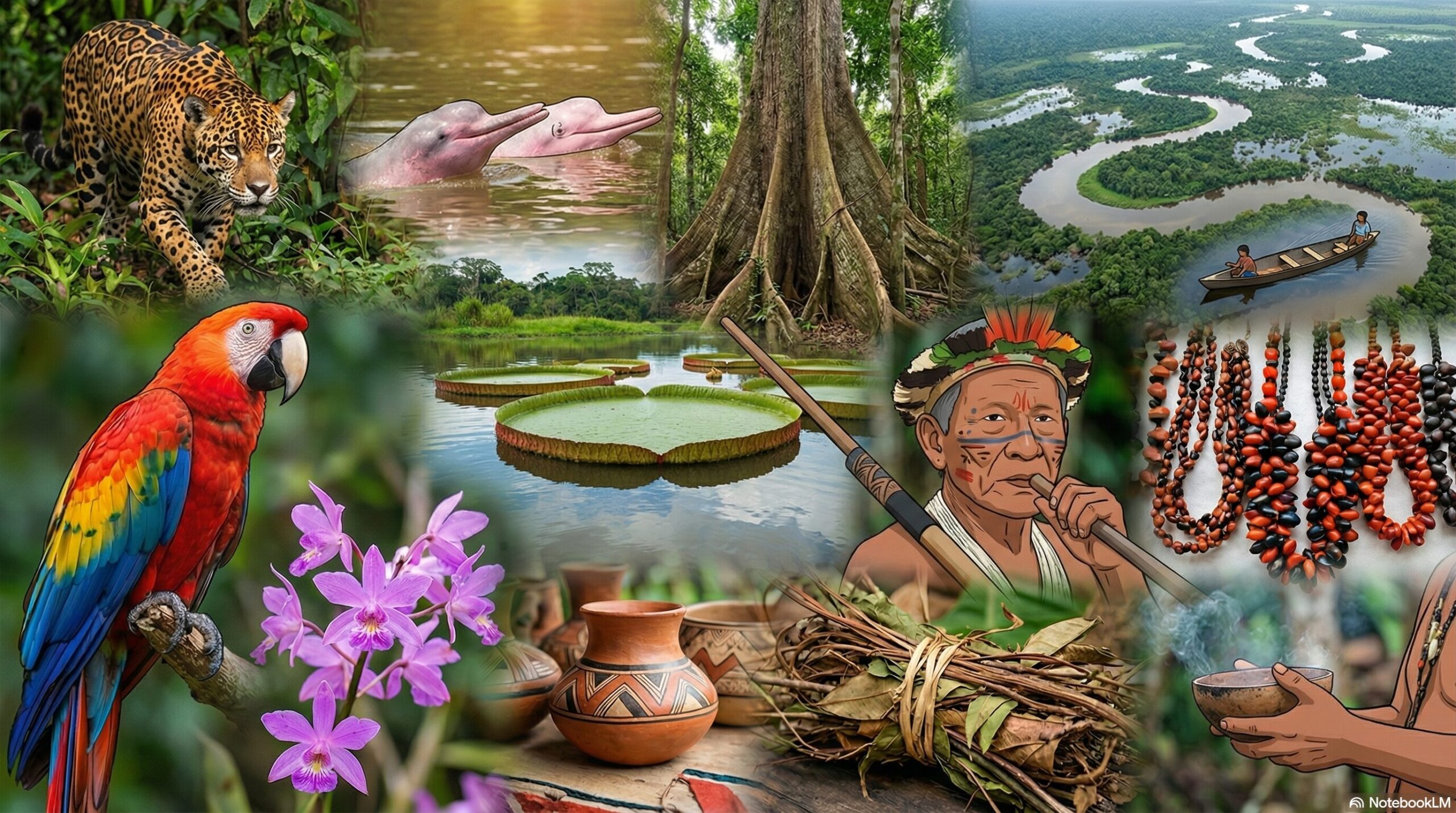
60% of Peru is Amazonian rainforest, the most biodiverse ecosystem on the planet. Pink dolphins, jaguars, macaws and 50,000 plant species in the world's lungs.
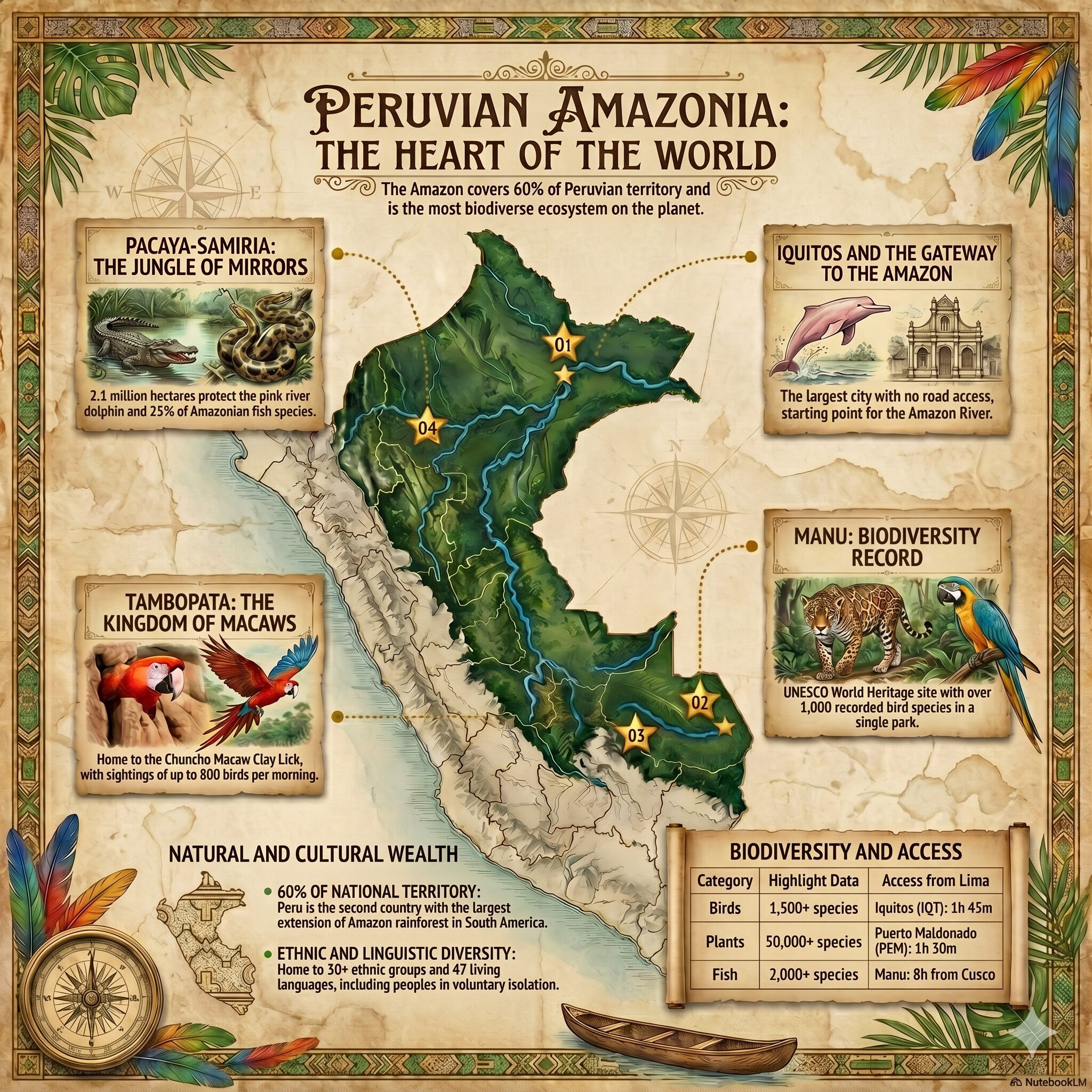
Peru holds 60% of its territory within the Amazon basin, the largest continuous tropical rainforest on Earth. Here, where the Amazon River is born from the Andes, biodiversity reaches figures that defy imagination: more bird species spotted in a single day than in an entire year across Europe.
From the cloud forests of Manu and Madre de Dios in the south, declared a World Heritage Site and considered the most biodiverse region on Earth, to the vast Pacaya-Samiria Reserve near Iquitos in the north, the Peruvian Amazon offers experiences found nowhere else in the world.
Iquitos, a city accessible only by river or plane, is the gateway to the northern Amazon. Puerto Maldonado, capital of Madre de Dios, is the starting point for the southern reserves. Both offer jungle lodges, wildlife watching, indigenous communities and the experience of getting lost in the continent's most pristine wilderness.
The Peruvian Amazon is not a uniform ecosystem, it ranges from the misty highland cloud forests to the vast rivers and lagoons of the tropical lowlands, including unique flooded forests found nowhere else on Earth.
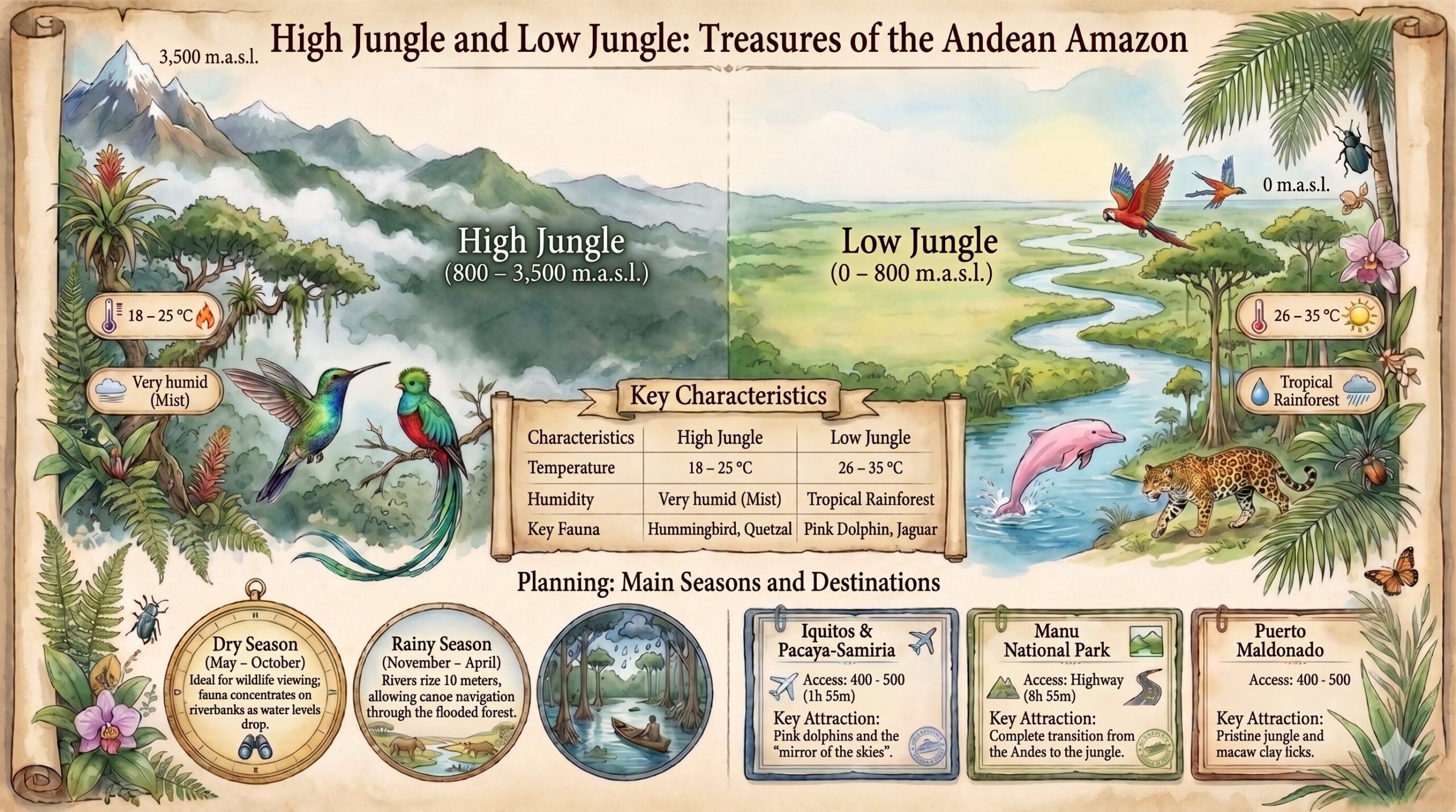
800 – 3,500 m above sea level
The transition zone between the Andes and the Amazon, cloud forests permanently wrapped in mist where the main Amazonian rivers are born. Manu National Park begins here, with biodiversity ascending from tropical jungle to highland grasslands in just 3 hours.
0 – 800 m above sea level
The vast Amazonian lowlands where the Amazon River itself is born from the confluence of the Ucayali and Marañón rivers near Iquitos. Flooded forests, oxbow lakes (cochas), palm swamps and the Pacaya-Samiria ecosystem, the "mirror of the skies" where the sky is reflected across millions of hectares of water.
Best time to visit
Rivers drop and wildlife concentrates on riverbanks and lagoons, ideal for spotting caimans, pink dolphins, anacondas and thousands of birds. The heat is intense (30–35°C) but manageable. Jungle lodges in Manu and Madre de Dios operate at full capacity.
Jungle at its most lush
Rivers rise up to 10 metres, you can canoe directly over the flooded forest, a uniquely Amazonian experience. Vegetation explodes in exuberant growth and fish (including piranha) venture into the flooded trees. More mosquitoes, strong repellent and long sleeves are essential.
Northern Peru. The world's largest city with no road access, gateway to Pacaya-Samiria National Reserve, South America's largest freshwater reserve. Pink dolphins, manatees and macaws.
Madre de Dios / Cusco. The most biodiverse region on the planet, from 3,500 m in the Andes down to the lowland jungle within a single park. Considered Peru's most important ecotourism destination.
Southern Peru. Tambopata National Reserve and Bahuaja-Sonene Park, home to the world's largest macaw clay lick (Chuncho) and easy access by flight from Cusco or Lima.
The Amazon rainforest was never an empty territory, advanced civilizations, river empires, the rubber boom trauma and the rise of modern ecotourism have all shaped the Amazon we know today.
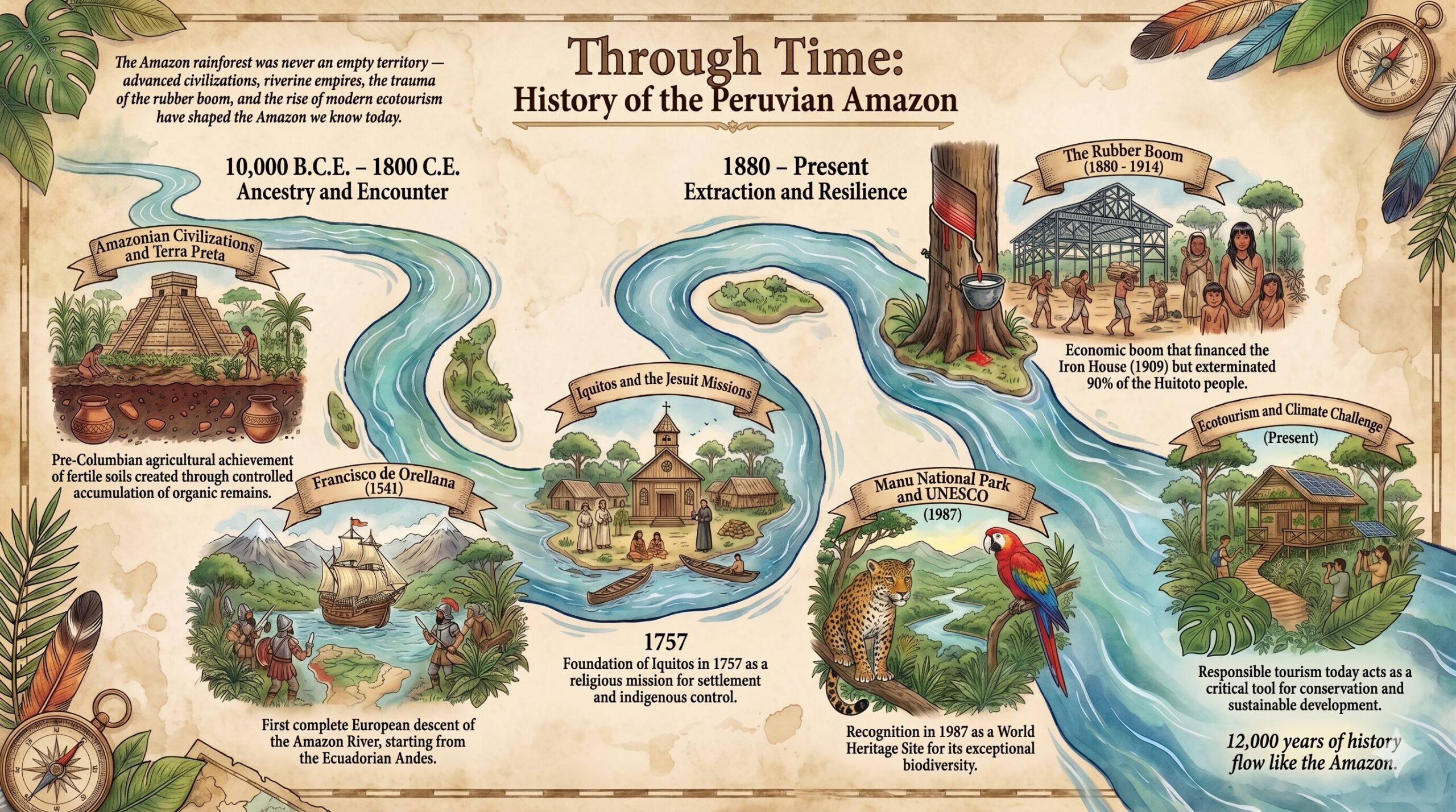
Contrary to the myth of the "green desert", the Amazon was home to complex civilizations with cities of tens of thousands of inhabitants. Terra Preta, black soil artificially created by Amazonian peoples, is one of the most fertile soils on Earth and proof of pre-Columbian agricultural engineering. Cultures such as the Omagua, the Tapajós and the builders of the Acre geoglyphs transformed the jungle over millennia.
Spanish conquistador Francisco de Orellana completed the first documented navigation of the Amazon River in 1541, departing from present-day Ecuador and reaching the Atlantic. His chronicles described riverside cities with millions of inhabitants, accounts dismissed for centuries as tropical fantasy, now being confirmed by modern archaeology.
The Jesuits established missions throughout the Peruvian Amazon, learning indigenous languages and creating the region's first written vocabularies. The founding of Iquitos as a military outpost in 1757 marked the beginning of permanent Spanish presence in the Peruvian Amazon. After the Jesuits were expelled in 1767, many indigenous communities were left without the relative protection these missions had offered.
Global demand for rubber from the industrial sector brutally transformed the Amazon. Iquitos became one of the richest cities in the world, its rubber barons imported Portuguese tiles, European operas and built the Casa de Fierro designed by Eiffel. On the other end, Julio César Arana's slave labour regime in the Putumayo region exterminated up to 90% of the local indigenous population in what is now recognised as genocide.
Manu National Park was created in 1973 and declared a World Heritage Site by UNESCO in 1987, considered the protected area with the greatest biodiversity on the planet. Its creation marked the beginning of the conservation era for the Peruvian Amazon and positioned Peru as a global ecotourism destination. Today it shelters voluntarily isolated communities protected by law.
The Peruvian Amazon today faces the tension between sustainable ecotourism growth, illegal gold mining in Madre de Dios (the world's largest of its kind), deforestation and indigenous peoples' rights. The Peruvian government maintains exclusion zones for voluntarily isolated peoples. Responsible tourism in certified lodges is now one of the main tools of active conservation.
The Peruvian Amazon is home to more than 50 indigenous ethnic groups with their own languages, cosmologies and ways of life, from communities that welcome visitors to voluntarily isolated peoples protected by the State.
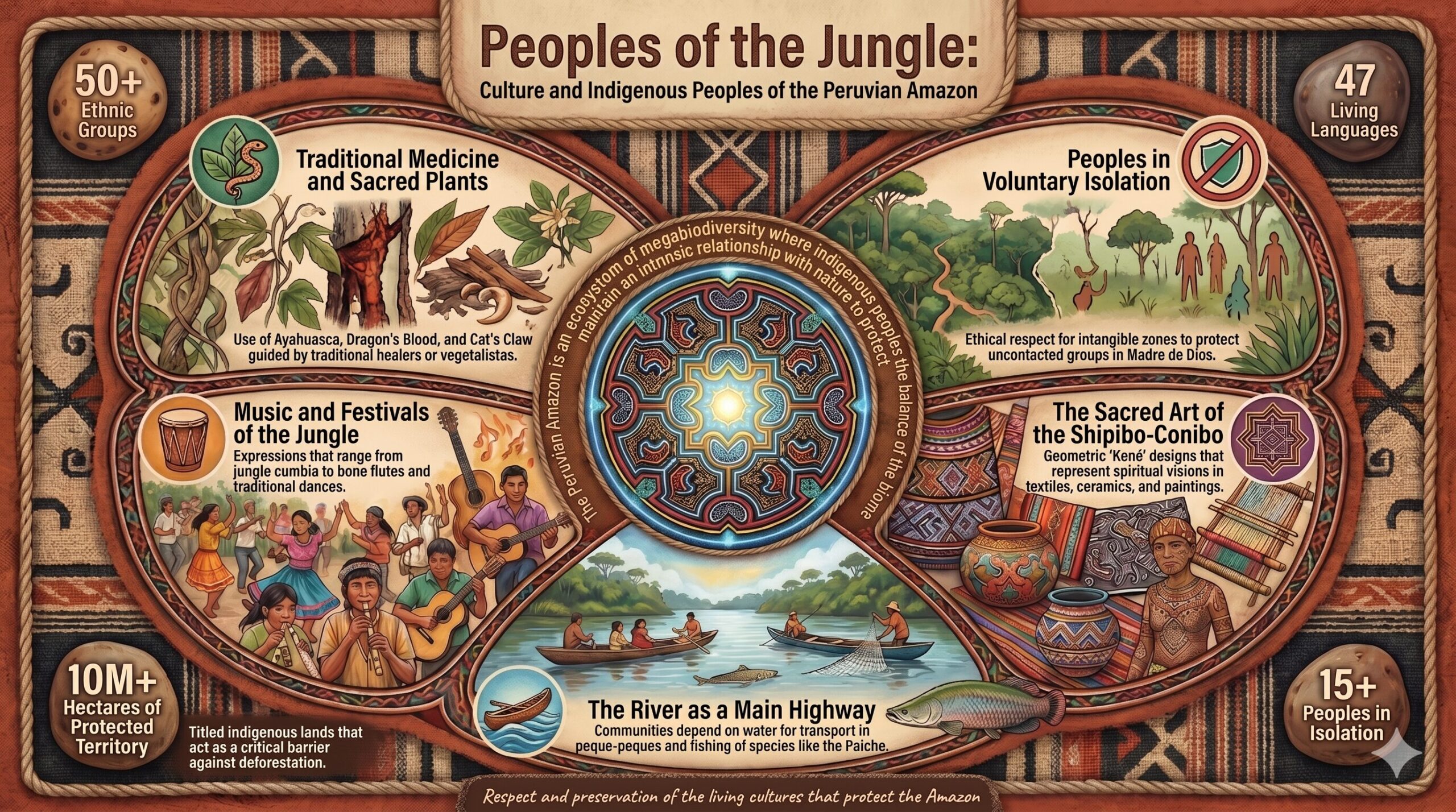
Amazonian peoples have developed over millennia one of the most sophisticated medical systems in the world. Ayahuasca (sacred medicine of the Shipibo-Conibo people), dragon's blood (sangre de grado), cat's claw (uña de gato) and hundreds of medicinal plants are now being studied by modern pharmacology. Healers known as vegetalistas are central figures in their communities.
The geometric patterns of the Shipibo-Conibo people (Ucayali River) are world-renowned, textiles, ceramics and paintings that reproduce ayahuasca visions and shamanic imagery. Their craftswomen have carried these sacred designs from the jungle to galleries in New York, Paris and Tokyo without losing their spiritual meaning.
For Amazonian peoples, the river is not an obstacle but the main road of daily life. Entire communities depend on fishing, including the subsistence fishing of paiche (the world's largest freshwater fish, up to 3 metres), and river trade. The canoe and the peque-peque (outboard motor) are the everyday vehicles of millions of people.
Peru legally protects indigenous peoples in voluntary isolation, communities that have chosen not to have contact with mainstream society. The intangible zones of Madre de Dios and the Napo River protect territories where unauthorised entry is prohibited. Respecting this choice is one of the greatest ethical challenges in Amazonian tourism.
Amazonian festejo, jungle cumbia (popularised by Los Mirlos and Juaneco y su Combo) and rituals with bone flutes and leather drums are unique expressions of mixed Amazonian culture. Patron saint festivals in riverside communities offer rare opportunities for authentic cultural exchange.
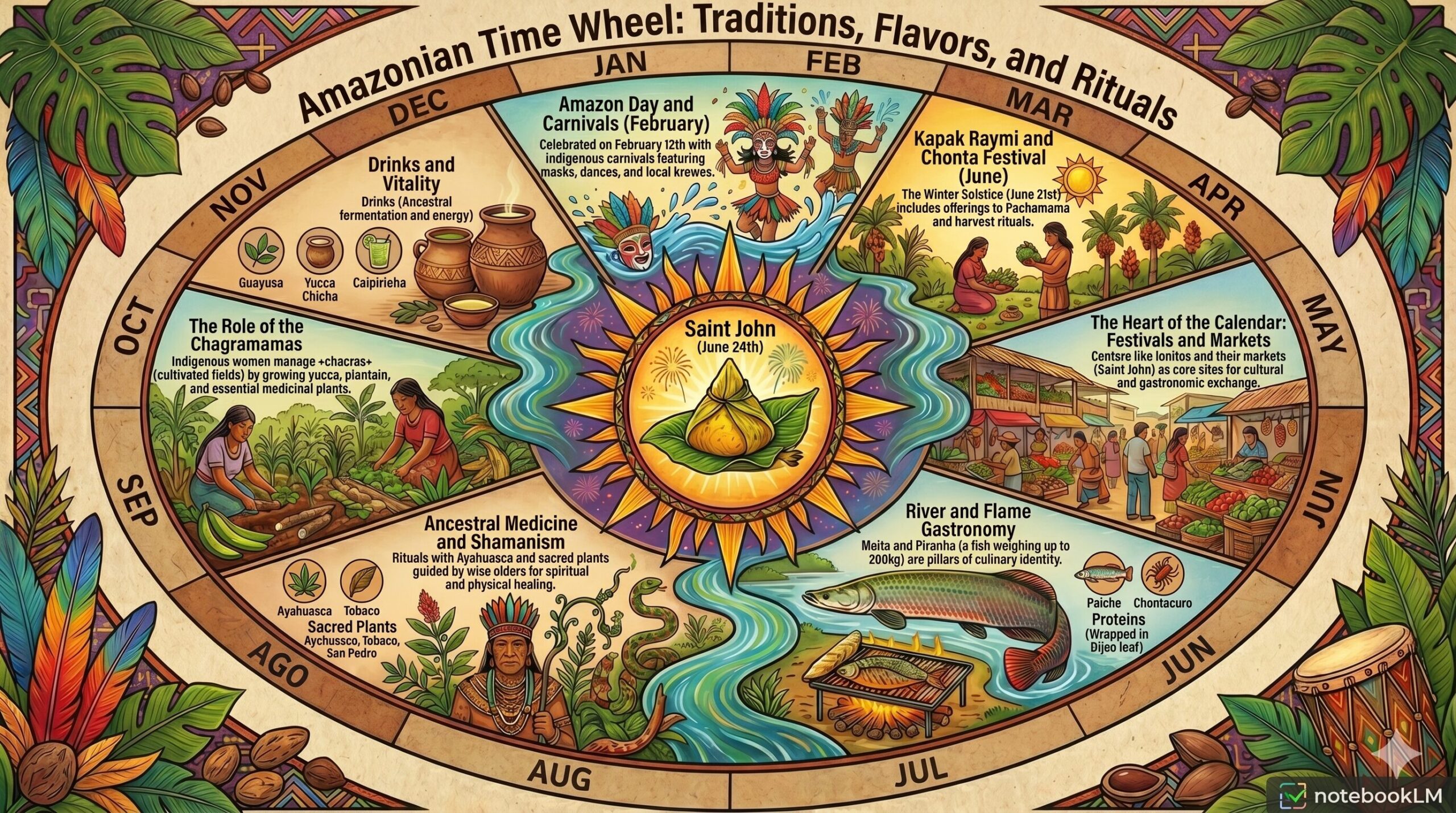
The Peruvian Amazon celebrates with a unique blend of indigenous ritual, mixed Catholic devotion and tropical exuberance, festivals where the jungle enters the city and the city returns to the jungle.
Amazon Day, June 24th
The most important festival throughout the Peruvian Amazon. On June 24th, Iquitos, Pucallpa and every jungle city come to a standstill, rivers of Juane (Amazonian tamale), ritual river baths at dawn, jungle cumbia music and fireworks reflected in the Amazon. The night of the 23rd is the most lively night of the year.
Water, Dance & Jungle
The carnivals of Iquitos and Pucallpa are the most intense in Peru, a full week of water battles, parades with feather and seed costumes, and the Miss Integration pageant. The "umsha", a gift-filled tree chopped down through dancing, is the most beloved tradition.
Founded January 5th + Iquitos Week
Iquitos celebrates its founding with a week of activities, a parade of boats on the Amazon, an indigenous craft exhibition, traditional dish competitions and the traditional boat tour of the Bellavista-Nanay Reserve. The city showcases its Amazonian pride with full energy.
Ayahuasca & Traditional Medicine
Ayahuasca ceremonies led by Shipibo vegetalistas or healers are ancient spiritual practices that tourism has turned into one of the main reasons for visiting the Amazon. They take place year-round at certified centres, always with medical supervision and a framework of cultural respect.
The Purple Procession Reaches the Amazon
Devotion to the Lord of Miracles transcends the coast and reaches the jungle, in Iquitos and Amazonian cities, thousands of devotees dressed in purple process through the hot streets in October, showing that Lima's faith took deep root throughout the colonial Amazon.
Fireworks on the Amazon
Christmas in the jungle has its own character, tropical heat, fireworks reflected in the Amazon, families in boats travelling from community to community and tacacho con cecina (the Amazonian Christmas dish) on every table. On December 31st, the riverbank becomes Peru's finest viewpoint.
River Fishing Tradition
Riverside communities celebrate the paiche (giant arapaima), the world's largest freshwater fish. Sport fishing tournaments, exhibitions of ornamental Amazonian fish and craft fairs featuring topa wood carvings and chambira seed jewellery are part of this celebration of Amazonian river life.
Shipibo-Conibo, Bora, Yagua
The craft markets of Iquitos (Belén, San Juan) and Ucayali communities are living spaces where Shipibo-Conibo, Bora, Yagua and Huitoto peoples sell their creations, textiles with sacred designs, seed necklaces, painted ceramics and arrows that are simultaneously art and testament to living cultures.
Amazonian cuisine is the great unknown of Peruvian gastronomy, patarashca, juane, tacacho and the immense paiche fish cooked in bijao leaves are experiences that can only be lived in Peru's jungle.
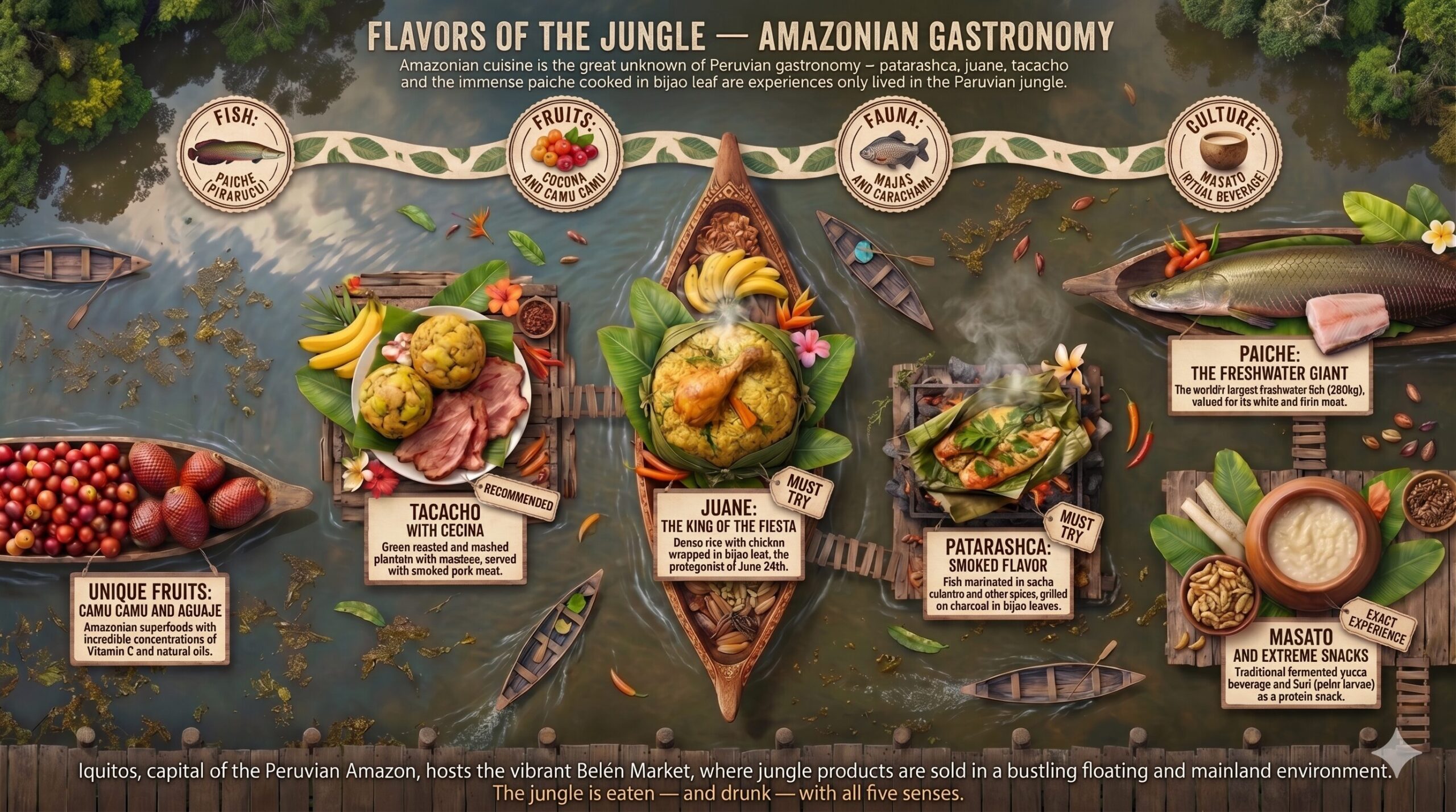
The Amazon's signature dish, rice with chicken, egg and olives wrapped in a bijao leaf and steamed. Especially eaten at San Juan festival (June 24th) but available year-round at any Amazonian market.
Amazon Dish #1Roasted and mashed green plantain with lard, served with cecina (smoked pork) and Amazonian chorizo. The most popular breakfast and lunch throughout the Peruvian jungle, energetic, bold and completely addictive.
Must TryAmazonian fish (boquichico, doncella or dorado) marinated in jungle coriander, garlic and chilli, wrapped in a bijao leaf and grilled directly over coals. The leaf imparts a smoky, herbal aroma that cannot be replicated outside the jungle.
Pure JunglePaiche (arapaima) is the world's largest freshwater fish, reaching 3 metres and 200 kilograms. Its white, firm, boneless meat has made it the star ingredient of Amazonian haute cuisine. In Iquitos it is served smoked, fried, grilled or in broths.
Giant of the AmazonThick chicken soup with ground peanuts, yuca, corn and jungle coriander, the quintessential celebration dish of the Peruvian jungle. Creamy, aromatic and completely unlike any Andean or coastal soup. Served at parties, baptisms and birthdays in all communities.
Soul FoodThe ceremonial and everyday drink of the jungle, yuca cooked, chewed and fermented for days. It is the hospitality drink of indigenous communities: refusing it is considered rude. Mildly flavoured and slightly fermented, it is the quintessential Amazonian chicha.
Ritual DrinkThe Peruvian Amazon has fruits that exist nowhere else, camu camu (the world's greatest source of vitamin C), aguaje (the Amazonian "tree of life"), cocona, copoazú, carambola and ungurahui. The juices and ice creams made from Amazonian fruits in Iquitos markets are unmissable.
Unique FruitsPalm weevil larvae, roasted or fried, are the most consumed protein snack in the Peruvian jungle. Suris are a fundamental protein source in indigenous communities and an exotic treat for adventurous visitors at Iquitos markets. When well prepared, they have a buttery flavour.
Extreme ExperienceBelén market in Iquitos is Peru's largest Amazonian market, hundreds of stalls with exotic fruits, live river fish, medicinal plants and street food that distil all the richness of the jungle. The restaurants in the city centre serve paiche in every form. And the best way to start the day in Iquitos is tacacho con cecina with fresh masato while the sun rises over the Amazon.
From the most biodiverse reserve on the planet to the world's largest river city, the Peruvian Amazon offers experiences that have no equivalent at any other destination on Earth.
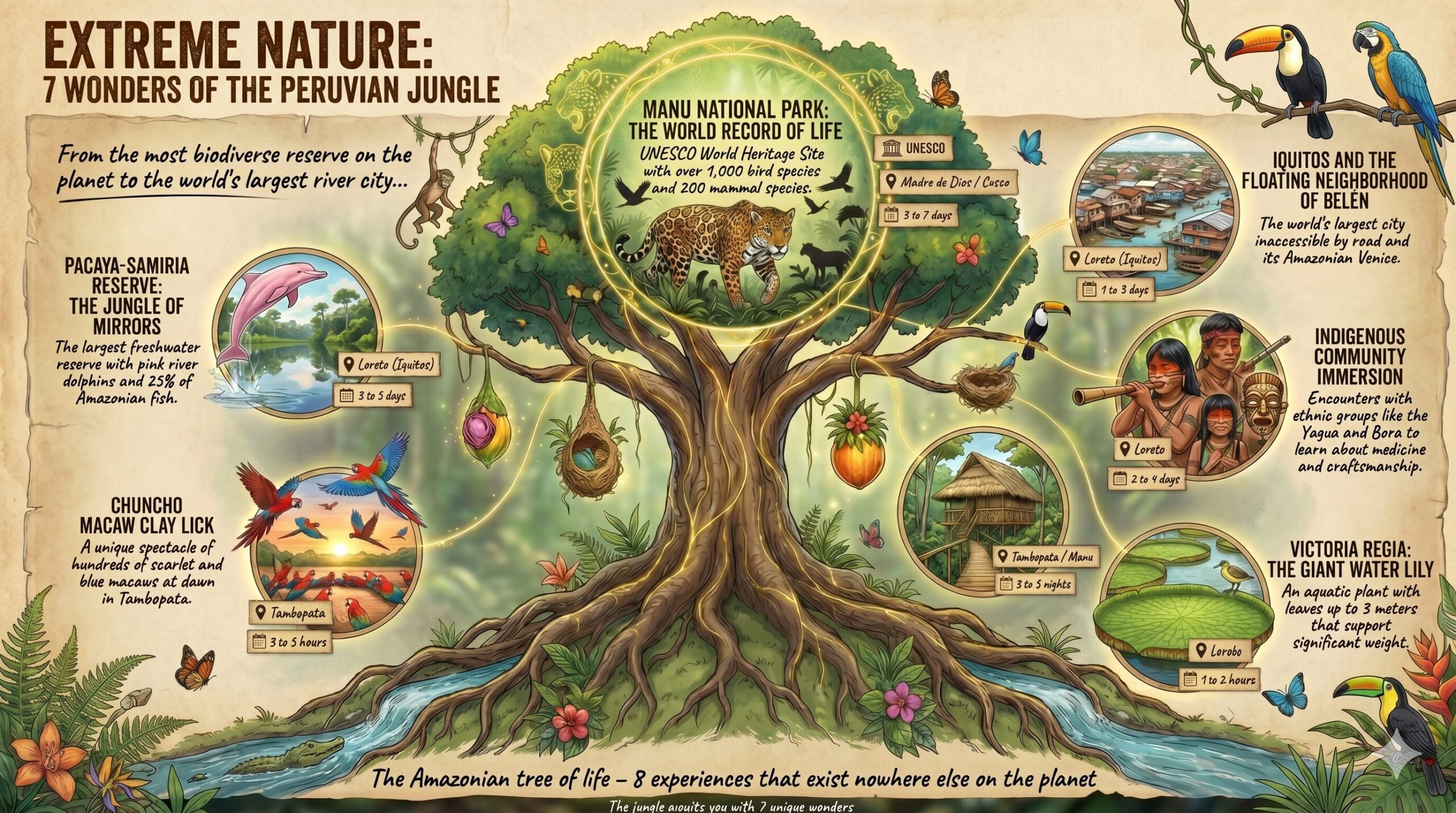
The most biodiverse region on the planet, a World Heritage Site with more than 1,000 bird species, 200 mammal species and indigenous communities in voluntary isolation. From 3,500 m in the Andes down to the lowland jungle in a single park.
South America's largest freshwater reserve, 13 million hectares of flooded forest, oxbow lakes and channels where pink dolphins, manatees and 25% of all Amazon fish species live.
The world's largest city with no road access. Belén, the "Amazonian Venice", has floating houses on the river. The Iron House (attributed to Eiffel) and Belén market are unmissable.
The world's largest macaw clay lick, hundreds of scarlet, blue and yellow macaws and parrots descend at dawn to eat clay. One of the most impressive ornithological spectacles on the planet.
The boto or pink dolphin (Inia geoffrensis) is the world's largest river dolphin species. In Pacaya-Samiria and the Nanay River near Iquitos, groups of dozens can be spotted, one of the most magical encounters the Amazon has to offer.
The ecolodges of Tambopata (Inkaterra, Refugio Amazonas), Manu and Pacaya-Samiria are the best way to experience the jungle, night walks, wildlife spotting, dawn canoe rides and resident biologists.
The oxbow lakes (cochas) are home to the giant Victoria Regia water lily, leaves that can measure 3 metres and support the weight of a child. Black caimans and great herons also inhabit the lagoons of Pacaya-Samiria and Manu.
The Yagua, Bora, Shipibo-Conibo and Huitoto communities that receive visitors offer authentic cultural exchange, music, crafts, traditional medicine and food from a responsible tourism perspective.
The Peruvian Amazon concentrates 10% of all species on Earth in less than 1% of the land surface, jaguars, anacondas, pink dolphins, 1,800 bird species and 50,000 plant species in the most complex ecosystem ever studied.
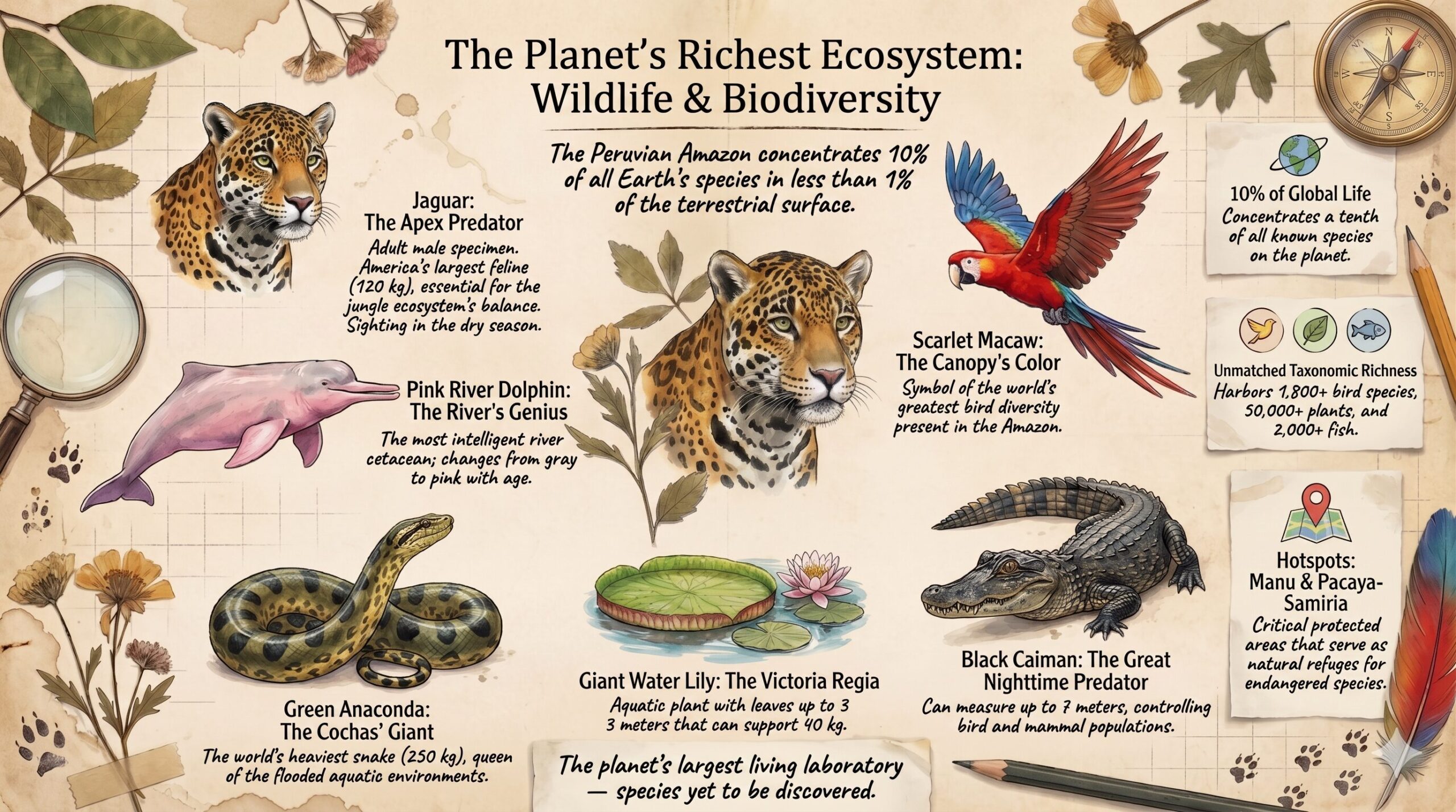
The largest cat in the Americas, up to 120 kg. Mainly nocturnal, it roams territories spanning hundreds of km². Madre de Dios and Manu are the best spotting zones, though encounters are rare and privileged.
The world's largest river dolphin, up to 2.5 m. Its intense pink colour in adults is unique in the animal kingdom. Sacred in Amazonian mythology, it inhabits the rivers and oxbow lakes of Pacaya-Samiria and the Nanay.
The world's heaviest snake, can exceed 250 kg and 8 metres in length. Lives in rivers, oxbow lakes and palm swamps in the lowland jungle. Non-venomous, kills by constriction. Pacaya-Samiria guides find them regularly during the dry season.
The Peruvian Amazon has the world's greatest diversity of psittacines. The Chuncho clay lick in Tambopata concentrates up to 700 scarlet, blue and yellow macaws in a single morning, one of the most spectacular natural shows on the planet.
The Amazon's largest predator, up to 5 metres. Easily spotted on night spotting trips with a torch, their eyes reflect red light from the water. The oxbow lakes of Pacaya-Samiria and Manu are the best places to observe them safely with expert guides.
The Peruvian Amazon has 32 primate species, the howler monkey (whose call carries 5 km), the spider monkey, the pygmy marmoset (the world's smallest primate, 15 cm) and the woolly monkey. In Manu, 13 species have been recorded in a single day of observation.
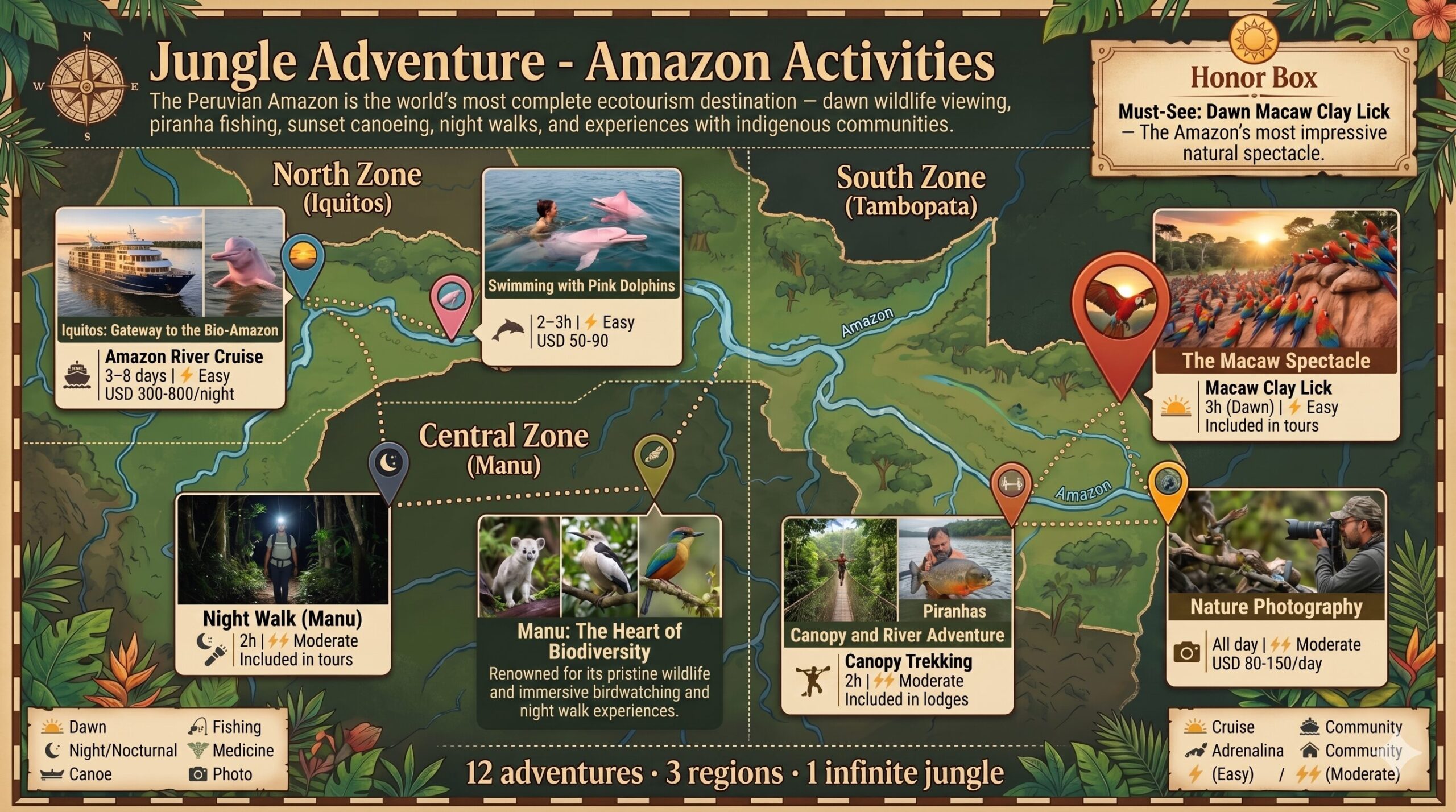
The Peruvian Amazon is the world's most complete ecotourism destination, from wildlife spotting at dawn to piranha fishing, sunset canoe rides, night walks and experiences with indigenous communities.
Dawn in the jungle is the peak activity time, primates, parrots, toucans and caimans emerge at first light. At the Chuncho macaw clay lick (Tambopata), hundreds of parrots descend in the most impressive dawn in the Amazon.
One of the Amazon's most iconic activities, fishing for piranhas with a rod and raw meat in Amazonian oxbow lakes. Red-bellied piranhas are the most active. Guides teach you to fish them safely and they can be cooked to eat afterwards.
Paddling a silent canoe through oxbow lakes and channels at sunset, when the sun turns the water orange and the jungle enters its most active moment, is one of the most memorable experiences on the planet. Guides spot animals that would be invisible to an untrained eye.
The jungle at night is another world, phosphorescent poison dart frogs, tarantulas, scorpions and the red eyes of caimans reflected in torchlight. Guided night walks in Manu, Tambopata and Pacaya-Samiria are among the most intense experiences in world ecotourism.
Certified visitor communities of Yagua, Bora and Shipibo-Conibo peoples offer blowpipe demonstrations, seed crafts, traditional cooking and music. Responsible tourism is the most effective tool for cultural preservation in the Amazon.
Specialist indigenous vegetalistas and guides share knowledge of the medicinal jungle, plant identification, healing uses and preparation of traditional remedies. A respectful introduction to one of humanity's richest medical systems.
On the Nanay River near Iquitos and in the oxbow lakes of Pacaya-Samiria, pink dolphins approach rafts and canoes out of curiosity. At some certified spots it is possible to swim near them under strict supervision, a mystical experience according to Amazonian cosmology.
The best lodges have observation platforms above the forest canopy, at 35–40 metres above the ground, where 90% of Amazonian wildlife lives. Walking among the treetops with parrots, toucans and monkeys at the same level completely changes one's perspective of the jungle.
The Peruvian Amazon is the world's most complete nature photography destination. Specialised birdwatching tours in Manu and Tambopata, with lists of over 600 species in 4 days, attract photographers from around the globe. Local guides know the best hides and spotting points.
Luxury river cruises depart from Iquitos and travel the Amazon for 3–8 days, with daily canoe excursions, community visits and wildlife spotting. The finest way to explore remote stretches of the Amazon with all the comfort of a boutique ship.
Belén market is the largest and most diverse in the entire Amazon, exotic fruits, live river fish, medicinal plants, ornamental wildlife and Amazonian street food. Essential to visit with a local guide for the floating market area and the Belén community.
Traditional medicine retreats with ayahuasca led by certified Shipibo-Conibo healers are one of the most common reasons to visit the Amazon. Centres such as Nihue Rao and Arkana in Iquitos offer 7–14 day retreats with medical supervision and a therapeutic focus.
The Peruvian Amazon requires different preparation from other destinations, vaccines, appropriate equipment and advance booking at certified lodges are essential for a safe and unforgettable experience.
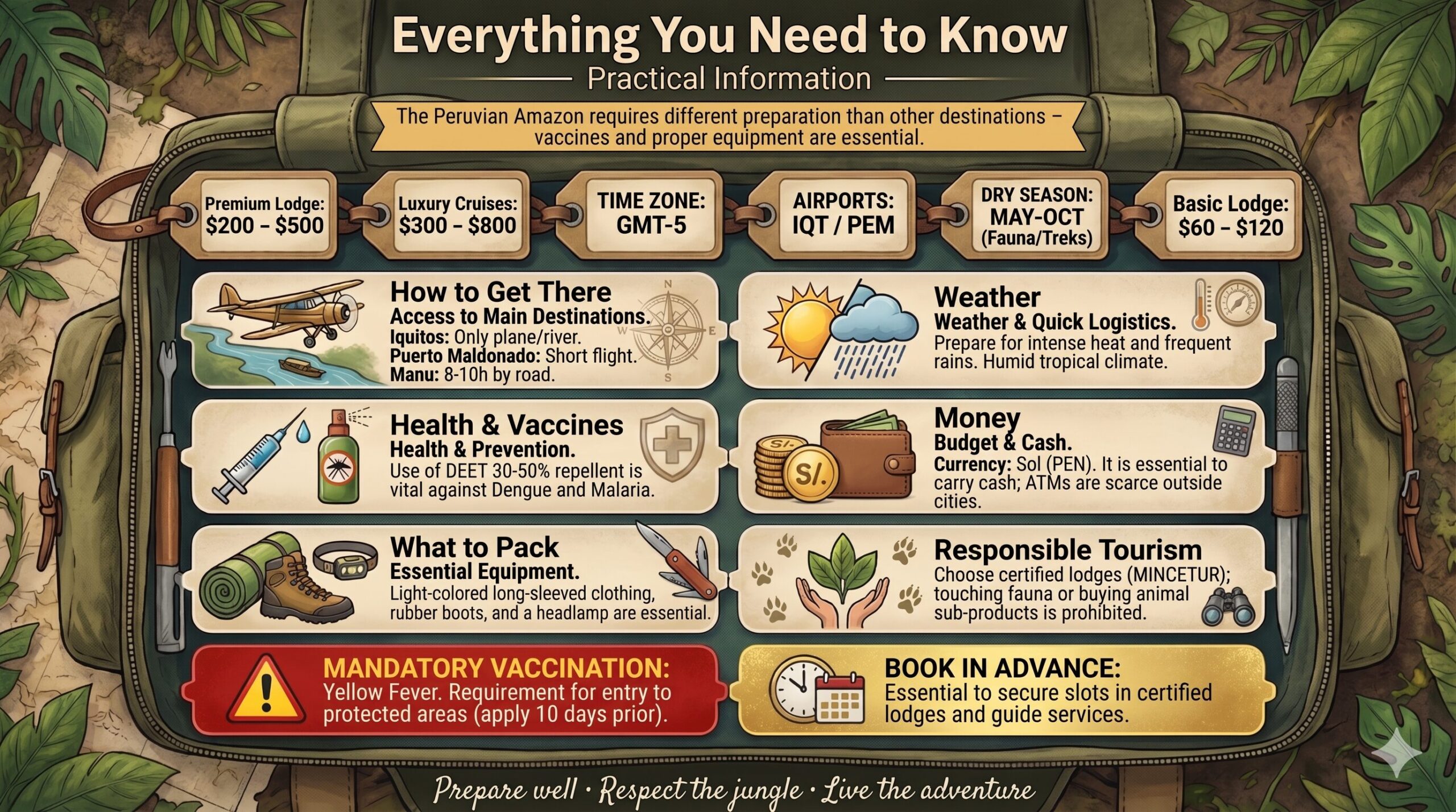
Required to enter Manu National Park, Pacaya-Samiria Reserve and other protected areas. Must be administered at least 10 days before travel. Carry your international vaccination certificate, it will be checked at park checkpoints.
The best Amazon lodges (Refugio Amazonas, Inkaterra, Manu Wildlife Center) have limited capacity and sell out 3–6 months in advance, especially during the dry season (May–October). Book through certified agencies like Peru Reservations to guarantee authentic and responsible experiences.