

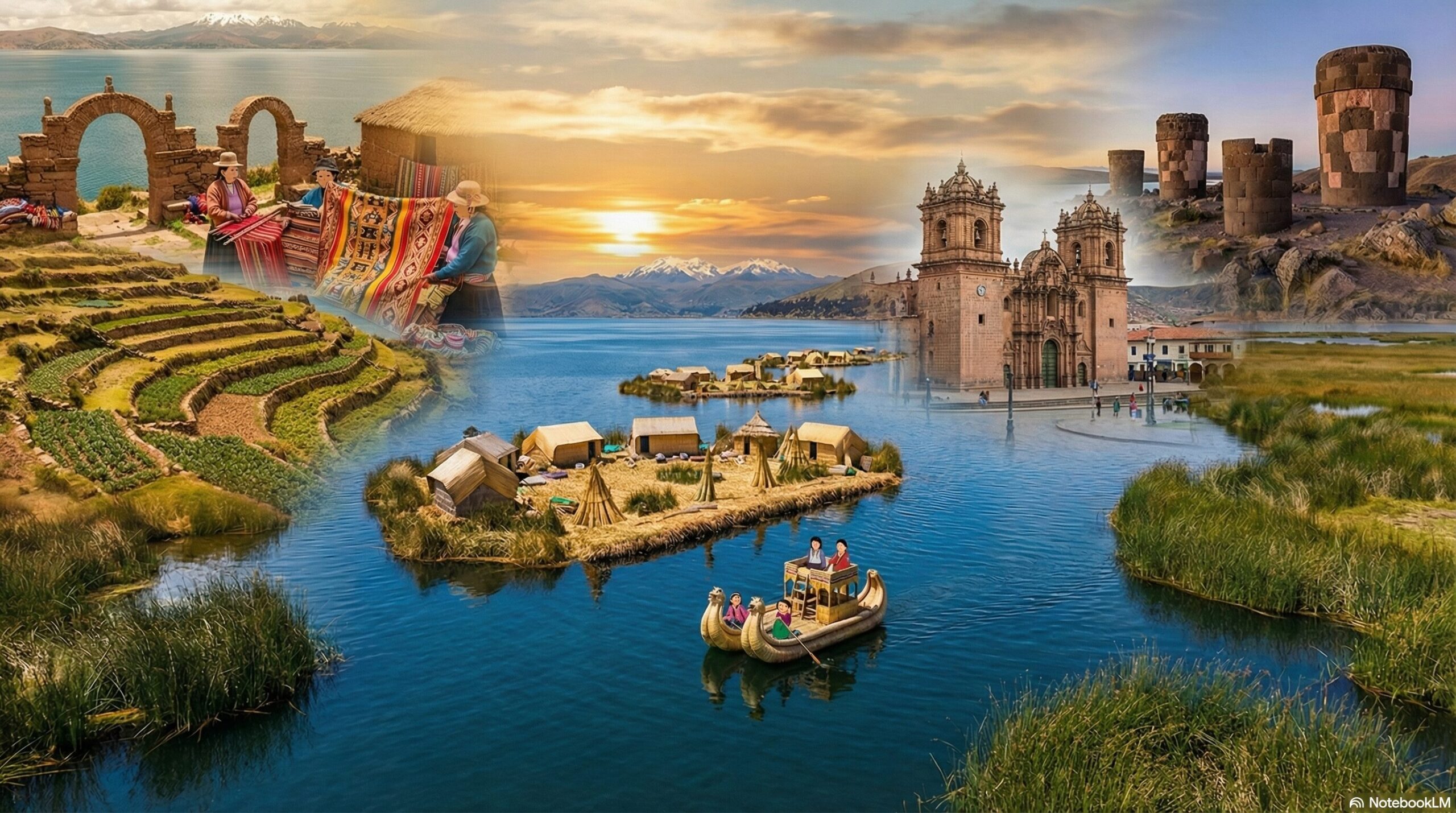
At 3,812 meters above sea level, where the sky meets the water and the floating totora islands preserve a living culture more than 2,000 years old.
Lake Titicaca is not merely the world's highest navigable lake at 3,812 meters above sea level, it is the place where, according to Inca cosmology, the god Viracocha created the sun, the moon, and the first human beings. Manco Cápac and Mama Ocllo emerged from its waters to found the Tahuantinsuyo Empire.
Today the lake is home to the Floating Islands of the Uros, Aymara communities who live on platforms built entirely of totora (lake bulrush), a tradition that began as a refuge from conquerors and survives as a way of life unique in the world. A few hours by boat, Taquile Island preserves a community organization declared UNESCO Heritage for its living textile art.
The lake is shared between Peru (60%) and Bolivia (40%). The city of Puno, on the Peruvian shore, is the gateway, known as the "Andean Folklore Capital" for its dance festivals. From Puno, boats reach the Uros in 30 minutes, Taquile in 3 hours, and the remote Amantaní Island where visitors can sleep with local families.
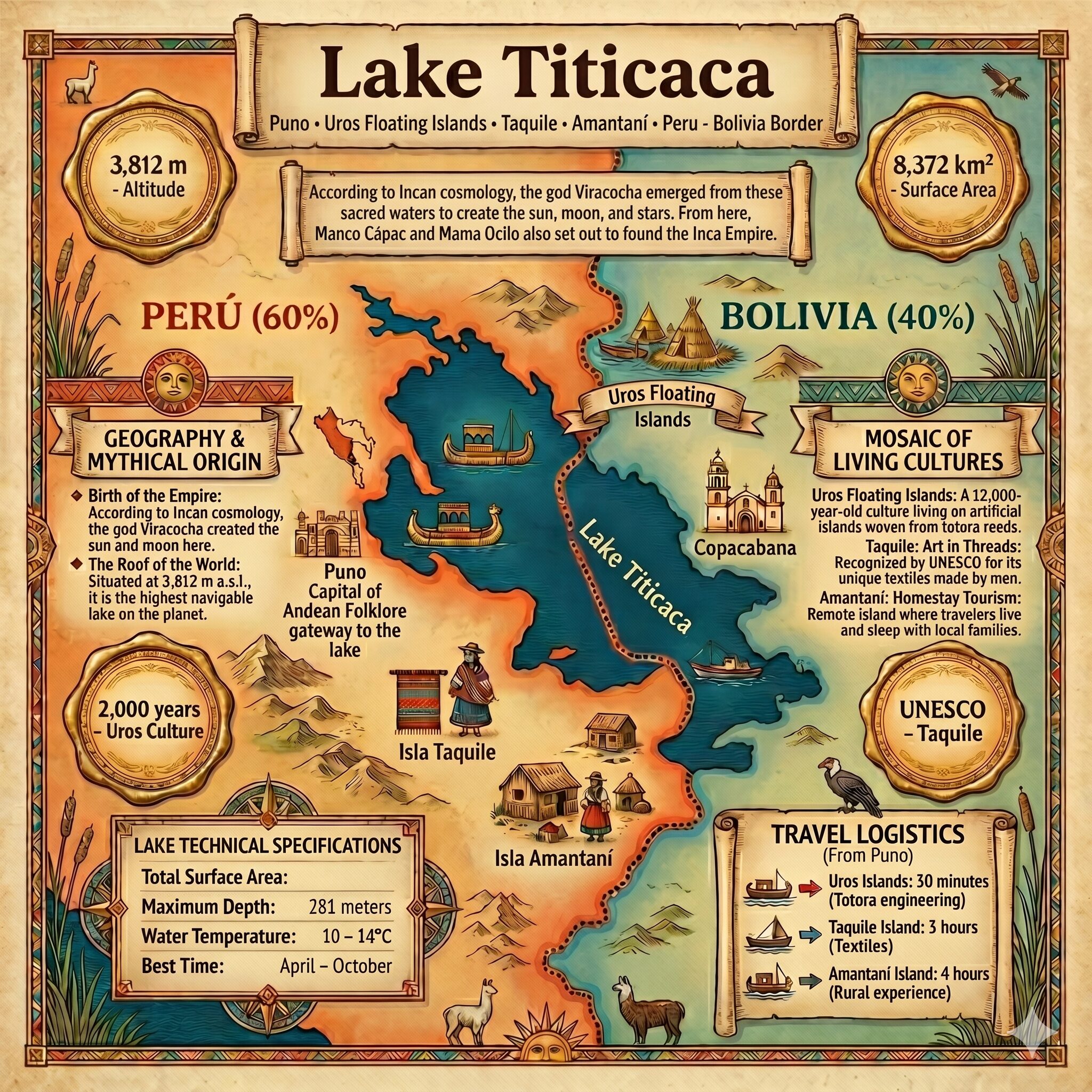
| Altitude | 3,812 m a.s.l. |
| Surface Area | 8,372 km² |
| Max. depth | 281 meters |
| Water temperature | 10–14°C |
| Inhabited islands | +40 islands |
| Uros culture | +2,000 years |
| Best season | Apr – Oct |
| From Cusco | 6–7h (bus/train) |
A glacial lake almost 4,000 metres above sea level, with its own microclimate, waters that regulate the temperature of the altiplano and an aquatic biodiversity found nowhere else on Earth.
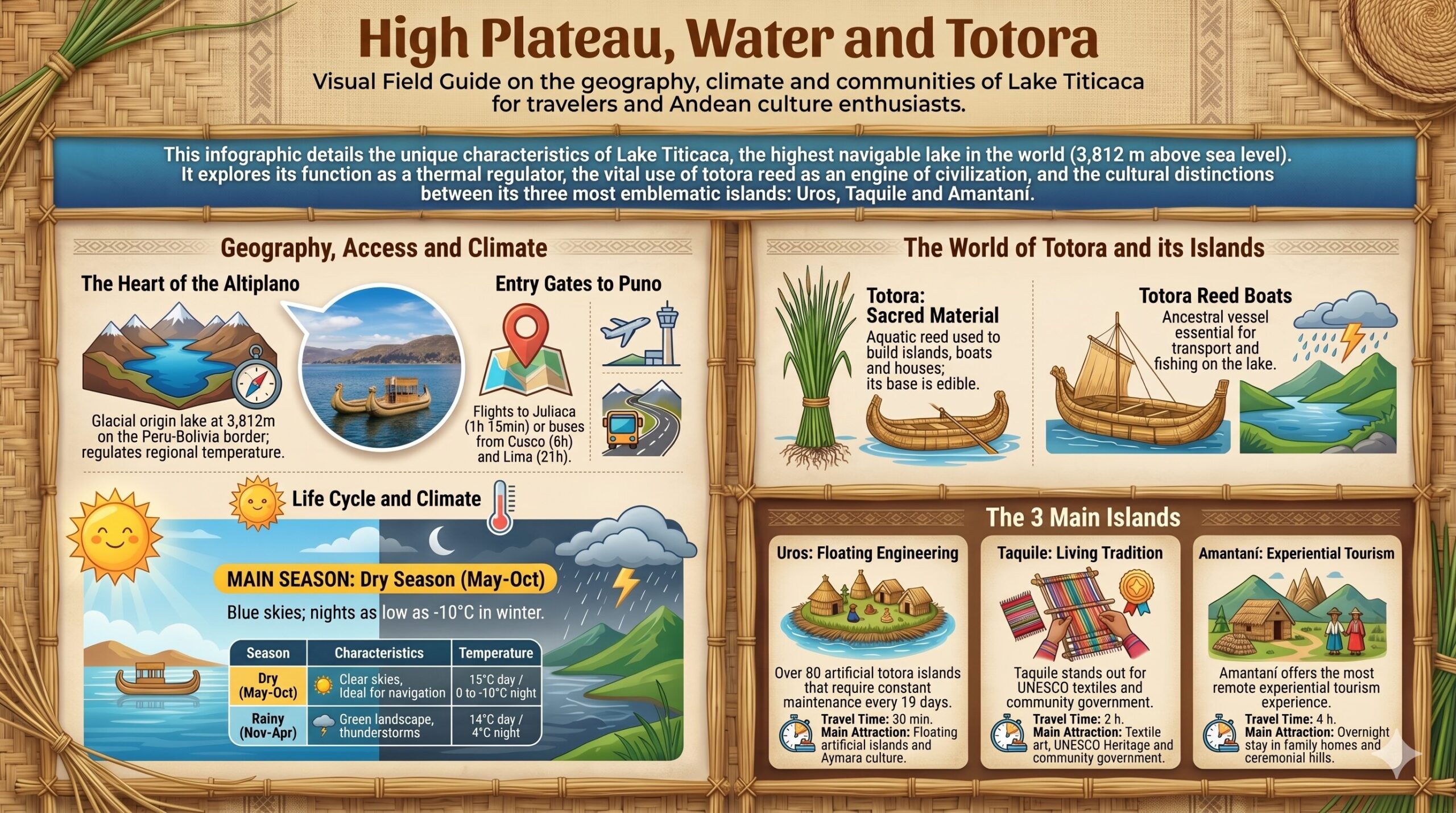
The lake sits on the Andean altiplano on the border between Peru and Bolivia at 3,812 metres above sea level. The Peruvian city of Puno (1.2M inhabitants) is the gateway, 6h from Cusco by bus or scenic train (PeruRail Titicaca) and 21h from Lima. Juliaca Airport (JUL) has daily flights from Lima (1h 15min) and is 45 minutes from Puno.
The lake acts as a giant thermal regulator, its waters absorb solar heat and release it overnight, moderating altiplano temperatures. Days: 15–22°C. Nights: 0 to -5°C year-round. Dry season (May–October): perfect blue skies, dry and cold days. Rainy season (November–March): spectacular lightning storms over the lake.
Totora (Schoenoplectus totora) is the aquatic reed that grows in the shallow margins of the lake and which the Uros use to build absolutely everything, floating islands, boats, houses and handicrafts. It grows up to 3 metres tall, the roots form a solid base you can walk on, and the white base of the stems is edible. The Uros continually replenish the upper layers of totora.
May–October (dry season) is the ideal time, clear skies for photos of the lake and altiplano, lower risk of rain during boat tours and more predictable temperatures. June–August is the season of Puno's major festivals (the Virgin of Candelaria in February is the winter exception). Avoid January–February: heavy rains and risk of flooding on the floating islands.
Lake Titicaca has more than 40 inhabited islands. Three are the key destinations for travellers:
30 min from Puno
The world's only artificial islands, built on floating totora platforms. Around 87 inhabited islands home to Aymara communities. The most visual and accessible experience on the lake.
UNESCO · 3h from Puno
Natural island at 3,950 m altitude. The Taquileans are governed by community assembly and produce the altiplano's most sophisticated textiles, the men weave, not the women. UNESCO Heritage 2005.
4h from Puno
The most remote and authentic island, no commercial hotels. Only families who host visitors in their homes. Staying on Amantaní is the most immersive and authentic experience Lake Titicaca offers.
The most important lake in the Andean world, mythical birthplace of the Inca Empire, heart of the Tiwanaku civilisation and refuge of living cultures that have endured since before the Spanish conquest.
The Pukara and Chiripa peoples were the first to develop intensive agriculture on the altiplano using the raised-field system (camellones), elevated fields built over swampland that allow farming at 3,800 m altitude. This system, rediscovered in the 20th century, was the most sophisticated in pre-Hispanic America. The first permanent settlements on the lake's shores date back more than 3,000 years.
The Tiwanaku civilisation (today in Bolivia, 70 km from the lake) was the greatest political and religious power on the altiplano for 700 years, its influence stretched from northern Chile to present-day Ecuador. Its stone monuments, monolithic gateways and the Kalasasaya solar calendar demonstrate an extraordinary level of astronomical and architectural achievement. Lake Titicaca was their sacred centre, the Island of the Sun and the Island of the Moon were their principal temples.
According to Inca mythology, Viracocha emerged from Lake Titicaca to create the sun, the moon, the stars and the first humans. Manco Cápac and Mama Ocllo rose from its waters to found Cusco. For this reason the lake was the holiest site in the Tawantinsuyu, centuries of ritual gold and silver offerings cast into the lake turned its bed into one of the world's greatest submerged archaeological treasures. The Incas built temples on the Island of the Sun and the Island of the Moon (on the Bolivian side), the most important pilgrimage sites in the empire.
The Spanish conquest transformed the altiplano but did not destroy the lakeside identity, the Aymara and Quechua peoples of the lake resisted assimilation, preserving their language, community organisation and rituals. The Uros, who had already been living on totora islands before the arrival of the Incas, used the lake as a refuge from the conquistadors and later from the Spanish. The city of Puno was founded in 1668 as a mining centre for silver extracted from the altiplano.
The Uros consider themselves the oldest people of the Andes, predating both the Aymara and Quechua. They claim their blood is "black" (it does not freeze in the altiplano cold) and that "they are not human beings but part of the lake". Their floating totora islands are the only form of permanent life on water in the world. Today around 2,000 people live on 87 islands and have adapted their economy to tourism without abandoning traditional totora construction.
In 2005 UNESCO declared the textile art of Taquile an Intangible Cultural Heritage of Humanity, the Taquilean weavings, where the men weave and not the women (a reversal of Andean norms), are the most complex on the altiplano. Tourism has grown exponentially since the 2000s, the current challenge is preserving the authenticity of the lake's communities against commercial pressure. The best operators work directly with the communities of Amantaní and Taquile.
Lake Titicaca is home to one of the oldest and most intact living cultures in the Americas, Aymara and Quechua peoples who have preserved their language, music, textiles and rituals since before the Inca Empire.

On Taquile, Andean social roles are reversed: the men weave and the women spin. The men's caps (chullos) communicate their marital status, a single man wears the top loose, a married man wears it tightly fitted. Taquile textiles are the finest on the altiplano, 200 stitches per square inch, and were declared UNESCO Intangible Cultural Heritage in 2005. Each garment takes months to complete.
The Uros constantly build and rebuild their islands, the totora rots from below and fresh layers must be added on top. An average island lasts 30 years. They have schools, health posts, solar panels and motorboats, but they still sleep over the lake, navigate on totora reed boats and eat the white roots of the rushes. A unique way of life with no parallel in the world.
Puno is the city with the most traditional dances in Peru, more than 300 registered dances in the department. The Diablada, the Siku (Andean panpipe), the Morenada and the Llamerada are expressions of a unique blend of pre-Hispanic rites and Andean Catholicism. The Virgin of Candelaria festival (February) is this folklore at its most spectacular.
Aymara is one of the most complex languages in the world, it has a concept of time that is the inverse of Western languages (the past is "in front", because we already know it, and the future is "behind", because we cannot yet see it). Spoken by more than 2.5 million people in Peru, Bolivia and Chile, Aymara is the native tongue of the lake, Quechua is also spoken on Taquile and Amantaní.
The lake's communities are governed by ayni (reciprocity) and minka (communal work), pre-Inca principles that organise social life. On Amantaní, families who host tourists do not compete with each other, the community system assigns visitors on a rotating basis so that everyone benefits equally. This organisation is the reason the homestay experience on Amantaní is genuine and not commercialised.
Puno has more registered dances than any other city in Peru, and Titicaca is the stage for rituals that blend Andean cosmovision with colonial Catholicism in a synthesis unique to the Americas.

Peru's Greatest Festival
The Festivity of the Virgin of Candelaria of Puno has been declared UNESCO Intangible Cultural Heritage of Humanity since 2014, two weeks of non-stop dancing (Diablada, Morenada, Caporales, Suri Sicuri) with more than 40,000 dancers and 200 musical bands. The greatest display of Andean folklore on the American continent.
Festival of the Sun on the Altiplano
The winter solstice (21 June) is celebrated in the lake's communities with offerings to Pachamama and the lake itself. On the Island of the Sun (Bolivian side) and in the communities of Taquile and Amantaní, fire ceremonies and expressions of gratitude to the sun last throughout the night. The most authentic version of Inti Raymi, with no tourist staging.
The Year's Most Sacred Ritual
On 1 August, Pachamama "opens her mouth", the most dangerous day of the Andean year. The lake's communities perform pagos (offerings) to the earth: ritual tables with coca, chicha, llama fat, flowers and sweets buried in the ground. The Uros' rituals include offerings to the lake itself, chicha and food cast into the water in gratitude for the lake's protection.
The Founding of the Folklore City
5 November celebrates the founding of Puno with a week of activities: a traditional dance parade on the main square, artisan textile competitions, a gastronomic fair and a re-enactment of the Inca myth of Manco Cápac and Mama Ocllo emerging from the lake at Puno's pier.
Syncretism on the Altiplano
Christmas in the lake's communities is a pure example of Andean syncretism, the Catholic midnight mass is combined with dances in traditional costume and offerings to Pachamama. On Taquile, men parade in their finest textiles and children wear new clothes woven by their fathers over the preceding year.
The Sound of Titicaca
The siku (reed panpipe) is the lake's sacred instrument, it is played in pairs because no single musician can perform the full melody alone (each plays half the notes), symbolising Andean duality. The deep, breathy sound of the siku over the lake at sunset is one of Peru's most unique sonic experiences.
28 July with a Lake View
Peru's Independence Day celebrations in Puno blend national patriotism with regional pride, a parade in traditional dance costume, fireworks over the lake, and the traditional wajtacha (totora reed boat competition) in Puno Bay. The July cold makes the celebration especially warm around community bonfires.
The Tradition of Welcoming Travellers
On Amantaní, the tradition of hosting travellers at home is not a tourist activity, it is an extension of the Andean system of reciprocity. Host families share their table, dress visitors in traditional clothing for evening celebrations and sleep under the most star-filled sky in Peru. A night on Amantaní is the lake's most authentic cultural experience.
Altiplano cuisine is Peru's most nutritious, designed to fuel bodies that live and work at 3,800 metres. Lake trout, native quinoa and ancestral chuño in dishes that have fed civilisations for millennia.

Rainbow trout (Oncorhynchus mykiss) was introduced to the lake in 1930 and thrived in its cold, deep waters, today it is Puno's most representative flavour. Grilled, as a high-altitude ceviche or braised with Andean herbs, Titicaca trout is larger, pinker and firmer than any farmed trout.
Native altiplano quinoa has more colour and flavour varieties than any export quinoa, black, red, yellow, white. Quinoa soup with vegetables and charqui (dried llama meat) is breakfast and lunch for lake communities: complete, nutritious and perfect for fighting the altiplano cold.
The altiplano's most emblematic dish, a hearty broth of chuño (freeze-dried potato), moraya, lamb or llama meat, wheat and chalona. Five thousand years of Andean food-preservation technology in a single comforting bowl.
Puno's most popular festive dish, whole pig slow-roasted in a clay oven with native potatoes, chicha de jora and Andean aromatic herbs. Served primarily at festivals and on Sundays. Puno's Laykakota market has the finest suckling pig in the city.
The altiplano take on Peruvian ceviche, lake trout marinated in lime and yellow chilli, served with boiled chuño instead of corn and cancha instead of crackers. The perfect fusion of coastal tradition and high Andean cuisine. A surprise for those expecting only warm dishes.
The hot purple corn drink with cinnamon, cloves and lime, the altiplano's breakfast that warms you like a hug at 3,800 m. Served in Puno's markets with freshly fried buñuelos from 6 AM. The best antidote to the cold lake morning.
On Taquile all restaurants are community-run, managed on a rotating schedule between island families. The menu is invariably quinoa soup + trout or chicken with rice and native potatoes. Eating with a lake view at 3,950 m while weavers work beside you is priceless.
Altiplano chicha de jora (fermented sprouted maize) has a more intense, tangy flavour than the coastal version, fermented in clay jars for days. It is the lake's ritual drink: a first sip is always poured to Pachamama before drinking. The most authentic is brewed in the homes of Amantaní.
Puno's Central Market (Av. Los Incas) has the best local breakfasts, api, buñuelos, tamales and quinoa soup from S/ 5. For refined trout dishes, the restaurants along Malecón Bahía (facing the lake) offer the best views and the finest chefs. Market set menus at S/ 8–12 are hearty and authentic.
Floating islands, the island of the weavers, the lake's most remote island and America's richest folklore, Titicaca is far more than the world's highest navigable lake.
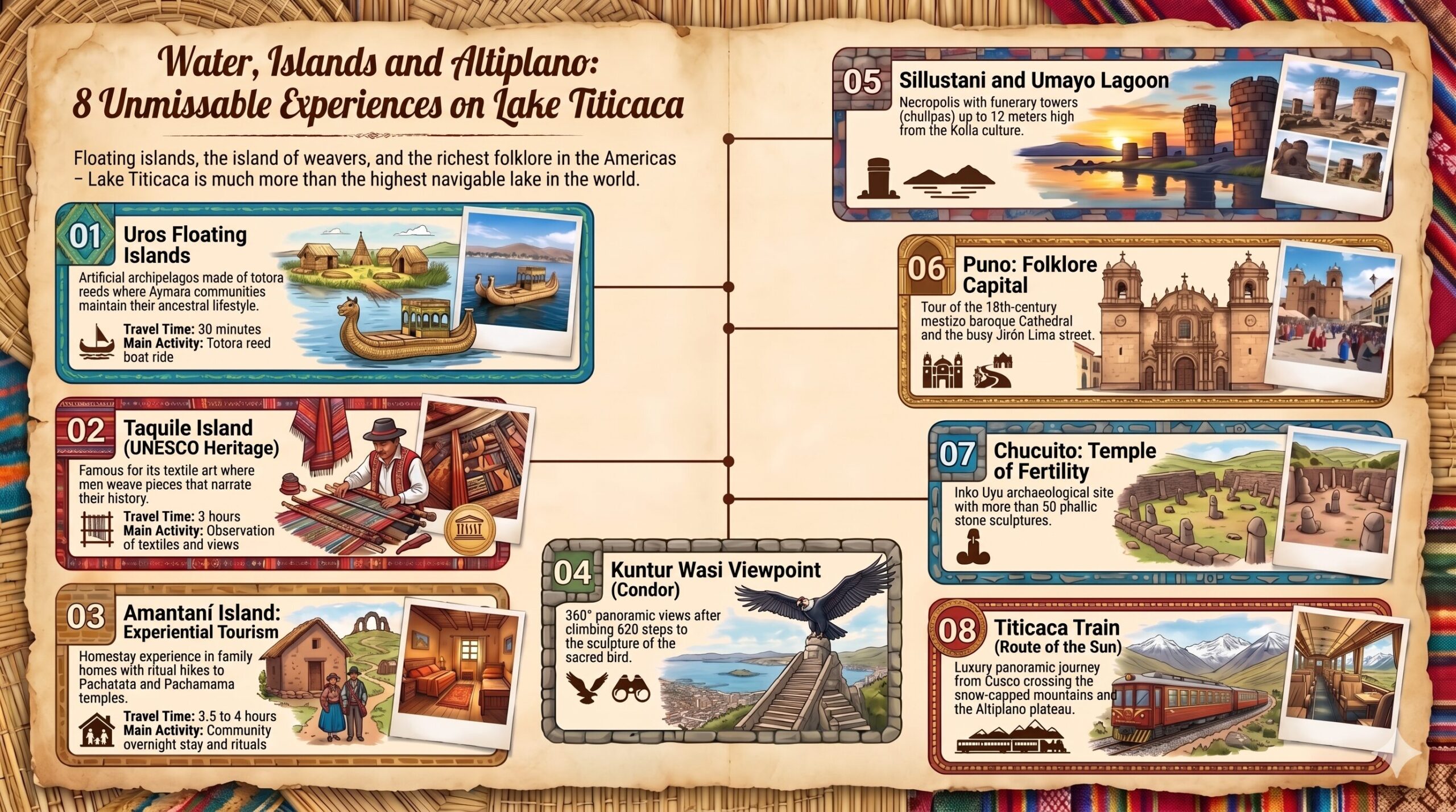
The world's only inhabited artificial islands, 87 floating totora platforms where Aymara communities have lived for centuries. Everything is totora: the islands, the boats, the houses, the crafts. Just 30 minutes by boat from Puno. The lake's most iconic and accessible attraction.
The island where men weave and the lake looks like an inland sea. At 3,950 m altitude, the 500 steps up from the jetty are rewarded with the most spectacular views on the lake. UNESCO Intangible Cultural Heritage for its textiles. Community lunch, direct sale of weavings and the deepest silence in Peru.
No hotels. No agencies. Just families opening their homes to travellers. Staying on Amantaní, dining with the family, dancing at the community celebration dressed in traditional costume, watching the sunrise over the lake from 4,000 m, is the most authentic and memorable Titicaca experience.
Puno's highest viewpoint, 360° views over the bay, the floating islands, the altiplano snow-capped peaks and the city. Reachable on foot in 20 minutes from the Plaza de Armas. The sunrise from here, when the lake reflects the first rays of sunlight, is one of Peru's most beautiful sights.
34 km from Puno, on a peninsula surrounded by Lake Umayo, cylindrical funeral towers of the Colla culture (pre-Inca) up to 12 metres tall. Sillustani's chullpas are the most impressive funerary structures in the Andes. The setting sun bathes the towers in extraordinary golden light at dusk.
The city itself is an attraction, the 18th-century baroque Cathedral, the Malecón Bahía with lake views, the Arco Deustua and the Central Market. Walking Puno among craftspeople, street musicians and Andean food stalls is a cultural immersion that perfectly complements the island visits.
The least-visited island on the Peruvian side, 3 hours from Puno on the Minor Lake. It grows grapes and has unique vineyards at 3,800 m altitude. Only 250 inhabitants, without electricity until a few years ago. The perfect off-the-beaten-path alternative for those who have already seen Uros and Taquile.
The Cusco–Puno journey on the PeruRail panoramic train is one of the world's most spectacular rail routes, 10 hours crossing the altiplano, 5,000 m snow-capped peaks, Aymara villages and Peru's highest plateau. The Vistadome train features an observation car and a live Andean music show.
Lake Titicaca is a unique ecosystem, isolated by mountains and altitude, it has evolved endemic species found nowhere else on the planet, from the world's largest aquatic frog to the flamingo that lives at 3,800 metres.
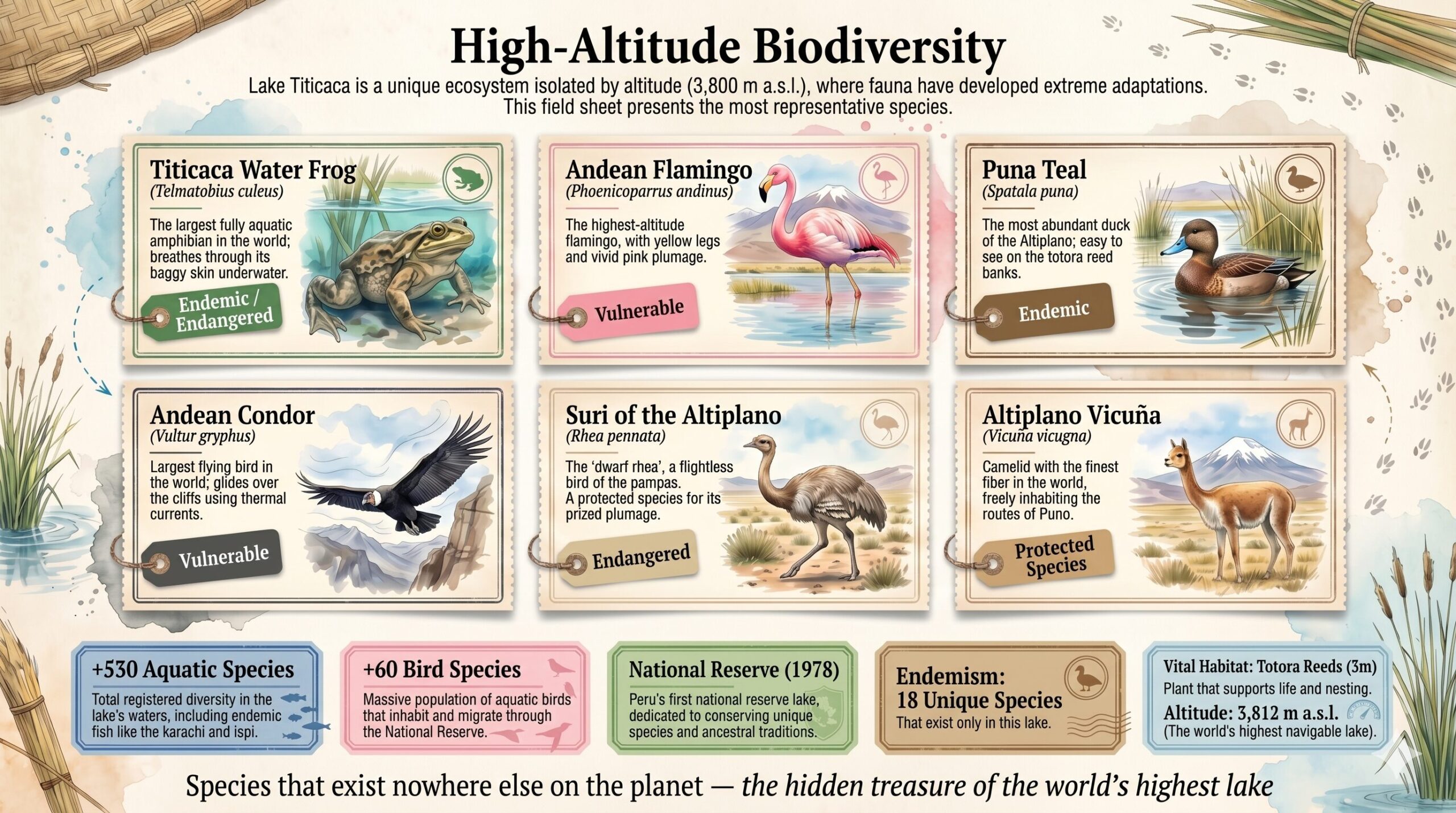
Telmatobius culeus, Endemic · Critically Endangered
The world's largest aquatic amphibian, it can weigh up to 1 kg and measure 25 cm. It never leaves the water. It breathes through its wrinkled skin (it has 3 times more skin than needed to absorb the limited oxygen at 3,800 m). It exists only in Lake Titicaca. Critically endangered due to pollution, boat traffic and use in traditional medicine.
Phoenicoparrus andinus, Vulnerable
The world's highest-living flamingo, on the shores of Titicaca and in the salt lagoons of Puna volcanoes. Deeper pink than its coastal relatives, with distinctive yellow legs. It migrates between Titicaca and the Atacama salt flats by season. In the shallow bays along the lake's northern shore, groups of hundreds can be spotted.
Spatula puna, Andean Endemic
The most abundant duck on the altiplano, with mottled white and brown plumage and the characteristic green wing speculum. Seen in large groups among the lake's totora reed shores. Easily spotted from the boats to the floating islands without binoculars.
Vultur gryphus, Vulnerable
The world's largest flying bird with a 3.2 m wingspan. It soars over the cliffs and snow-capped peaks surrounding Lake Titicaca on Andean thermals. Puno's Mirador del Cóndor is named for it, sightings occur regularly at dawn. Best sightings: at the cliffs of Colca Canyon, a few hours from the lake.
Rhea pennata, Endangered
The Andean relative of the ostrich, a flightless bird 80 cm tall that inhabits the puna plains around the lake. Very difficult to see today, historical hunting decimated its numbers. Its plumage is the most prized in traditional Andean crafts. The few remaining groups are found in the grasslands of the Titicaca National Reserve.
Vicugna vicugna
The smallest and most elegant Andean camelid produces the world's finest natural fibre, thinner than human hair. Herds of vicuñas graze freely on the plains around Lake Titicaca. On the road from Puno to Sillustani or Arequipa, it is common to pass groups of 20–30 individuals by the roadside.
Sailing between floating islands, sleeping under Peru's densest starry sky, walking 2,000-year-old terraced fields and listening to the siku at sunset, Titicaca offers experiences unlike anything else in the world.
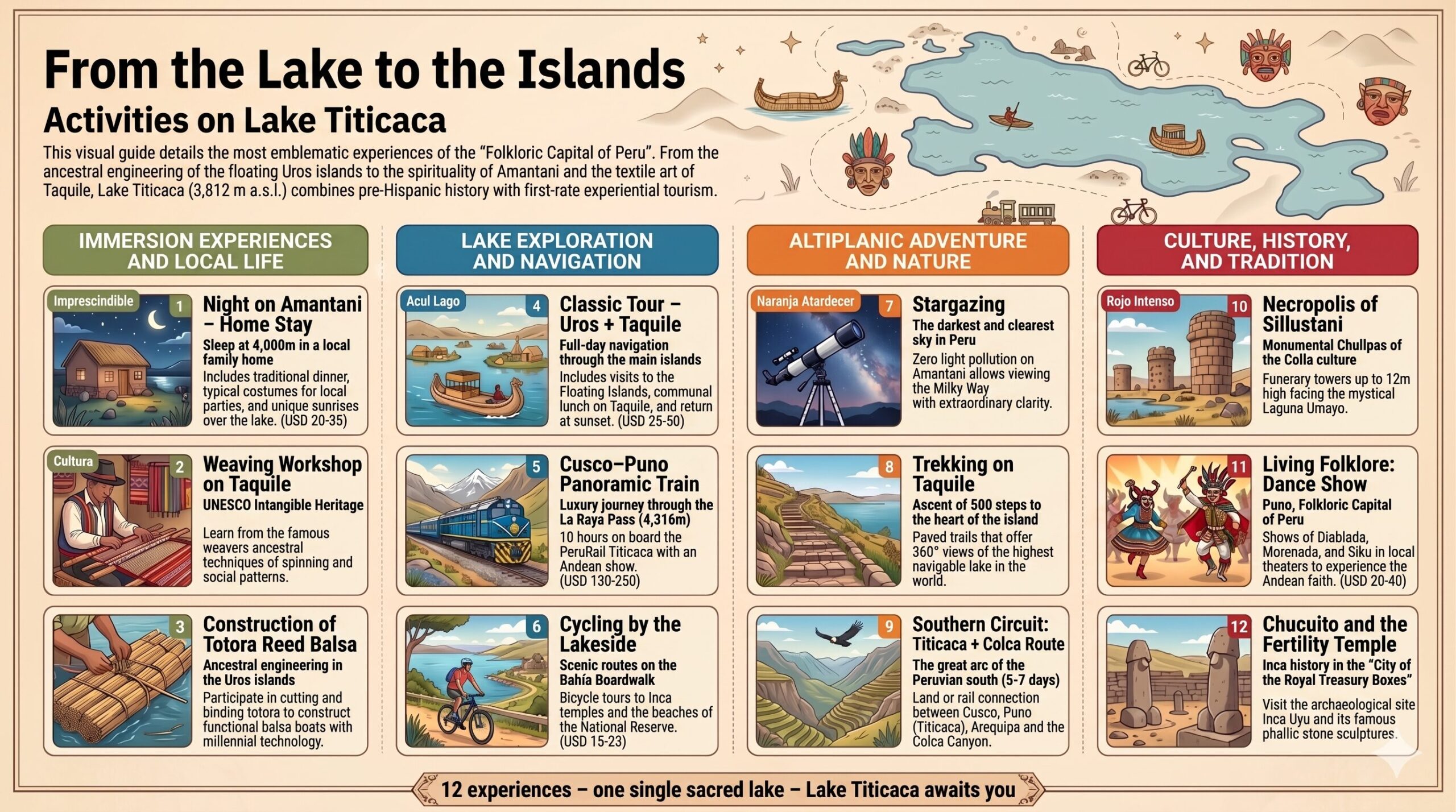
The lake's most transformative activity, sleeping in a family home on Amantaní, dining with them, dressing in traditional clothing for the evening celebration on the plaza and waking at dawn to watch the lake from 4,000 m. The most authentic and intimate Titicaca experience, unmatched anywhere on the Peruvian trail.
The classic full-day tour, early departure from Puno's pier, visit to the Uros floating islands (2h), crossing to Taquile (3h), community lunch with lake views, island walk and return to Puno at sunset. The most popular tour and the best introduction to the lake.
Taquile's men teach Andean weaving techniques, preparing plant-dyed wool, using the Andean knitting needle and the geometric patterns that encode social messages. A 2-hour workshop with a master weaver. Pieces bought directly on the island benefit 100% of the artisan's family.
The Titicaca altiplano has Peru's least light pollution and the continent's thinnest atmosphere, the Milky Way is visible to the naked eye with extraordinary clarity. From Amantaní or the lake's shores, far from Puno's lights, the night sky surpasses any stargazing point on the Peruvian coast.
34 km from Puno, the chullpas (funeral towers) of the Colla culture on a peninsula ringed by Lake Umayo. The cylindrical towers of up to 12 m are more impressive than many of Peru's more famous sites. Can be combined with a visit to the community of Llachón or a sunset return across the puna grasslands.
Uros community members teach how totora is cut, dried and lashed together to build a functional boat, a hands-on demonstration of 2,000-year-old technology. Some operators let you sail on the boat you helped build. The most participatory and immersive activity on the floating islands.
Puno's Malecón Bahía has a lakeside cycle path with stunning views. Mountain bike routes also lead to shoreline communities, Chucuito (Inca Uyu fertility temple), Juli (16th-century colonial churches) and the rocky beaches of the Titicaca National Reserve. Flat terrain, moderate altitude, extraordinary views.
18 km from Puno, the best-preserved colonial village on the lake, with the 16th-century Church of Santo Domingo and the famous (and controversial) Inca Uyu Fertility Temple with its stone phallic sculptures in situ. Chucuito also has an active community of textile artisans who sell directly. A perfect half-day from Puno.
The PeruRail Titicaca Train (10 hours, departing Cusco at 7:30 AM) is one of the world's most spectacular rail journeys, crossing La Raya Pass (4,316 m), endless puna dotted with vicuñas and flamingos, arriving in Puno at sunset as the lake reflects the orange horizon. Andean musical show included on board.
Puno has more than 300 registered dances, the Diablada, Morenada, Llamerada and Suri Sicuri are performed at evening shows in restaurants and theatres around the city. The Virgin of Candelaria season (February) brings the dances to the streets, but folklore shows for visitors run year-round.
Taquile Island is explored entirely on foot, 500 steps from the jetty to the main plaza, and paths circling the whole island with 360° lake views. No guide needed, signage is clear and the islanders are welcoming. Bring water (no fountains on the island), snacks and the strongest sunscreen you own.
Peru's most complete southern circuit by land, Cusco → Puno (panoramic train) → Lake Titicaca (Uros + Taquile + Amantaní) → Arequipa → Colca Canyon (condors). 5–7 days. The route combining the sacred lake, the white city and the world's deepest canyon in one extraordinary geographic arc.
Titicaca has one critical factor that many travellers underestimate: altitude. At 3,812 metres, the body needs to acclimatise before any physical activity. With the right planning, the experience is extraordinary.

Puno (3,827 m) and the islands sit even higher than Cusco. If you arrive directly from Lima without acclimatisation, 60% of travellers will experience soroche symptoms in the first 24–48h. Plan at least 1 rest night in Puno before any physically demanding tours.
The PeruRail Titicaca Train acclimatises you gradually, it leaves Cusco (3,400 m), climbs to La Raya Pass (4,316 m) and descends to Puno over 10 hours, giving the body time to adapt. More expensive, but you arrive feeling ready. The bus covers the same route faster but the altitude impact is more abrupt.