

White volcanic sillar stone, three guardian volcanoes and 3 hours away the deepest canyon in the world, where condors soar at the height of aircraft.
Arequipa is Peru's second most important city and, for many travellers, its most beautiful, built in sillar, the white volcanic rock that gives its churches, convents and colonial mansions a luminosity unique on the continent. Its historic centre, declared a UNESCO World Heritage Site in 2000, preserves the purest colonial architecture in South America.
Behind the city rise three volcanoes, El Misti (5,822m), Chachani (6,057m) and Pichu Pichu (5,664m), which have watched over the city since pre-Hispanic times. Three hours away by road, the Colca Canyon (3,270 metres deep, twice the depth of the Grand Canyon) is the habitat of the Andean condor and one of the most spectacular natural landscapes on the planet.
Arequipa is also the gastronomic capital of southern Peru, rocoto relleno, adobo and chupe de camarones are dishes that can only be eaten authentically here. The city has such a strong identity that its inhabitants call themselves "arequipeños" first and Peruvians second, a regional pride reflected in their architecture, cuisine and character.
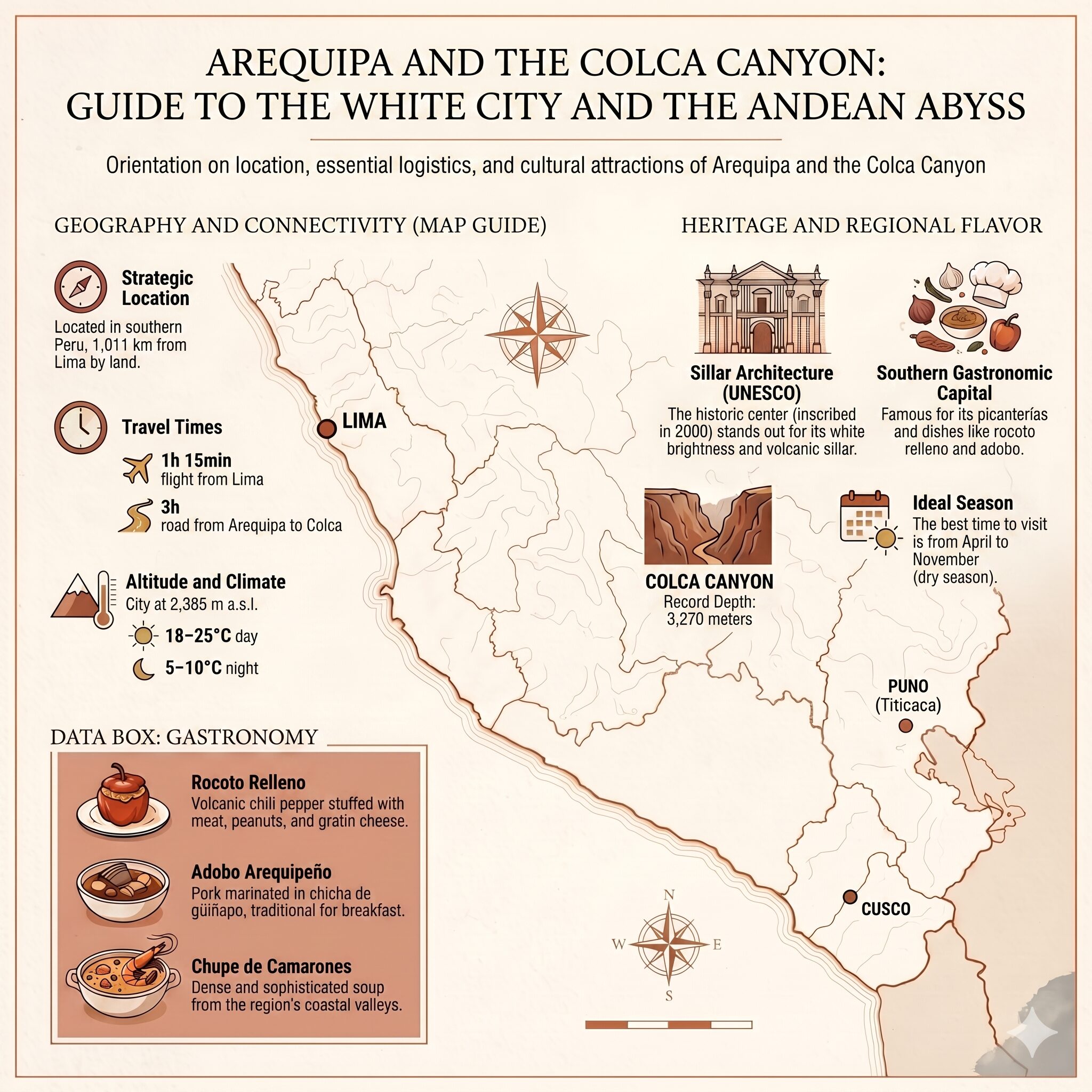
| Location | Southern Peru, 1,011 km from Lima |
| City altitude | 2,335 m a.s.l. |
| Colca (depth) | 3,270 metres |
| Climate | 18–25°C day / 5–10°C night |
| UNESCO | Historic centre (2000) |
| Best season | Apr – Nov (dry season) |
| From Lima | 1h 15min by plane |
| To Colca | 3h from Arequipa |
Arequipa lives among volcanoes, El Misti watches over it, the Colca surrounds it and sillar stone builds it. A geography of extremes that has forged one of the strongest regional identities in Peru.
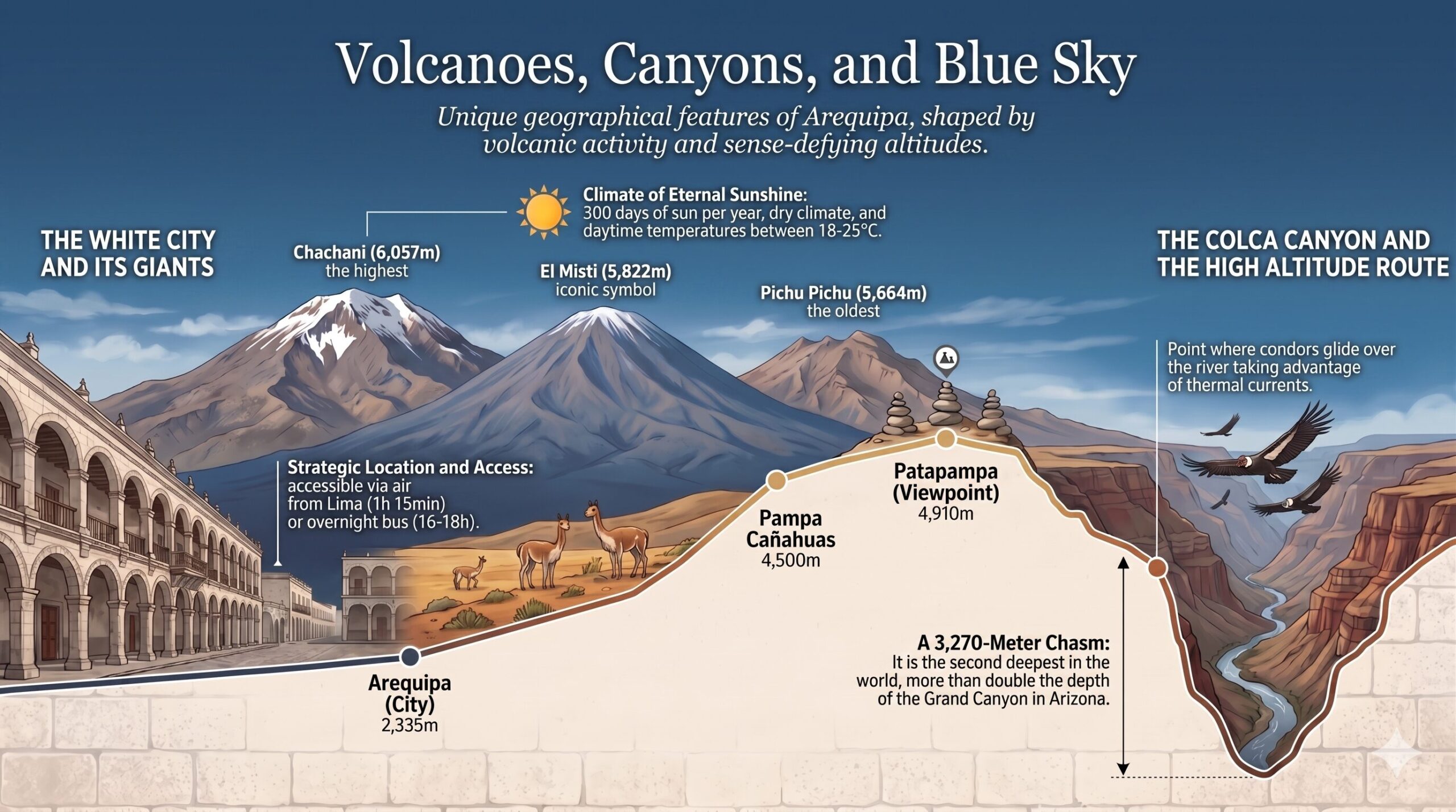
Arequipa sits at 2,335 metres altitude in southern Peru, 1,011 km from Lima. Rodríguez Ballón Airport (AQP) has direct flights from Lima (1h 15min), Cusco (45min) and other cities. By land: overnight bus from Lima (16–18h), bus from Cusco (9–10h) or from Puno (5–6h). It is the perfect stopover city on the Cusco→Puno→Arequipa route.
Arequipa is surrounded by three active or potentially active volcanoes: El Misti (5,822m), the city's symbol, visible from every point with its perfect snow-capped cone; Chachani (6,057m), the highest and the favourite for technical ascents; and Pichu Pichu (5,664m), the oldest and most eroded. The white sillar stone used to build the city is the volcanic rock from these ancient eruptions.
Arequipa has one of the best climates in Peru, 300 days of sunshine a year, temperatures of 18–25°C by day, dry cold at night (5–10°C). No humidity, no coastal drizzle, no tropical rain. The rainy season (December–March) brings short afternoon showers but days remain sunny. The dry season (April–November) is the best time for the Colca Canyon.
150 km north of Arequipa (3h by road), the Colca Valley and Canyon reaches 3,270 metres in depth, more than twice the Grand Canyon in Colorado (1,600m). The Colca River runs between walls of volcanic rock that rise abruptly. The Cruz del Cóndor, at 3,840m altitude, is the viewpoint where condors soar on thermal currents at dawn just metres from visitors.
The journey from Arequipa to the Colca passes through some of the most spectacular landscapes in the Andes:
2,335 m
Depart 3–4 AM to arrive at Colca at dawn
4,500 m
Vicuña and flamingo reserve
4,910 m
The route's highest point, 6 volcanoes visible
3,840 m
Condors at 9 AM, the highlight of the trip
From an Inca city founded among volcanoes to a colonial jewel of white sillar stone, from the rebel capital of independence to a UNESCO World Heritage Site, Arequipa has always been Peru's proudest city.
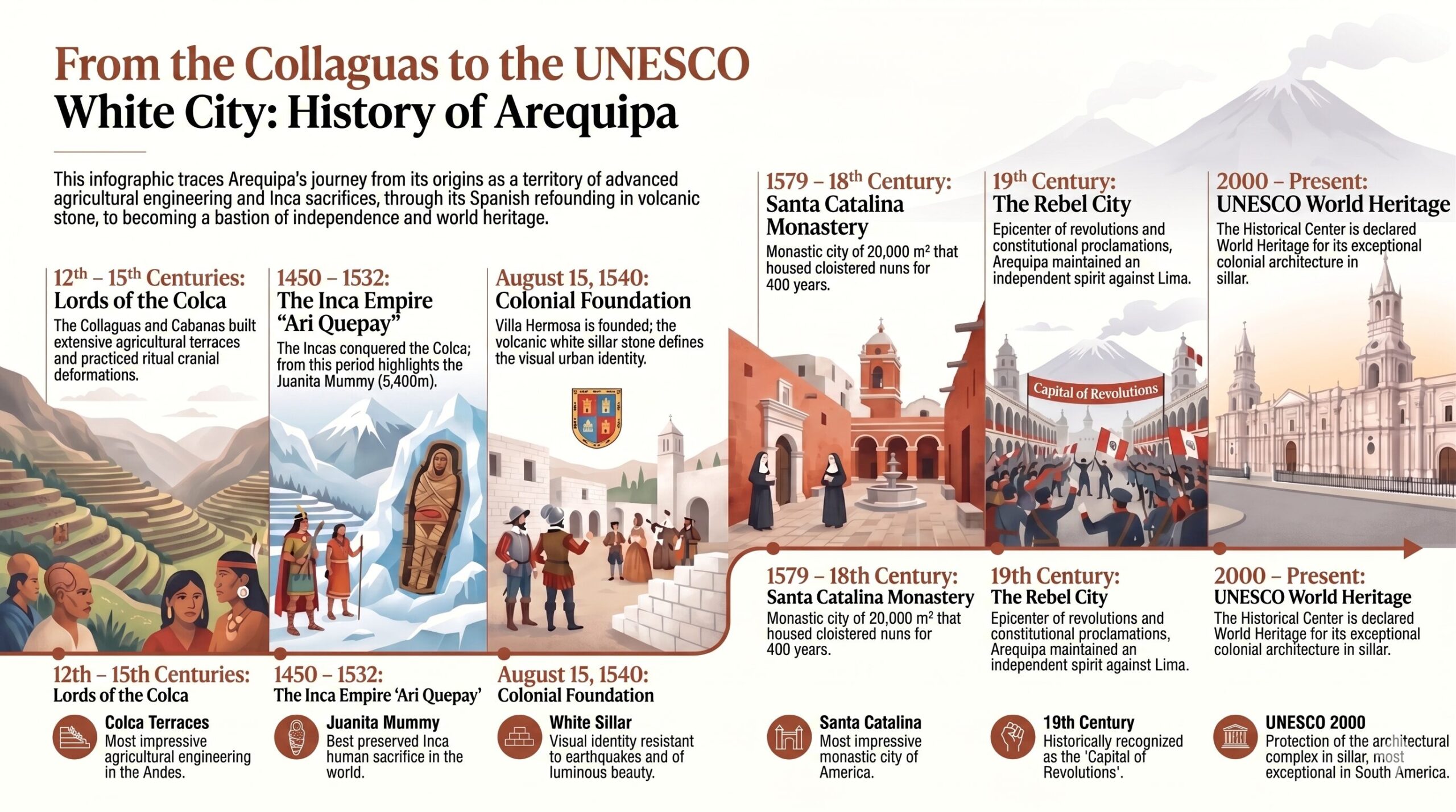
Before the Incas, the Colca Valley was inhabited by the Collagua and Cabana peoples, who built the most extensive agricultural terraces (andenes) in the Andes, ritually deformed their skulls to distinguish themselves (the Collaguas elongated their skulls, the Cabanas widened theirs) and worshipped the volcanoes as deities. The Collagua culture mummies, perfectly preserved by the canyon's dry climate, are today archaeological finds of exceptional value. The mummy "Juanita", the ice maiden of El Misti, is Arequipa's most important archaeological discovery.
The Incas conquered the Colca Valley around 1450 under Inca Mayta Cápac. Tradition holds that upon seeing the volcanic landscape, Inca soldiers exclaimed "ari quepay" (Quechua: "yes, stay here"), the etymological origin of the name Arequipa. Inca Huayna Cápac transformed the site into an important administrative centre of the Tahuantinsuyu. The mummy "Juanita" (the Misti maiden), found in 1995 at 6,400m, is the best-preserved Inca human sacrifice in the world, with the body, clothing and ritual objects intact.
Spanish captain Garci Manuel de Carbajal founded the Villa Hermosa de Arequipa on 15 August 1540. The conquistadors discovered that the local volcanic rock, sillar, a white porous ignimbrite, was perfect for construction: easy to carve, earthquake-resistant and of a uniquely luminous beauty. The churches, convents and colonial mansions built with sillar during the 17th and 18th centuries created the purest and most coherent architectural ensemble of Spanish colonial America.
The Santa Catalina Convent, founded in 1579, is Arequipa's crown jewel, a city within a city of 20,000 m² of labyrinthine alleyways, cloisters, kitchens and cells where cloistered nuns lived for 400 years. Its walls painted red, turquoise blue and ochre contrast with the white sillar. It was closed to the public until 1970. Today it is the most striking colonial monument in Peru outside Cusco.
Arequipa was the epicentre of Peru's 19th-century revolutions, several constitutions were proclaimed from here and rebellions against Lima's central power were led from the city. Its independent character even manifested in a separatist movement ("Republic of Arequipa") during national crises. Arequipeños are proud to have produced several Peruvian presidents and to have historically been the most critical of the central government. This rebellious spirit lives on in Arequipa's cultural identity today.
In 1995, mountaineer Johan Reinhard discovered "Juanita", the Inca maiden sacrificed 500 years ago at the summit of El Misti at 6,400m, frozen and perfectly preserved. The discovery transformed Arequipa's tourism. In 2000, the Historic Centre of Arequipa was declared a UNESCO World Cultural Heritage Site, recognising the ensemble of colonial sillar architecture as the most exceptional in South America.
Arequipa is Peru's proudest city, with a cultural identity so strong that its inhabitants define themselves as arequipeños before Peruvians. Unique colonial art, its own gastronomy and an independent character that has shaped the country's history.
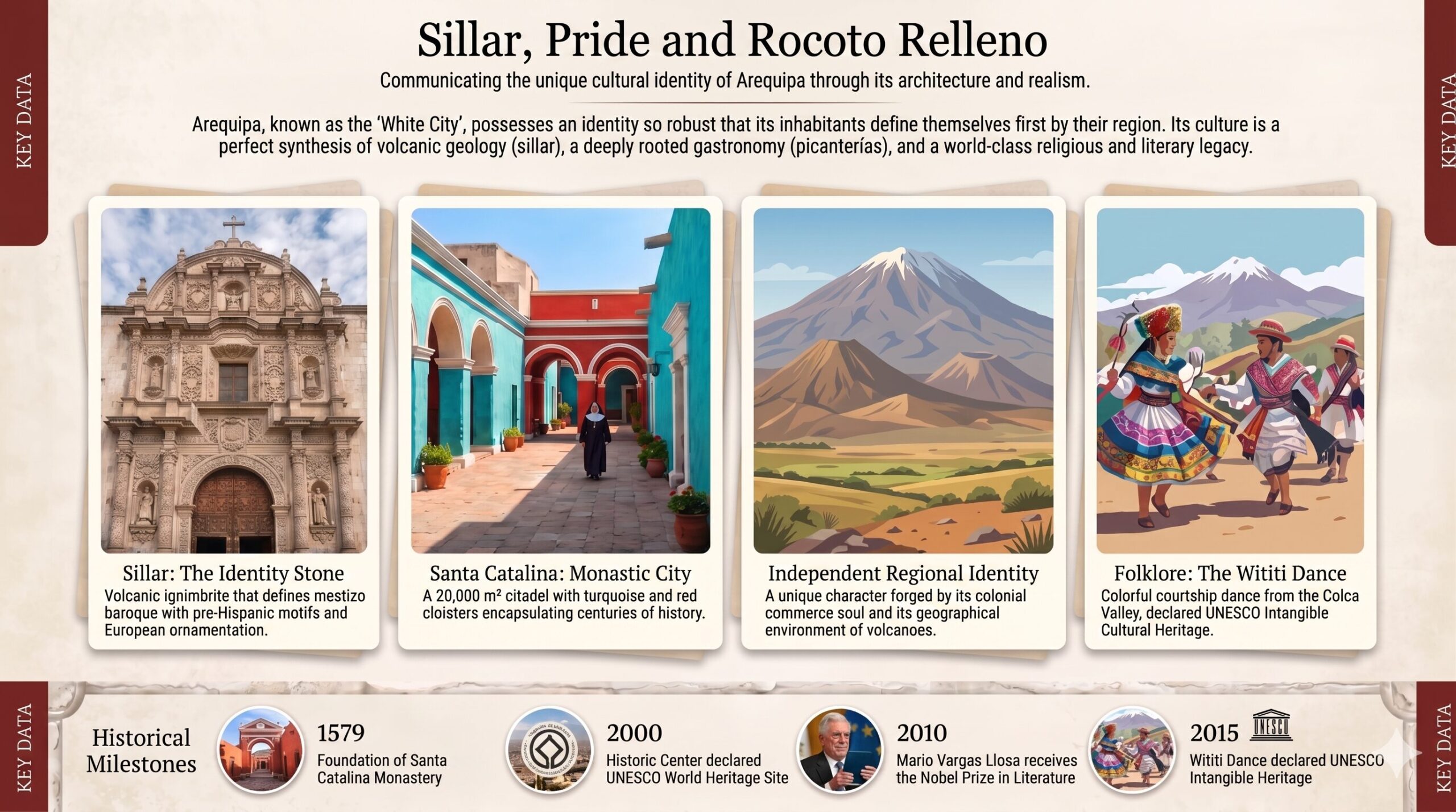
Sillar is a white, porous volcanic ignimbrite quarried from El Misti since colonial times. Its ease of carving allowed local craftsmen to develop their own ornamental style, mestizo baroque or "Arequipa style", where pre-Hispanic motifs (serpents, pumas, Andean flowers) fuse with European ornamentation. The result is the most beautiful and original colonial architecture on the American continent.
Arequipa's cuisine is the most celebrated in southern Peru, with dishes that cannot be found with equal authenticity anywhere else: rocoto relleno (spicy pepper stuffed with meat and cheese), adobo arequipeño (pork marinated in chicha and chilli), chupe de camarones (Majes river prawns) and ocopa (yellow chilli and peanut sauce). The picanterías, traditional restaurants with centuries-old recipes, are the gastronomic soul of the city.
Founded in 1579, Santa Catalina is a 20,000 m² monastic city, alleyways with Spanish names (Córdoba, Toledo, Seville), cloisters painted turquoise and rust red, colonial kitchens and cells where nuns lived in seclusion for 400 years. Opened to the world in 1970, it is today Arequipa's most visited monument and one of the most impressive in all of South America.
Arequipa has produced the greatest number of Peruvian presidents, intellectuals and artists per capita, from novelist Mario Vargas Llosa (Nobel Prize in Literature 2010, born in Arequipa) to philosopher Francisco García Calderón. The city has a centennial university tradition (National University of San Agustín, founded 1828) and an exceptional reading culture in the Latin American context.
Arequipa is the gateway to the altiplano, the region's dances blend Aymara, Quechua and colonial influences. The wititi, a courtship dance from the Colca Valley declared a UNESCO Intangible Cultural Heritage in 2015, is the most original expression. The festivals of the Virgin of the Assumption in Chivay (August) and Arequipa's Holy Week are the most important folklore events.
Arequipa celebrates with the intensity of a city that never forgets its roots, from the Colca dances declared UNESCO Heritage to the most solemn Holy Week in Peru.
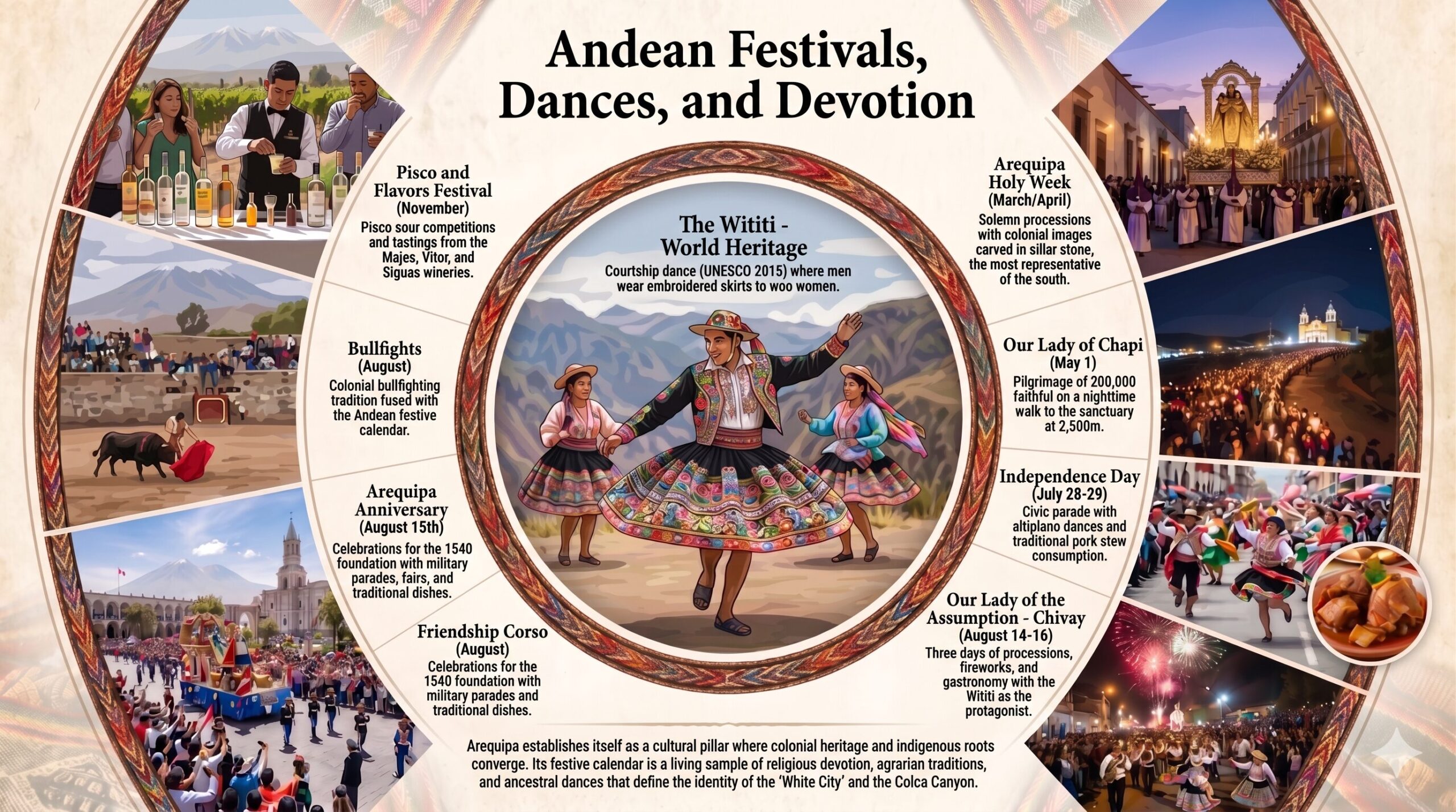
August 14–16
The most spectacular festival in the Colca Valley, three days of dances (wititi, shacshas, negritos), a procession of the Virgin through the streets of Chivay, fireworks and a gastronomic fair featuring the canyon's traditional dishes. The wititi, a UNESCO 2015 Heritage courtship dance, is the undisputed star of the festival.
March / April
Arequipa's Holy Week is the most solemn in southern Peru, nighttime processions with colonial sillar-carved images, flower carpets in the historic centre, and the Good Friday procession of the Lord of Miracles through the cathedral and colonial churches of the white city.
Year-round in the Colca
The wititi is a courtship dance from the Colca Valley in which young men wear brightly embroidered costumes to court women. Declared an Intangible Cultural Heritage of Humanity by UNESCO in 2015, it is the most unique cultural expression of the canyon and one of the most original dances in the Peruvian Andes.
August 15
August 15, feast day of the Virgin of the Assumption and also the date of the Spanish founding in 1540, is Arequipa's most important date. Military parade at the Plaza de Armas, a sillar craft fair, traditional dish competition (rocoto relleno and chupe de camarones take centre stage), fireworks in front of the cathedral and concerts in the historic cloisters.
November
Arequipa has its own pisco wineries in the Majes, Vítor and Siguas valleys, using negra criolla and quebranta grapes that produce a pisco quite different from Ica's. The Pisco & Flavours Festival celebrates this winemaking tradition with tastings, cocktail competitions (the Arequipa pisco sour is more tart) and visits to the Majes valley wineries.
May 1st
On 1 May, more than 200,000 Arequipa pilgrims make the walk to the Sanctuary of the Virgin of Chapi, 45 km from the city centre at 2,500m altitude. The nighttime pilgrimage (departing at midnight on 30 April) is the largest act of faith in southern Peru and one of the most important pilgrimages in the country.
July 28–29
Arequipeños celebrate national holidays with a distinctly local character, the civic parade on Av. Ejército includes contingents of altiplano and Colca Valley dances. Picanterías open with chicha de guiñapo and the dish of the day is invariably pork adobo marinated in chicha, the recipe eaten on 28 July in Arequipa for centuries.
August & patron saint festivals
Arequipa maintains one of Peru's oldest bullfighting traditions, the Arequipa bullring holds corridas during the city's Anniversary (August) and at district patron saint festivals. The tradition arrived with 16th-century Spanish colonisers and fused with the Andean festivals of the pre-Hispanic agricultural calendar.
Arequipa's cuisine is the most celebrated and original in southern Peru, with dishes that cannot be found with equal authenticity anywhere else in the world, and the oldest picanterías on the continent.
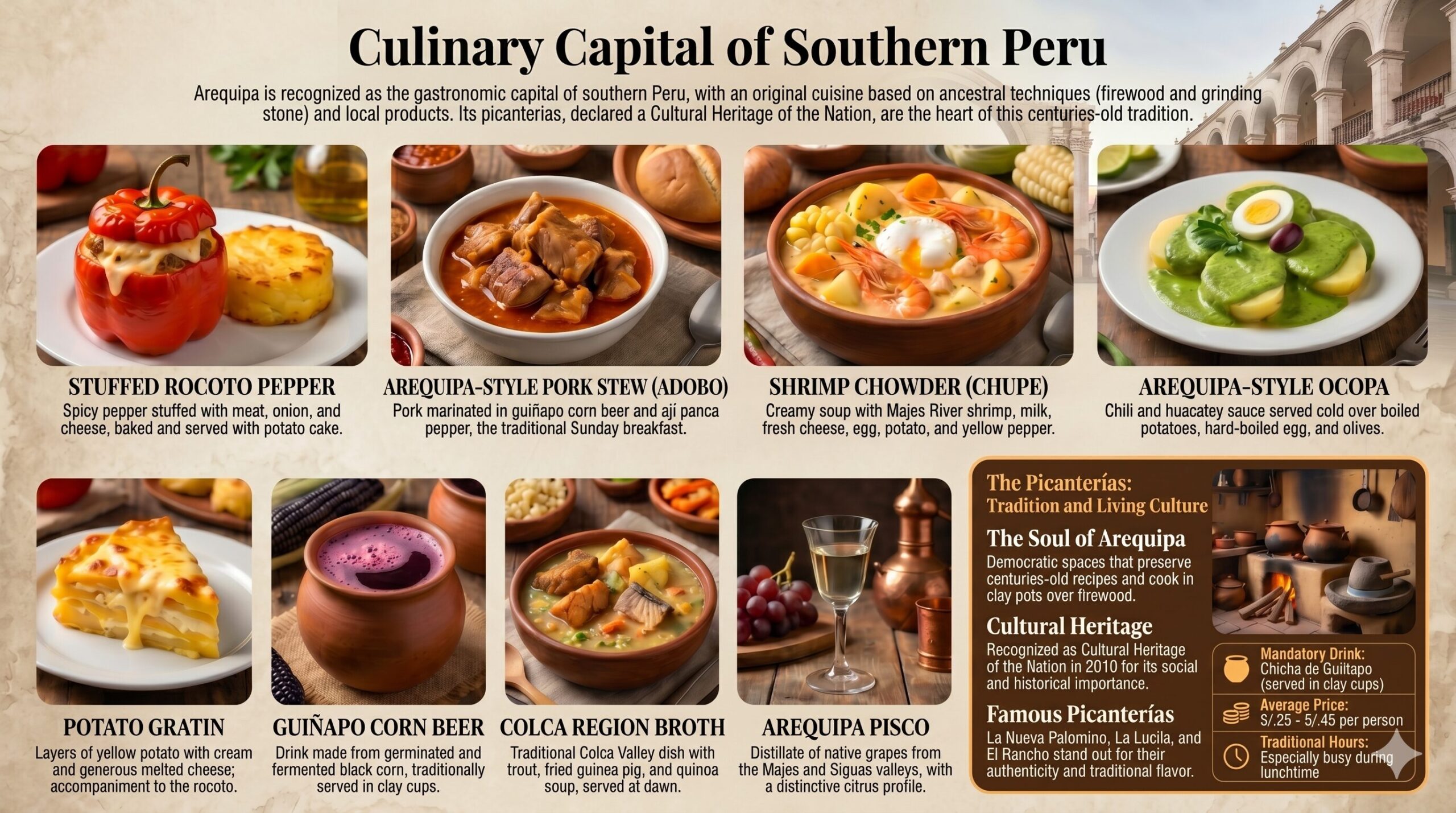
Arequipa's most iconic dish, the rocoto, a thick-walled Andean spicy pepper, is stuffed with minced beef and pork, onion, olives, hard-boiled egg and cheese, then baked until the casing is crispy. Always served with potato cake. The secret lies in soaking the rocoto in salted water to reduce the heat without losing the flavour. In traditional picanterías, it is eaten on Sundays with chicha de guiñapo.
Pork marinated for 24 hours in chicha de guiñapo (fermented purple corn chicha), ají panca, garlic, cumin and vinegar, the adobo arequipeño is eaten exclusively at Sunday breakfast, served with three-cornered bread. It is the oldest dish in the Arequipa tradition and the favourite hangover cure after the Anniversary festivities.
Southern Peru's most exclusive soup, made only with river prawns from the Majes (Arequipa's most important river), which have a unique flavour and size. The base is milk, egg, potato, yellow chilli and fresh cheese. Only restaurants in Arequipa and along the Majes river route have access to authentic fresh prawns. Season: May–November.
Arequipa's most original sauce, a blend of yellow chilli, roasted peanuts, fresh cheese, mint, huacatay and vanilla wafers, served cold over boiled potatoes, hard-boiled egg and black olives. The result is a combination of sweet, spicy and herbal flavours that exists in no other cuisine in the world. It is the obligatory first course of any picantería lunch.
The inseparable accompaniment to rocoto relleno, layers of yellow potato with cream, egg and oven-gratinéed cheese. This is not the classic French gratin: it is denser, creamier and has a touch of yellow chilli that gives it the distinctive Arequipa flavour. Many travellers discover it as a side dish and end up ordering a second portion on its own.
Arequipa's most distinctive drink, a fermented chicha made from black guiñapo corn, dark purple in colour, tart in flavour and between 2 and 4 degrees alcohol. This is the drink enjoyed in picanterías from a clay cup, used to marinate the adobo and the defining beverage of the August festivities. Artisanal guiñapo chicha production is a centuries-old tradition that survives only in Arequipa.
In the Colca Valley the gastronomy changes, the star dish is caldo de locos (trout with Andean herbs), Colca river trout (the coldest and most flavourful in the south), fried guinea pig with canyon herbs, and quinoa soup with broad beans and native potatoes served at Chivay restaurants at dawn before heading to Cruz del Cóndor at 5 AM.
Picanterías are Arequipa's oldest restaurants, neighbourhood establishments with centuries-old recipes, chicha de guiñapo served in clay cups, a menu that changes day by day and honest prices. La Nueva Palomino (Yanahuara), La Lucila and El Rancho are the most famous. The ritual: order the chicha from the jug, taste the ocopa and order rocoto relleno with potato cake. Price: S/25–45 per person.
Arequipa's picanterías are so important to the city's cultural identity that the Peruvian State declared them a National Cultural Heritage in 2010. Look for those with the "Picantería Tradicional" sign, they are the ones that maintain the original recipes without adapting for tourism.
From Peru's most beautiful city to the world's deepest canyon, Arequipa offers two worlds in one: UNESCO colonial heritage and extreme volcanic nature.
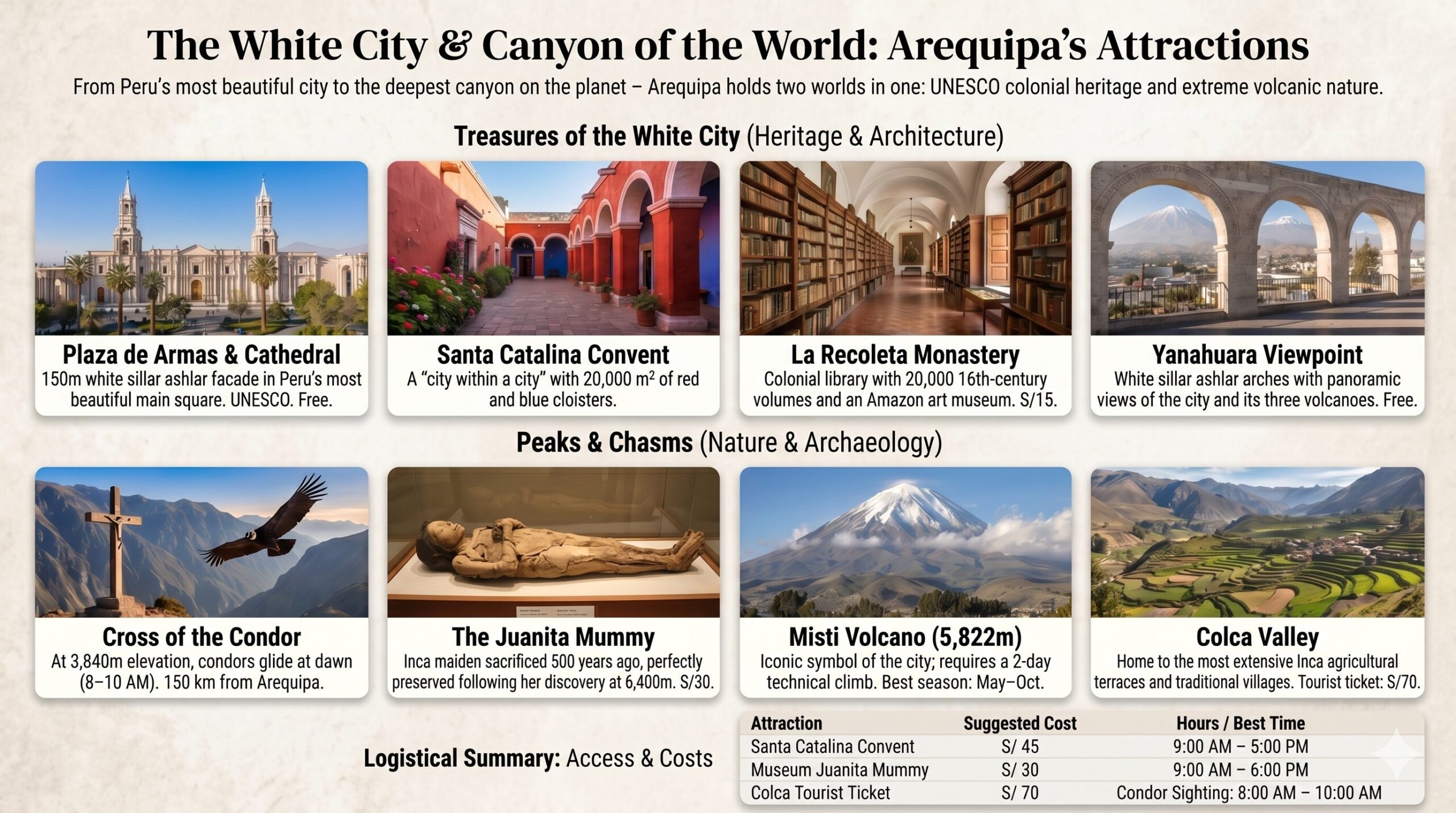
The most spectacular viewpoint in the Andes, at 3,840m above the Colca Canyon, the Andean condor soars on dawn thermal currents just metres from visitors. The spectacle occurs between 8 and 10 AM, when the sun warms the canyon walls and condors (with their 3.2-metre wingspan) rise without moving their wings from the floor of the 3,270m-deep gorge.
Founded in 1579 and closed to the world until 1970, 20,000 m² of labyrinthine alleyways with Spanish names (Córdoba, Toledo, Seville), cloisters painted turquoise blue and rust red, colonial soot-black kitchens and cells where Dominican nuns lived in seclusion for 400 years. It is the most striking colonial monument in Peru outside Cusco and one of the most unique cultural experiences on the continent.
Peru's most beautiful square, the white sillar Cathedral with its 150m façade dominates the northern side. Built between 1544 and 1656, destroyed by earthquakes and rebuilt three times, its mestizo baroque sillar with pre-Hispanic ornaments is the finest example of Arequipa art. The southern portals and colonial fountain complete the UNESCO 2000 ensemble.
The Inca maiden sacrificed 500 years ago at El Misti's summit at 6,400m, found in 1995 by Johan Reinhard, frozen and perfectly preserved with her clothing, grave goods and ritual offerings intact. On display at the UCSM Andean Sanctuaries Museum, Juanita is the best-preserved pre-Hispanic human being in the world and Arequipa's most important archaeological find.
The 1648 Franciscan convent holds one of Peru's most important colonial libraries, with over 20,000 volumes from the 16th to 19th centuries, and an exceptional pre-Hispanic and Amazonian art museum. Its sillar cloisters and inner gardens are the most peaceful in Arequipa's historic centre, just 5 minutes from Santa Catalina.
The Colca Valley has the most extensive and impressive agricultural terraces (andenes) in the Andes, built by the Collagua before the Inca Empire, still farmed today. The villages of Yanque, Coporaque, Maca and Lari preserve 17th-century baroque churches and traditional festivals where the wititi is danced in the squares. The valley is as beautiful as the canyon it hides.
Arequipa's finest viewpoint, the carved sillar arches frame the city's most iconic view: the cathedral, the historic centre and the three guardian volcanoes (Misti, Chachani, Pichu Pichu) in perfect perspective. At dawn, when sunlight illuminates the white sillar and El Misti is snow-capped, the photograph is Arequipa's most famous. Restaurants and picanterías nearby.
Arequipa's symbol, El Misti has the most perfect and recognisable volcanic cone in Peru. The technical ascent (no crampons required for most of the year) takes 2 days with camp at 4,600m. Summit view: coastal cities, the Colca, Chachani and the Pacific Ocean on clear days. Certified local guide required. Guide companies operate from Arequipa city centre.
3,270 metres deep, twice the depth of the Grand Canyon in Colorado. Home of the Andean condor, the most extensive Inca terraces in the Andes and Peru's highest thermal springs.
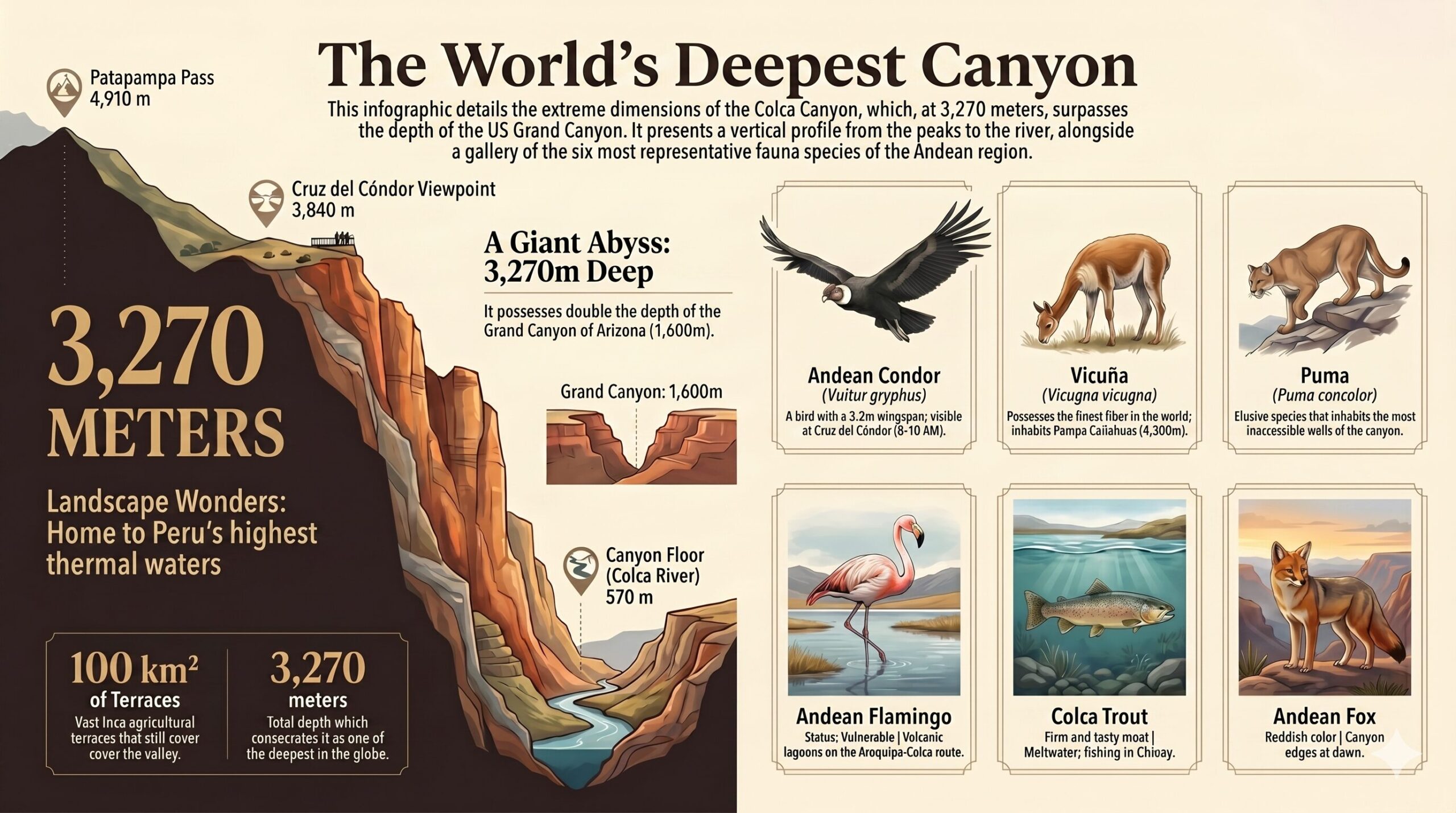
The Colca Canyon is the world's deepest canyon measured from rim to river, at 3,270 metres it surpasses the Grand Canyon in Colorado (1,609m) and the Cotahuasi Canyon in Peru (3,535m by some measurements). The Colca River runs at the bottom at 570m above sea level, while the canyon rim reaches 3,840m at Cruz del Cóndor.
The Vultur gryphus has a wingspan of up to 3.2 metres, the greatest of any land bird in the world. At Cruz del Cóndor, the thermal currents that rise up the canyon walls as the morning sun warms them lift the condors effortlessly from the canyon floor to the level of the viewpoints. The spectacle occurs between 8 and 10 AM. The Colca hosts the world's most concentrated condor population.
The Colca Valley's agricultural terraces are the most extensive and impressive in the Andes, built by the Collagua and Cabana peoples before the Inca Empire (12th–15th centuries) and expanded by Inca engineers in the 15th century. The Colca terraces cover more than 100,000 hectares of canyon walls, transforming impossible slopes into fertile land that still produces maize, potatoes and quinoa using 800-year-old techniques.
1 km from the centre of Chivay (the Colca Valley capital), La Calera thermal baths have water at 38–40°C with high volcanic mineral content. The experience of bathing in open-air thermal pools at 3,650m altitude with the altiplano starry sky overhead is one of the most memorable moments for Colca visitors. Open until 9 PM, perfect after Cruz del Cóndor.
The Colca Canyon is one of the richest ecosystems in the Andes, from puna at 4,900m to the subtropical canyon floor at 570m, with very different fauna at each altitude.
The world's largest bird by wingspan, 3.2m. It does not flap its wings: it soars on thermal currents for hours. Can live 70 years. The Colca has the world's greatest concentration. Best time: 8–10 AM at Cruz del Cóndor.
The world's finest fibre (12 microns). Large herds in Pampa Cañahuas at 4,500m, the Aguada Blanca National Reserve is the best viewpoint on the road to the Colca.
The pink flamingos of the puna can be seen at the high-altitude lakes on the Arequipa–Colca route, especially at the Salinas and Aguada Blanca National Reserve with its volcanic lakes.
Colca River trout are the most flavourful in southern Peru, the cold glacial melt water from the volcanoes and the altitude give them a firm texture and exceptional taste. Caught and cooked at restaurants in Chivay and Yanque.
The reddish Andean fox, large, with reddish fur and pointed ears, is seen at the canyon rim at dawn and dusk. It is the largest terrestrial predator in the Colca Valley.
Pumas exist in the canyon but are extremely difficult to spot, they inhabit the most inaccessible canyon walls. Local communities report their tracks on the canyon floor during the 2-day Cabanaconde–Sangalle trek.
From a colonial Sunday picantería lunch to climbing El Misti, Arequipa offers the most varied combination in southern Peru: living culture, authentic gastronomy and extreme adventure among volcanoes.
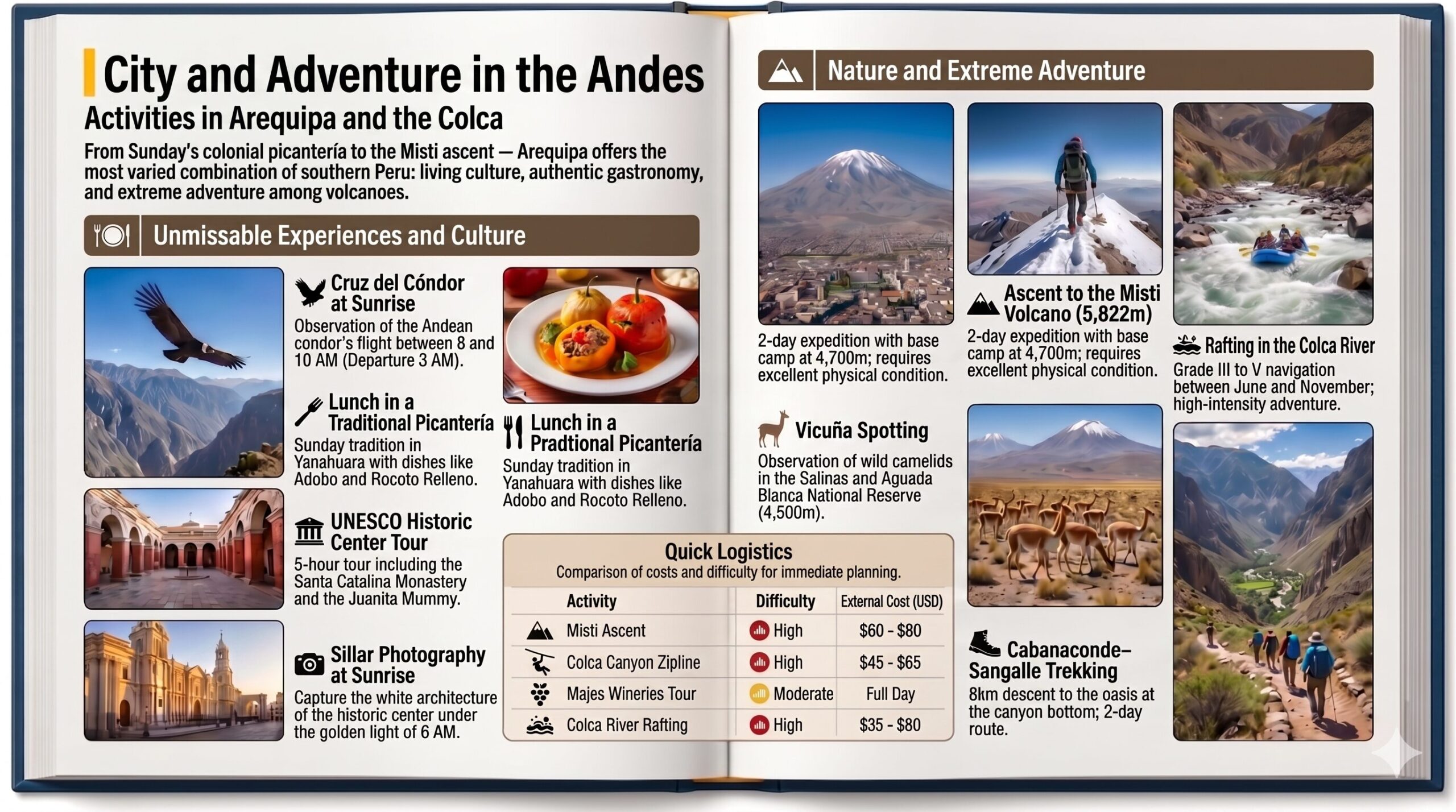
The most memorable experience in southern Peru, leave Chivay at 5 AM to reach Cruz del Cóndor by 7:30 AM. At 8, the sun warms the canyon walls and the condors begin to soar. Seeing an Andean condor with a 3-metre wingspan at 5 metres distance is the moment every Arequipa traveller remembers most. Bring a jacket, it is cold at the viewpoint until 9 AM.
Sunday is the sacred day of Arequipa's picanterías, families fill the restaurants from midday. The ritual: a jug of chicha de guiñapo in clay cups, ocopa as a starter, rocoto relleno with potato cake as the main. La Nueva Palomino, La Lucila and La Benita are the most traditional. Price S/30–50 per person. Book ahead on high-season Sundays.
Arequipa's essential route: Plaza de Armas → Cathedral → Santa Catalina Convent (2h) → Andean Sanctuaries Museum (Juanita) → Santa Catalina Street → La Recoleta Monastery. The walking tour of the historic centre fits in a half-day, the afternoon is free for Yanahuara picanterías and the viewpoint with El Misti in sight.
After an early morning at Cruz del Cóndor, the perfect reward is La Calera thermal baths 1 km from Chivay, volcanic water pools at 38–40°C with valley views. Best time: sunset (5–7 PM) when temperature drops and the sky fills with colour. Entrance: S/15. Bring swimwear, locals hire it. Open until 9 PM.
The most accessible ascent of a 5,000m+ volcano in South America, no crampons or technical mountaineering experience required. Day 1: camp at 4,600m. Day 2: summit at dawn with crater view and the Pacific. Summit temperature: -10°C to -20°C. Hire a certified guide in Arequipa (USD60–80 per person with equipment). Best season: May–October.
The canyon's most spectacular trek, descend from Cabanaconde (3,287m) to the Sangalle oasis on the canyon floor (2,200m) via 8km trails with 360° views of 3,000m walls. The oasis has natural warm-water pools among palm trees. Overnight in basic camping and ascent the following day. No guide needed, the trail is marked and locals provide directions.
The Colca River has technical rafting sections on the canyon floor, from family grade III to expert grade V in the Canco and Achoma rapids. Chivay agencies organise excursions (USD35–80 per person). The dry season (June–November) is when the river is at the right level and the water is at its clearest.
At 3,800m altitude, with no light pollution and the altiplano's dry atmosphere, the Colca Valley sky is one of the best in Peru for astronomy. The Milky Way is visible to the naked eye. Chivay agencies offer telescope astronomy nights (USD20–30) or simply head out of town at 9 PM with a blanket.
The golden dawn light on Arequipa's white sillar is the city's most sought-after photograph, snow-capped El Misti in the background, the illuminated cathedral and the empty Plaza de Armas before tourists arrive. Best spots: Yanahuara viewpoint (with colonial arches), Bolognesi bridge over the Chili River and Santa Catalina cloisters at 9 AM opening.
The Aguada Blanca and Salinas National Reserve, at 4,500m on the road from Arequipa to the Colca, has the largest vicuña concentration in southern Peru, herds of 20–50 animals beside the road, with Andean flamingos on the volcanic lakes in the background. This stop is mandatory on all Colca tours and lasts 20–30 minutes at dawn when the animals are most active.
The Majes Valley wineries (2h from Arequipa) produce Peru's most distinctive pisco, using negra criolla and quebranta grapes grown at 1,400m. Bodegas Paz, Haras de Majes and Finca Tradición receive visitors with tastings and lunch featuring Majes river prawns (the finest in Peru). The tour pairs perfectly with a visit to the Sipia waterfalls.
Arequipa is the perfect stopover on Peru's southern route, after the Colca, the natural circuit continues to Puno (bus 5h, with stops on the altiplano) and from there to Cusco by train or bus. The reverse route Lima → Paracas → Ica/Huacachina → Arequipa → Colca → Puno → Cusco is the classic Peru itinerary in 2–3 weeks.
From how to get there to where to stay and what to pack, everything essential for planning your visit to Arequipa and the Colca Canyon.
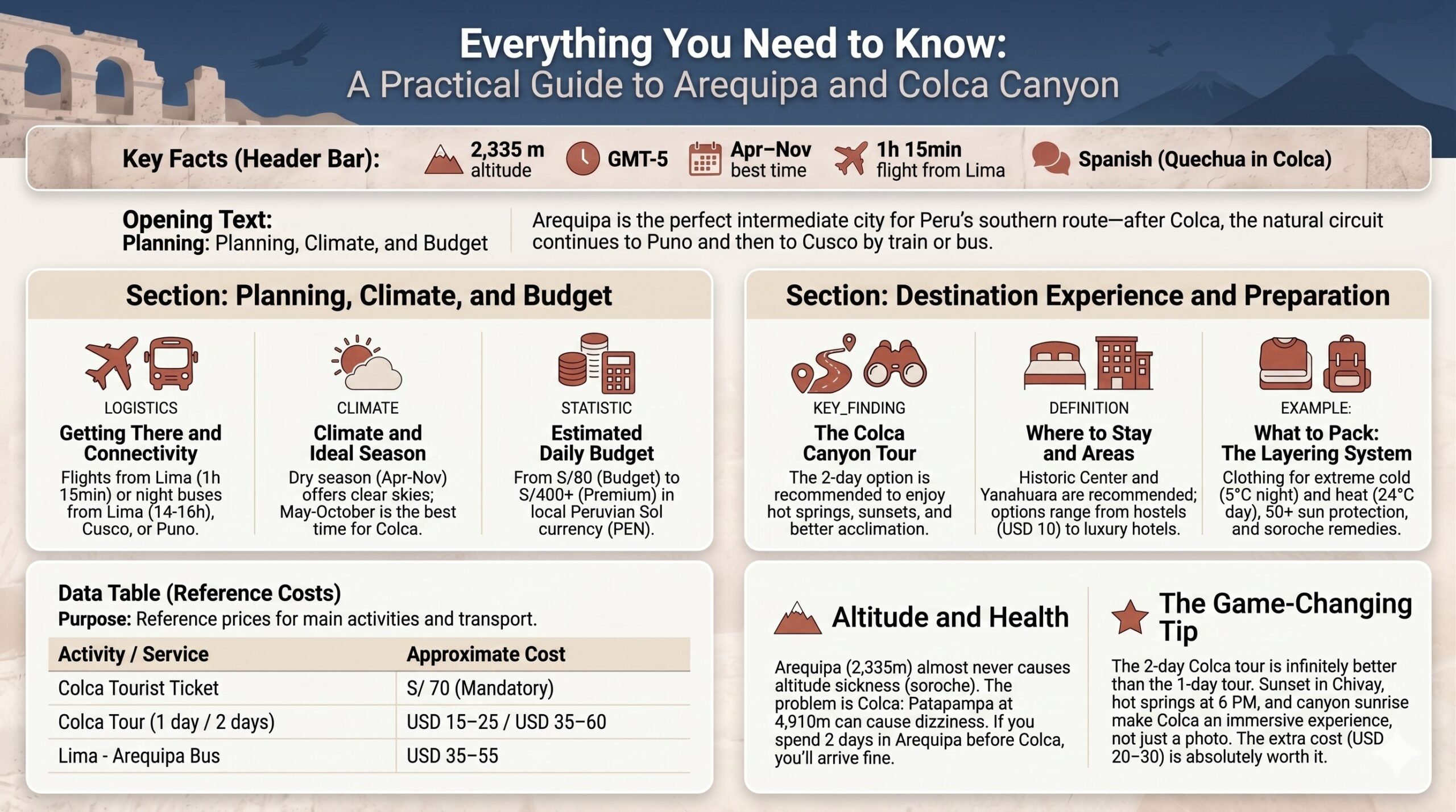
Arequipa is at a moderate altitude and very few visitors suffer altitude sickness in the city. The challenge is the road to the Colca, the Patapampa pass at 4,910m can cause dizziness, headaches and nausea even in acclimatised travellers. The solution: if you arrive in Arequipa on the same day as your Colca tour, drink coca tea and ascend slowly. With 2 days in Arequipa beforehand, you will arrive without problems.
The 2-day Colca tour is infinitely better than the 1-day, not because of Cruz del Cóndor (which is the same), but because the first evening in Chivay, the thermal baths at 6 PM and the canyon dawn before the viewpoint turn the Colca into an immersive experience, not just a photograph. The extra cost (USD20–30) is absolutely worth it.