

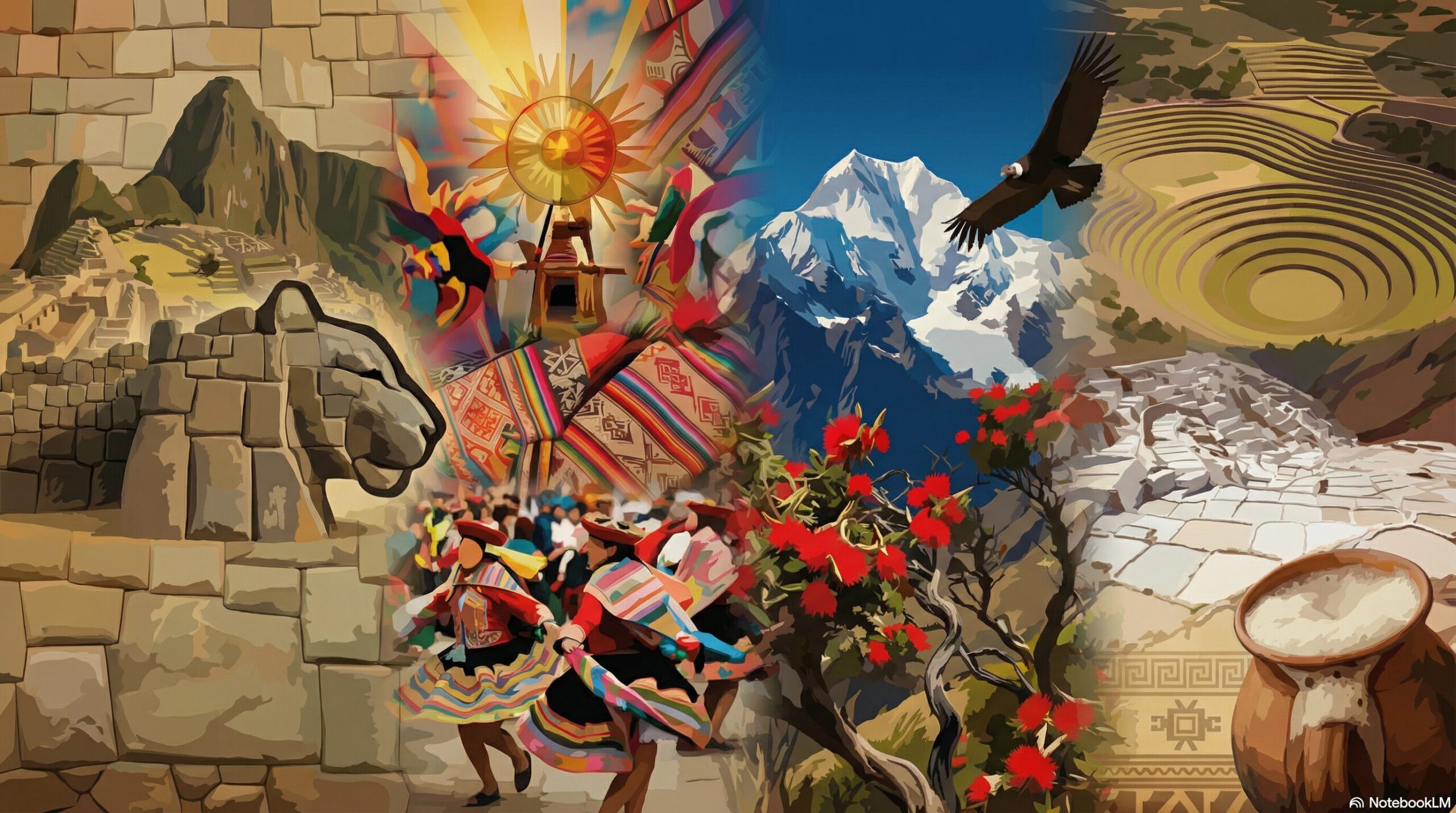
Where stone temples whisper centuries of history, Andean festivals light up the sky and every cobblestone street leads to a new discovery.
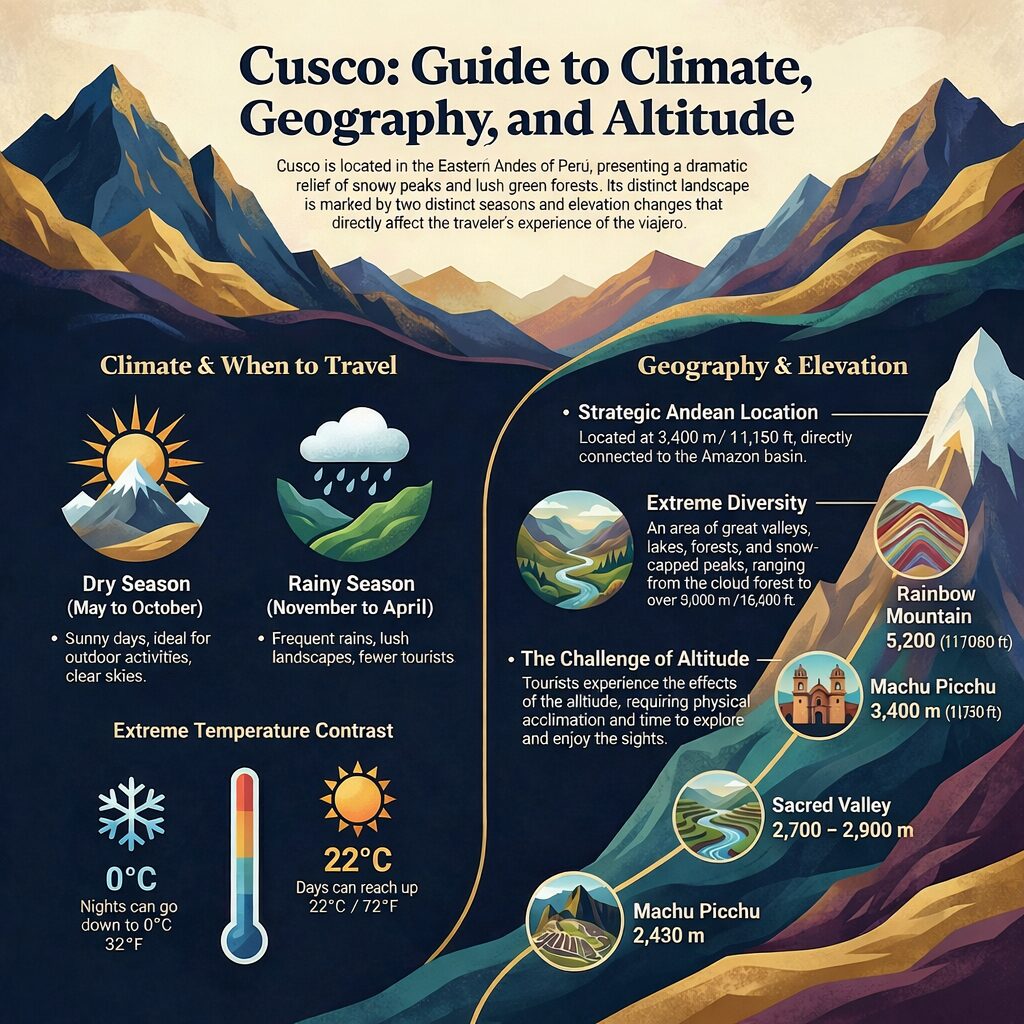
Cusco, known to the Incas as Qusqu, "navel of the world", sits at 3,400 metres above sea level in the Peruvian Andes. For centuries it was the heart of the most extensive empire the Americas had ever known, dominating a territory stretching from present-day Colombia to central Chile.
Today the city remains a living monument. Spanish baroque churches rise directly on Inca stone foundations, and on the surrounding mountains centuries-old terraces still channel Andean rains exactly as Tawantinsuyu engineers conceived them. Quechua is still heard on every corner, festivals still follow the solar calendar and the gastronomy draws on crops domesticated here thousands of years ago.
For the traveller, Cusco is much more than a gateway to Machu Picchu. It is a destination in its own right, a city where history, culture, adventure and gastronomy converge at every turn.
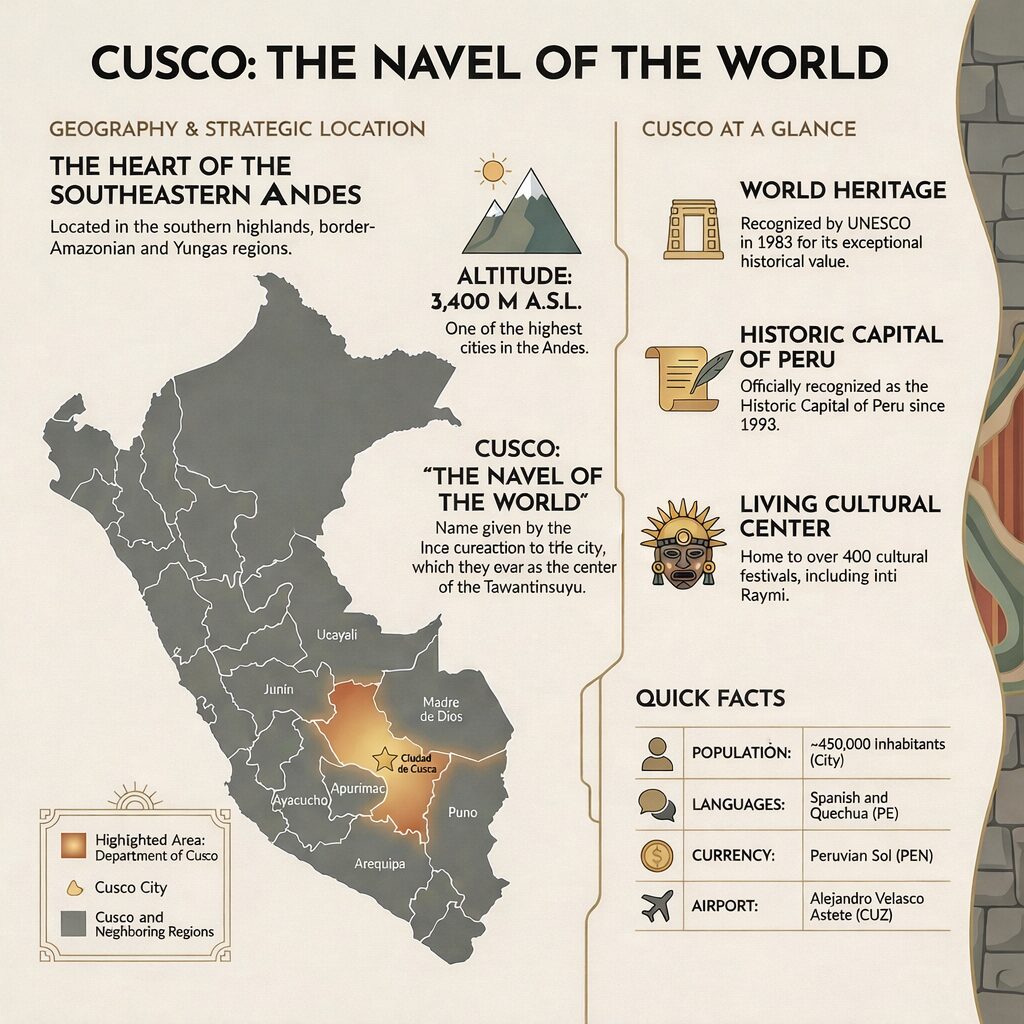
High in the Andes, Cusco sits in a dramatic landscape of snow-capped peaks, deep valleys and cloud forests, each zone with its own climate and character.
South-eastern Peru, in the Eastern Andes. Latitude 13°31′S, Longitude 71°58′W. Surrounded by mountain ranges exceeding 6,000 m.
May to October: clear skies, sunny days and cool nights. The ideal window for trekking, photography and outdoor activities.
Afternoon rains keep valleys lush and green. Fewer tourists, lower prices and vibrant green landscapes. Mornings are usually clear.
The Cusco region spans dramatic changes in elevation, from the urban centre to the highest passes and misty cloud forests.
From the first Andean settlements to the capital of an empire that spanned a continent, and through Spanish conquest to the vibrant city of today.
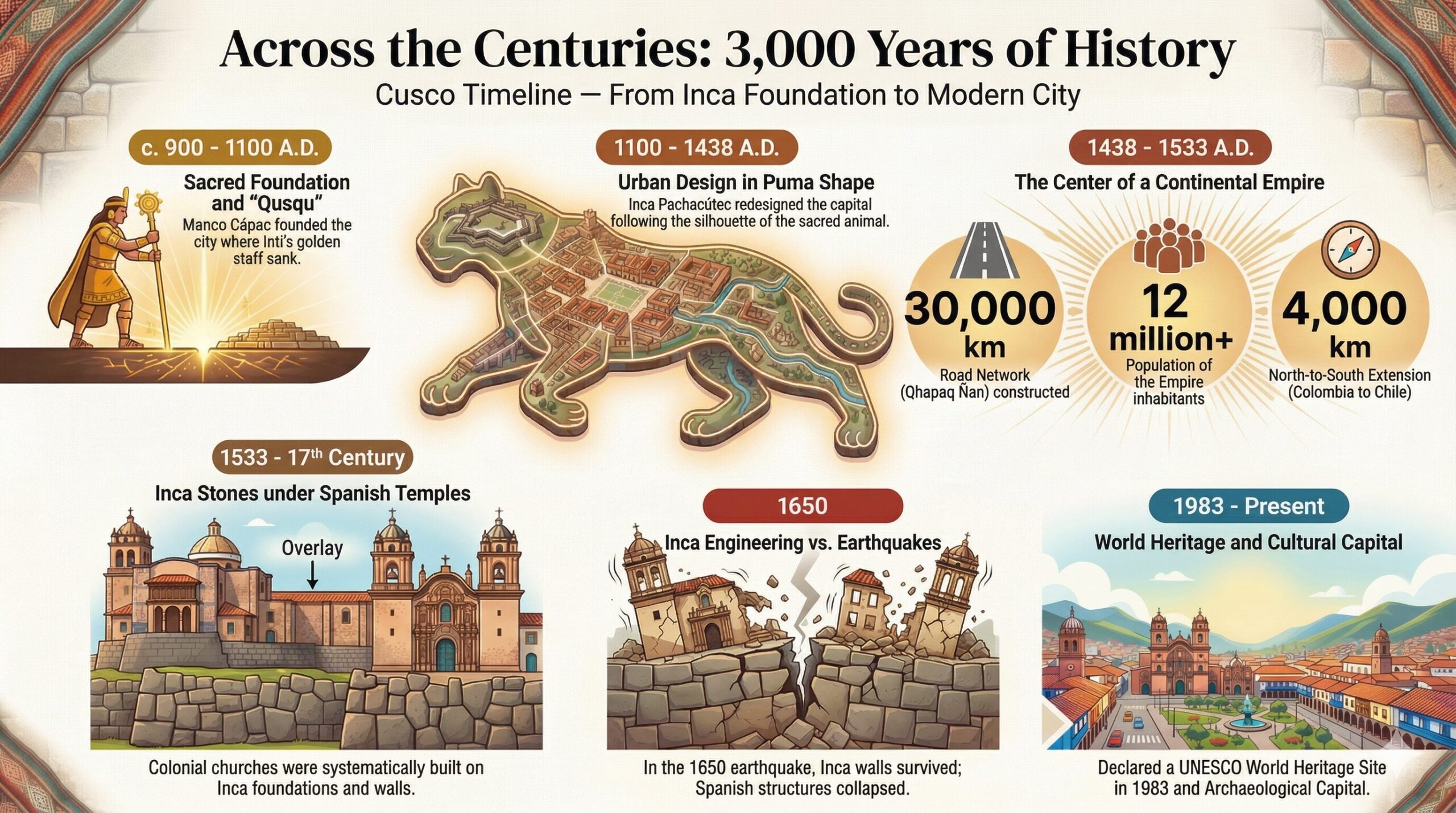
The Cusco valley was inhabited by various Andean cultures long before the Incas. The Killke people built early structures whose remains are still found beneath colonial buildings. The valley's strategic location, at the intersection of several rivers, made it a natural communications hub.
According to legend, Manco Cápac, the first Sapa Inca, founded Cusco at the spot where a golden staff given by the sun god Inti sank into the earth. The city became the political and religious heart of the Tawantinsuyu ("The Four Regions Together"), the largest empire in pre-Columbian America.
Under the rule of Pachacuti (1438–1471) Cusco was completely rebuilt with the precision stone masonry we admire today. The city was laid out in the shape of a puma, a sacred animal. At its height, the Tawantinsuyu stretched 4,000 km from Colombia to Chile, with a road network of over 30,000 km.
In 1533 Francisco Pizarro took Cusco after capturing the last Inca emperor Atahualpa. The Spanish systematically built their churches and palaces on Inca foundations, a layering of civilisations visible throughout the city. The Cathedral on the Plaza de Armas was built over the palace of Inca Viracocha; the Dominican Convent, over the sun temple Qorikancha.
A devastating earthquake struck Cusco in 1650. While Spanish colonial architecture collapsed, Inca foundations and walls remained intact, clear proof of the extraordinary engineering of the Tawantinsuyu. The city was rebuilt on the same foundations that still stand today.
Cusco was declared a UNESCO World Heritage Site in 1983, in recognition of both its colonial baroque architecture and the Inca remains it incorporates. Today it is Peru's most visited city and a world-class cultural destination, while remaining a living and dynamic community of nearly half a million people where Quechua, traditions and Andean identity are proudly maintained.
Cusco is not a museum piece, it is a living culture where Andean identity, the Quechua language and centuries-old traditions are proudly present in everyday life.
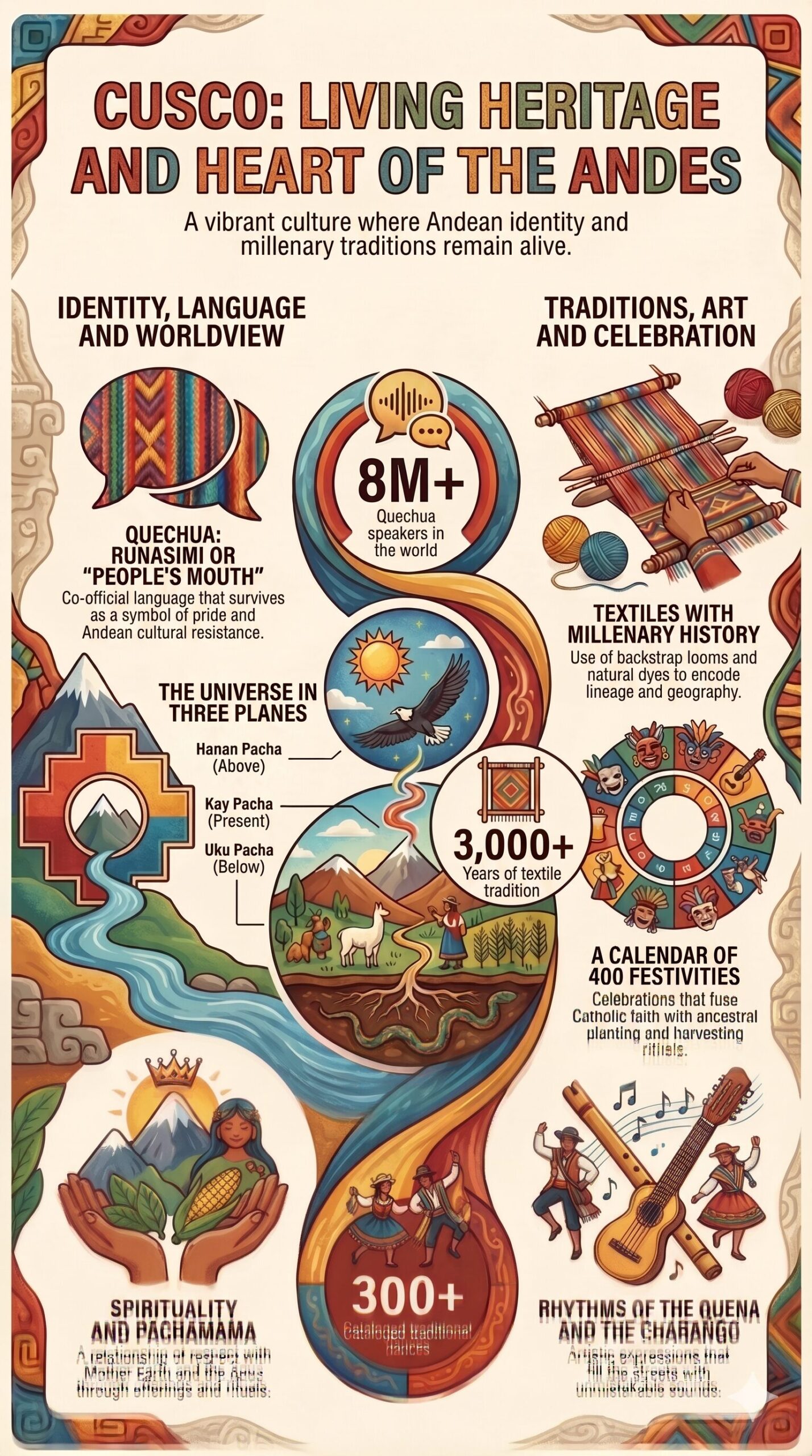
The Inca language survives. Quechua (Runasimi, "mouth of the people") is co-official in Cusco and is spoken by millions in Peru, Bolivia and Ecuador. Greet a local with "¡Allillanchu!" (How are you?) and watch their face light up.
Andean textile art is one of the most sophisticated in human history. Each community uses distinct patterns and colours to encode lineage, geography and history. In Chinchero and San Blas, weavers still use backstrap looms and natural dyes from plants and insects.
Andean spirituality revolves around Pachamama (Mother Earth) and the Apus (mountain spirits). Before any meal, a few drops of chicha are poured onto the ground as an offering. Earth-payment ceremonies are performed at sowing and harvest, blending Catholic and Inca beliefs.
Over 300 distinct dances have been catalogued in the Cusco region, many linked to the agricultural and religious calendar. The unmistakable sounds of the quena (Andean flute) and charango (small guitar) fill the cobbled streets, especially during festivals.
For the Andean world, the universe divides into three planes: Hanan Pacha (the upper world), Kay Pacha (the present world) and Uku Pacha (the lower world). This worldview permeates Cusco's architecture, art, gastronomy and celebrations to this day.
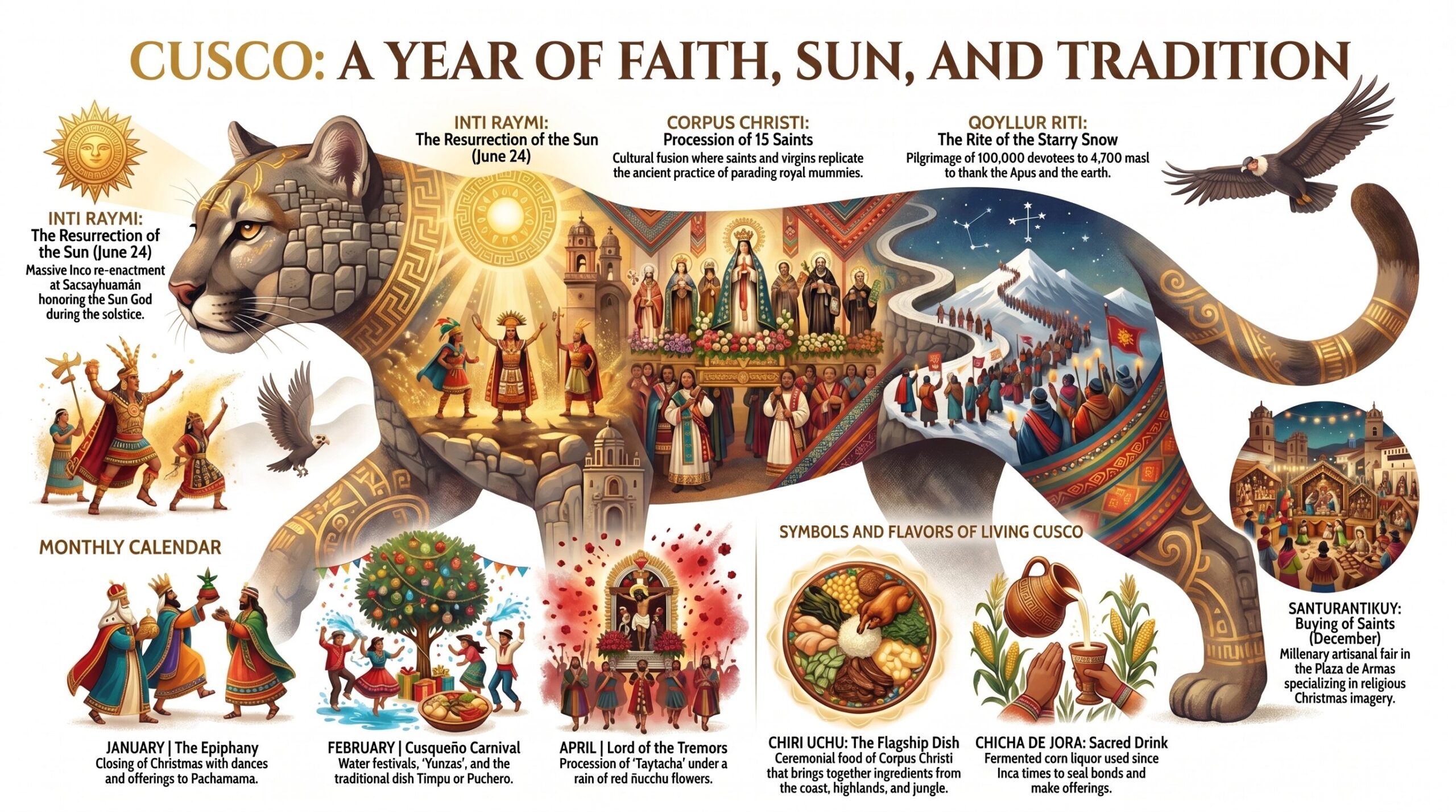
Every month in Cusco is marked by a festival that blends Catholic faith with Inca solar ritual, some of the most spectacular celebrations in South America.
Festival of the Sun
The most spectacular Inca celebration re-enacted today. Thousands gather at Sacsayhuamán for a dramatic ceremony honouring Inti (the Sun God) during the winter solstice. Actors in full Inca regalia perform ancestral rites before over 100,000 spectators.
Inca & Catholic Fusion
Fifteen statues of saints and virgins are carried through Cusco's streets in elaborate processions. This Catholic festivity perfectly replicates the Inca practice of parading royal mummies, an extraordinary cultural synthesis that endures to this day.
Pilgrimage to the Starry Snow
One of the most extraordinary pilgrimages in the world: up to 100,000 devotees ascend to 4,700 m to dance, pray and carry blocks of glacial ice down the mountain in an ancestral rite of renewal and gratitude.
Water, Dance & Music
The Andean carnival mixes water and foam battles with live music and traditional dances. Streets fill with water balloons and music groups competing neighbourhood by neighbourhood with costumes and choreographies prepared for months.
Remembering the Ancestors
Families bring bread and food offerings to cemeteries to share with their ancestors. A profound blend of mourning and celebration, graves are decorated with marigolds and tables laid with the deceased's favourite dishes.
Taitacha Temblores
The historic figure of Christ is solemnly processed through Cusco. Venerated since supposedly halting the earthquake of 1650, the image is covered in red ñucchu flowers while thousands accompany it along the colonial streets.
Almudena
The patron festival of the Almudena neighbourhood brings communities from across the region with typical dances such as Qhapaq Qolla, Saqra and Qhapaq Negro. A festival of colour and faith overflowing this picturesque Cusco neighbourhood.
Three Kings' Day
On 6 January Cusco celebrates Epiphany with its own peculiarities: craft fairs, dances of the nations and distributions of miniatures and despachos to Pachamama to bless the new year with abundance and health.
Cusco is the birthplace of the potato, quinoa and giant corn. Its cuisine is one of the great culinary traditions of the world, millennia-old ingredients, intense flavours and modern creativity.
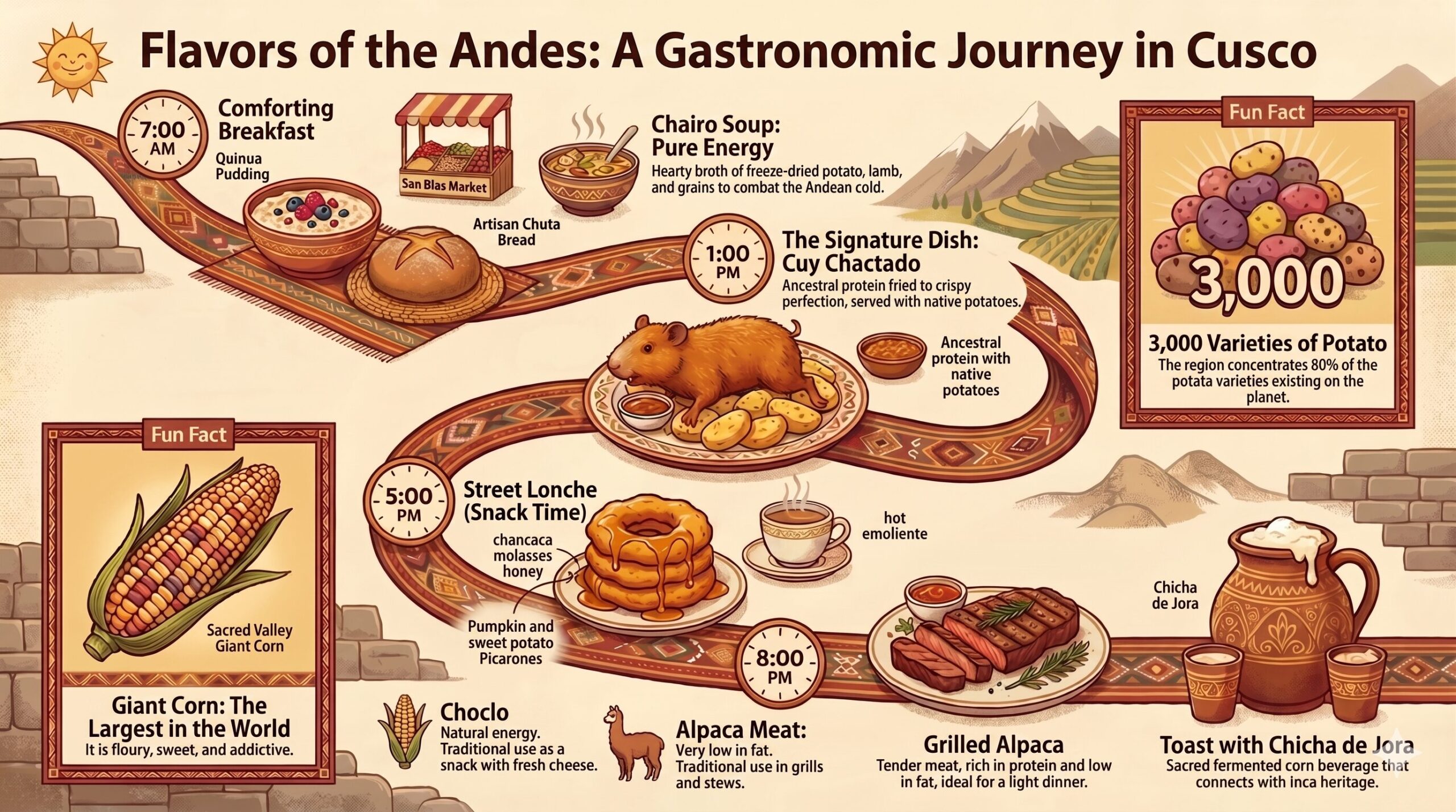
The most emblematic dish of the Andes, guinea pig pressed and fried until crispy, served with native potatoes and chilli sauce. A food consumed here for 5,000 years.
TraditionalThe perfect remedy for altitude, a hearty broth of chuño (freeze-dried potato), lamb, chickpeas, wheat and vegetables. Its flavours intensify the higher you are.
ComfortingGiant-kernel Andean corn with fresh local cheese. Cusco's choclo has the largest kernels in the world, floury, slightly sweet and absolutely addictive. A must at the San Pedro Market.
Street FoodGrilled alpaca loin, lean, high in protein and low in fat. A tender meat with a mildly gamey flavour that pairs perfectly with native potatoes and yellow chilli.
Must TryThe sacred drink of the Incas, fermented corn chicha served in clay cups. Chicha morada (purple corn, non-alcoholic) is equally revered and deeply refreshing.
Sacred DrinkRocoto chilli stuffed with spiced minced meat, raisins, olives and hard-boiled egg, gratinated in the oven. A spicy and complex dish blending pre-Hispanic ingredients with Spanish colonial techniques.
SpicyThe Inca superfood, hundreds of varieties of quinoa, kiwicha and cañihua are grown at this altitude. It appears in soups, salads, desserts and even drinks throughout the city.
SuperfoodFried sweet potato and squash doughnuts drizzled with chancaca syrup (cane molasses with spices). Cusco's most popular street dessert, crispy outside, soft inside.
DessertCusco's choclo has the largest kernels in the world. The Cusco region is the origin of over 3,000 potato varieties, around 80% of all existing varieties on the planet.
From the temple of the sun at the heart of the city to the great fortress that crowns it from above, the sites of Cusco span 3,000 years of human genius.
Monumental Inca complex dominating Cusco, built with stones weighing up to 125 tonnes fitted together without mortar.
The golden heart of Cusco, once the Inca Huacaypata, stage for great ceremonies, today flanked by the Cathedral and La Compañía church.
Temple of the Sun, once sheathed in pure gold, today visible beneath the convent of Santo Domingo.
100 years in the making, built on Inca foundations. Houses the Christ of the Earthquakes and the famous Last Supper painted with guinea pig.
The artisans' neighbourhood, cobbled lanes, woodcarving workshops and the famous pulpit carved from a single tree trunk.
The most famous example of Inca masonry perfection, a single stone fitting seamlessly against 12 neighbours without mortar.
A festival of colours and flavours, exotic fruits, fresh juices, handicrafts and the everyday cuisine of the people of Cusco.
Inca sanctuary carved directly into living rock, with underground labyrinths and ceremonial channels for ritual offerings.
Tipón · Piquillacta · Andahuaylillas · Raqchi · Waqrapukara · Laguna Huaypo · Maras (Awanacancha textiles)
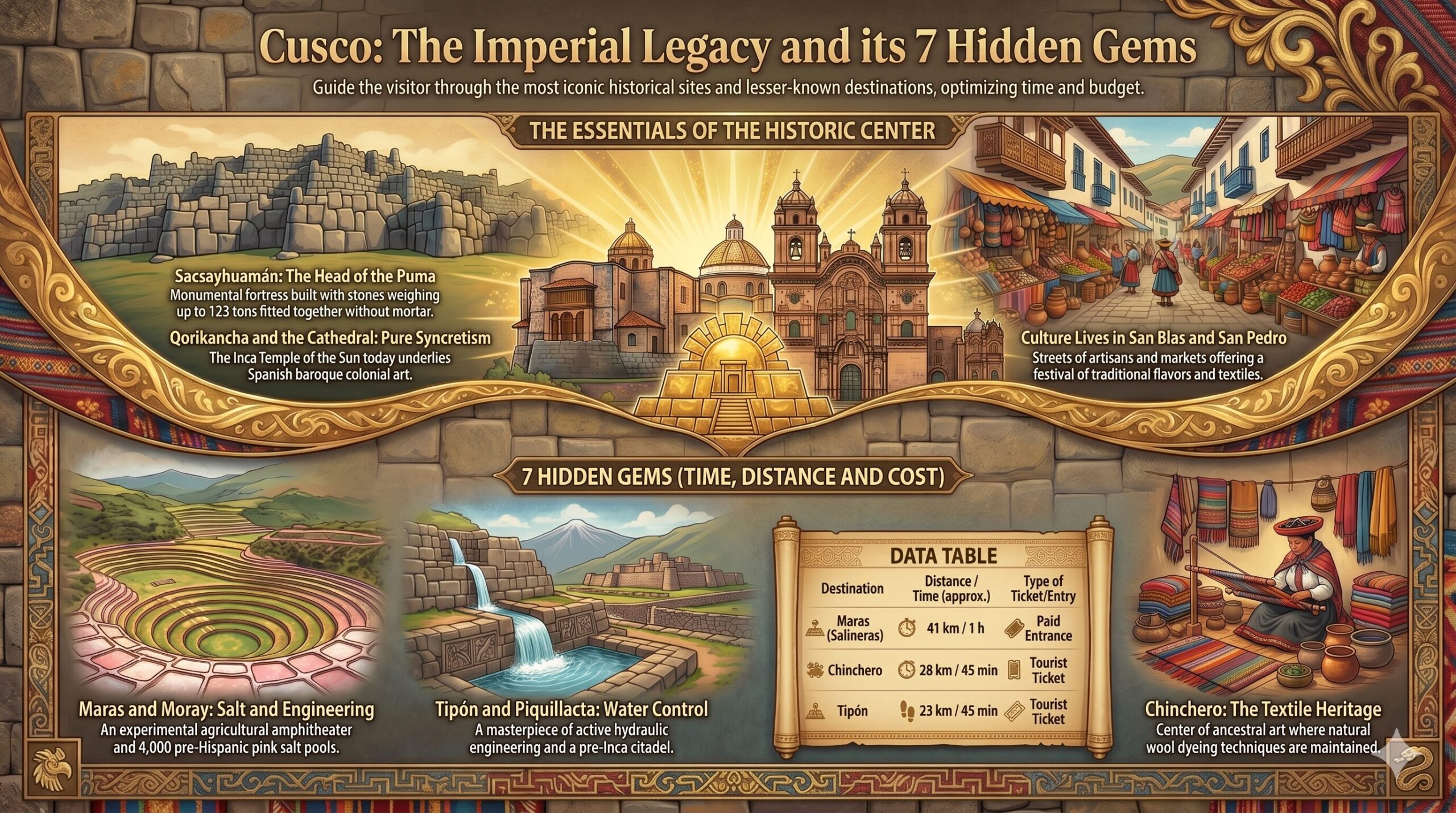
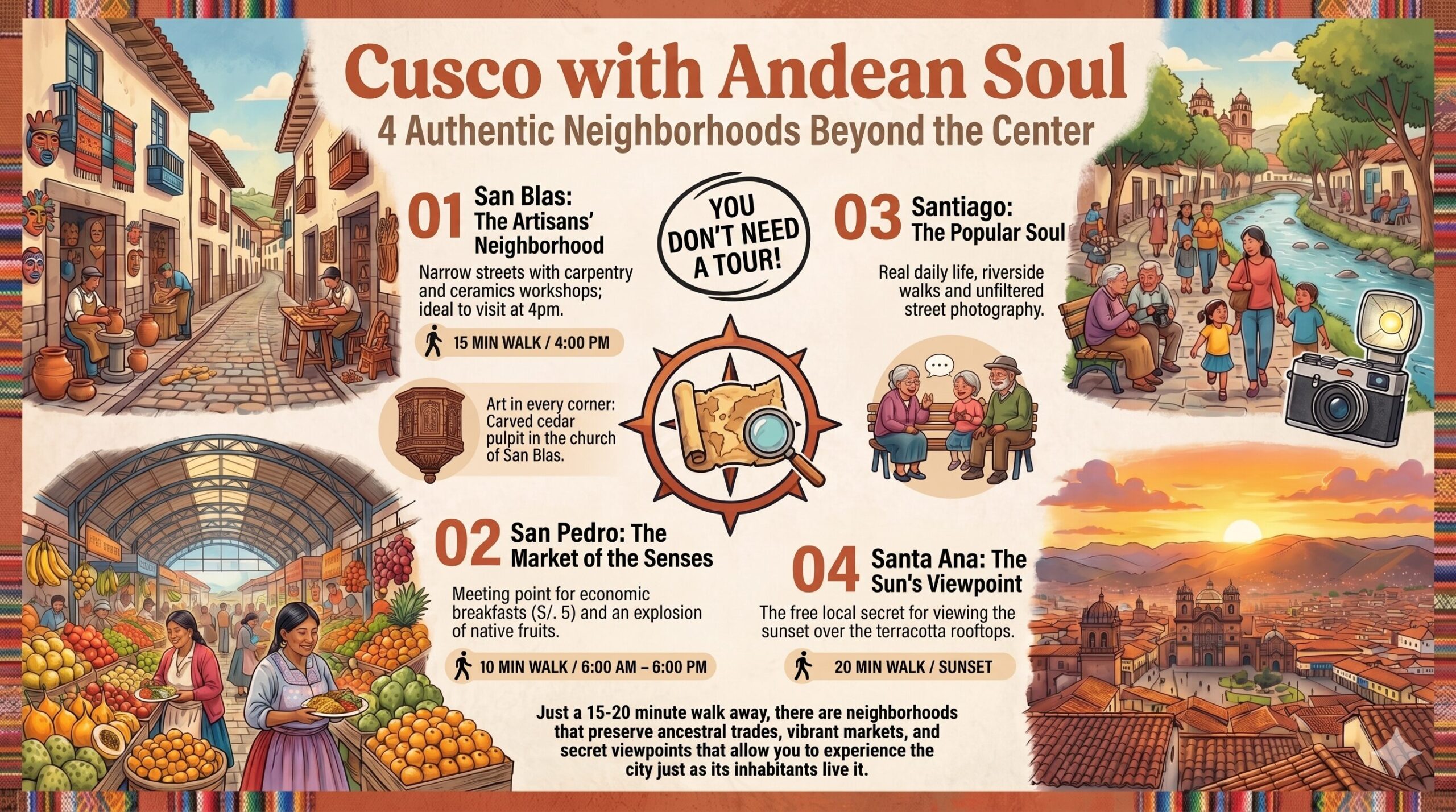
Whether you want to hike ancestral trails, learn to cook Andean cuisine or simply wander cobbled colonial streets, Cusco has it all.
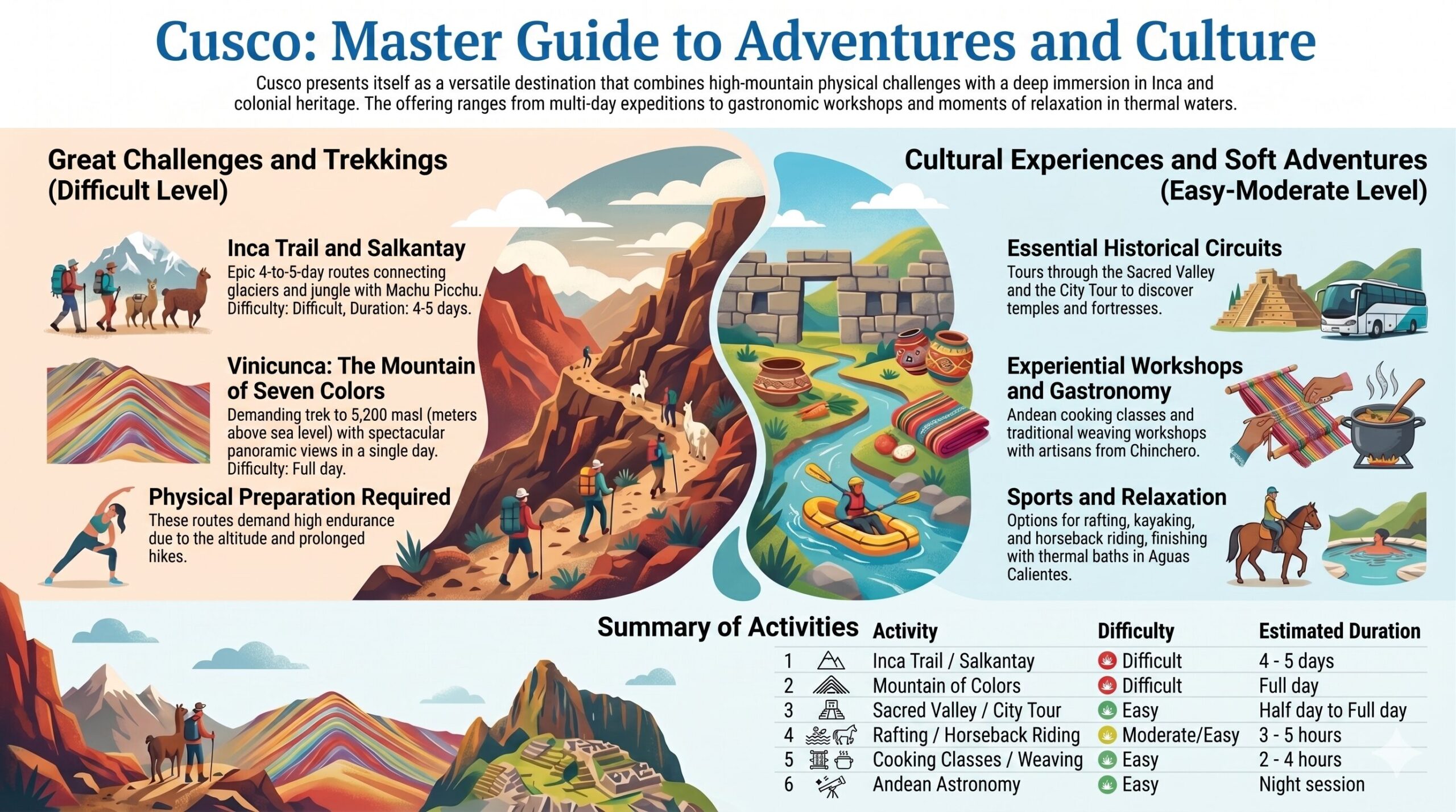
The classic 4-day trek through cloud forests and Inca ruins to the Sun Gate above Machu Picchu. The most iconic hike in the Americas.
Trek to Vinicunca (5,200 m) for the famous multicoloured ridge. Full day from Cusco with spectacular panoramic views.
Ruins and market at Pisac, fortress of Ollantaytambo, weaving community of Chinchero. The essential full-day tour from Cusco.
Cathedral, Qorikancha, Sacsayhuamán, Qenqo, Puca Pucara and Tambomachay, the classic city circuit with a specialist guide.
The Urubamba River offers grade II–IV rapids, turquoise waters through spectacular Andean canyons. Excitement guaranteed.
San Pedro Market visit + Andean cooking class. Learn to prepare ceviche, cuy, causa and chicha morada with local chefs.
Explore the Sacred Valley on Peruvian Paso horses, a breed renowned for its exceptionally smooth gait, perfect for mountain terrain.
Learn to spin, dye with natural pigments and weave on a backstrap loom alongside Andean artisans from Chinchero. A deeply enriching cultural experience.
The world's most popular Inca Trail alternative: a 5-day traverse from the Salkantay glacier (4,630 m) down to the tropical jungle of Machu Picchu.
Paddleboard and kayak on the calm waters of Lake Huaypo, surrounded by Andean mountains at 3,000 m altitude. A perfect option on rainy days.
After the Inca Trail or any trek, the natural hot springs at Aguas Calientes (Machu Picchu Pueblo) are the perfect muscle recovery remedy.
At 3,400 m with minimal light pollution, Cusco's night sky is extraordinary. Some operators offer telescope sessions with guides versed in Inca cosmovision.
Everything you need to know to travel with confidence, from preparing for altitude to getting around the city.
At 3,400 m, soroche (altitude sickness) affects many first-time visitors. Take it seriously.
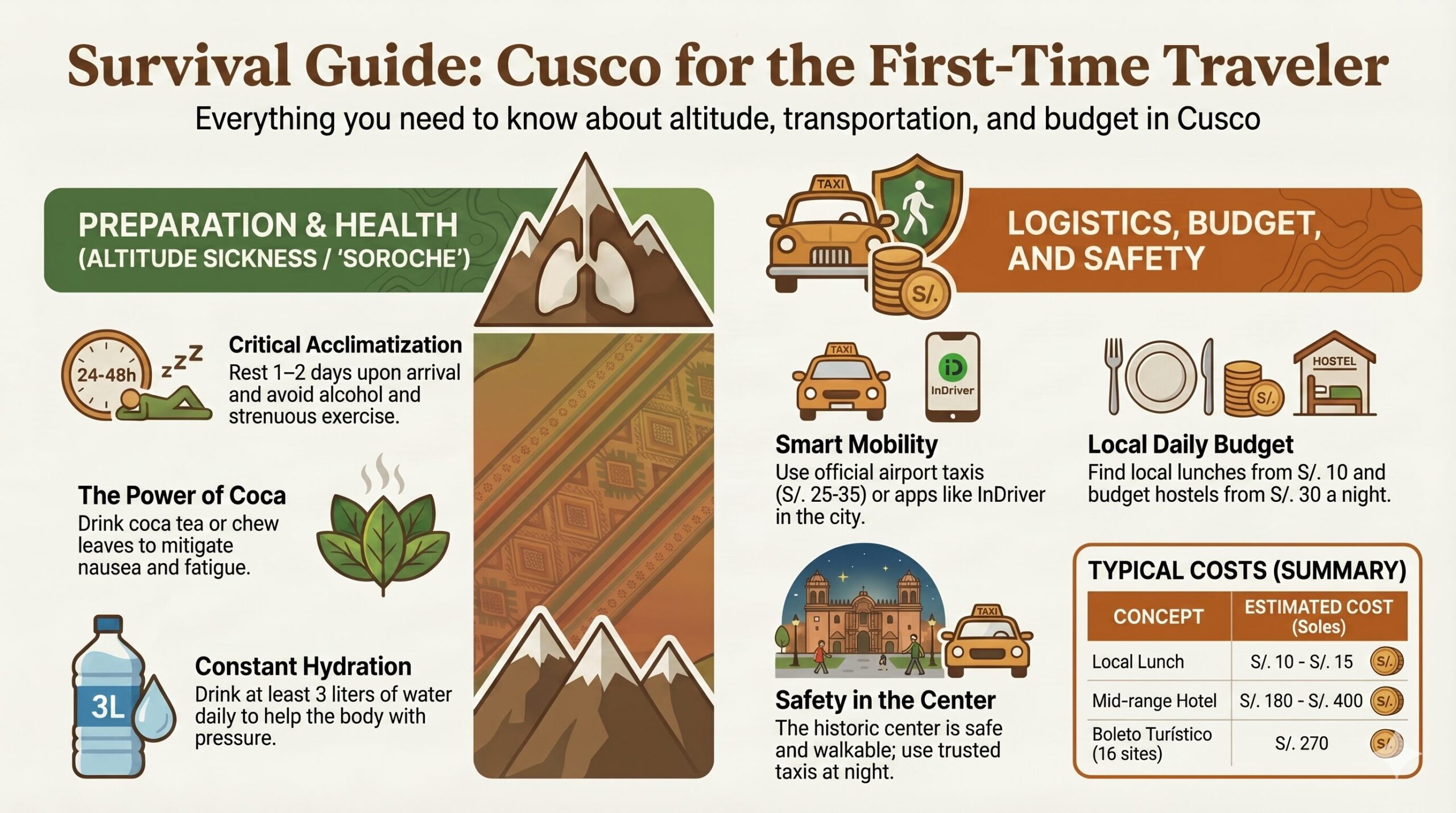
Symptoms include headache, nausea and fatigue. If symptoms worsen (disorientation, difficulty breathing at rest) seek medical attention immediately. Cusco has well-equipped clinics.
Cusco is generally safe for tourists. Be cautious with valuables in crowded areas. Avoid deserted alleyways at night. Use app-based taxis or ask your accommodation to call a trusted one.