

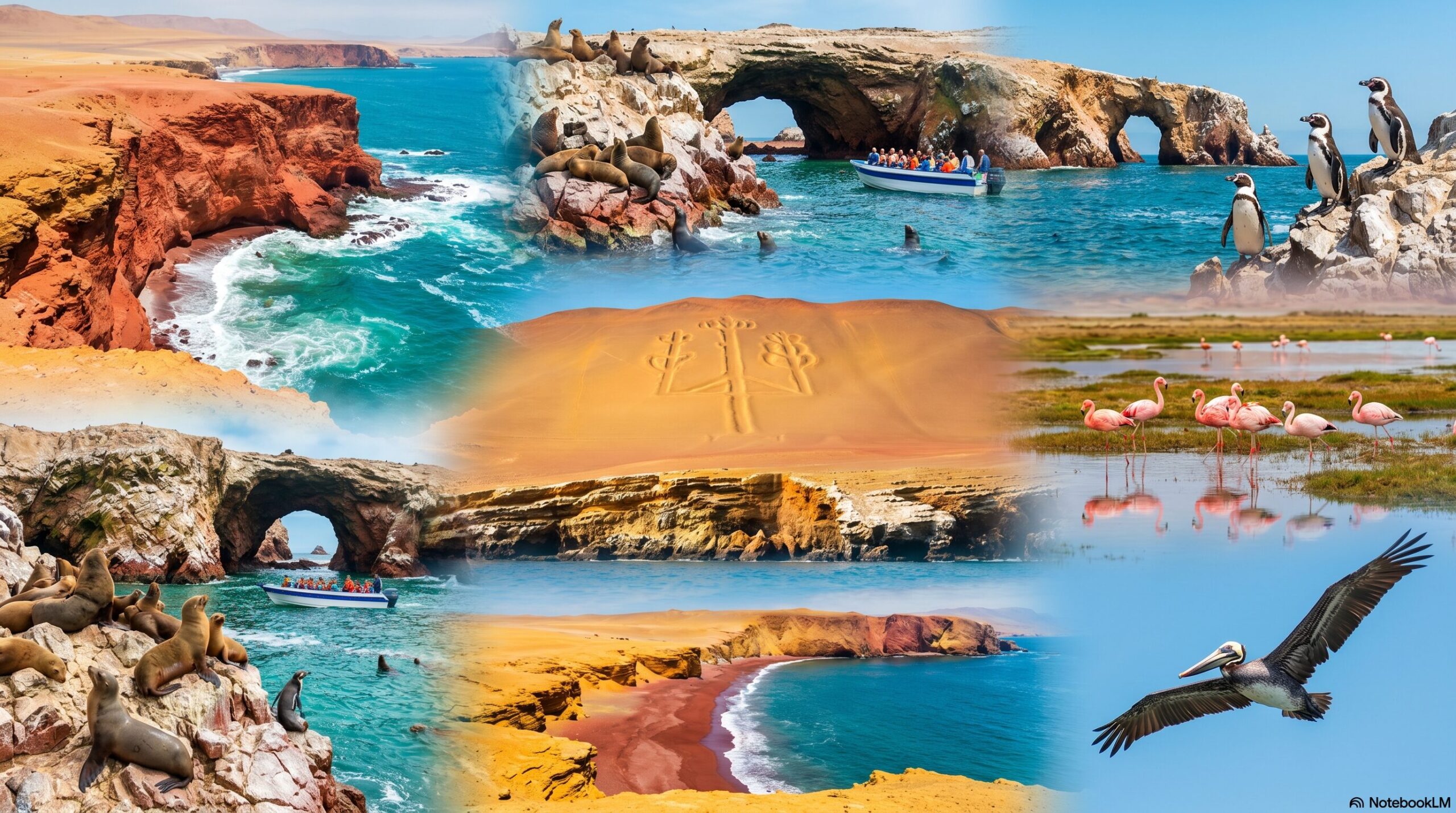
Where the desert meets the Pacific, red cliffs over turquoise waters, thousands of penguins, sea lions and dolphins at the Ballestas Islands. Peru's Galápagos, just 4 hours from Lima.
Where the world's most arid coastal desert plunges into the Pacific in 200-meter cliffs, that is Paracas. A turquoise bay sheltered by a reddish headland, flanked by the Paracas National Reserve (335,000 hectares) and the Ballestas Islands, the most impressive marine wildlife refuge in South America.
The Ballestas Islands are home to thousands of Humboldt penguins, sea lions, dolphins and 180 species of seabirds on islands that cannot be set foot on, only circled by boat, just meters from colonies of wild animals that have never been tamed. A wildlife experience that competes directly with the Galápagos Islands.
The town of Paracas is a booming coastal resort, boutique hotels facing the sea, seafood restaurants right on the beach and the best base for exploring both the reserve and the vineyards of Ica and the Nazca Lines. The fastest-growing tourism hub in southern Peru.
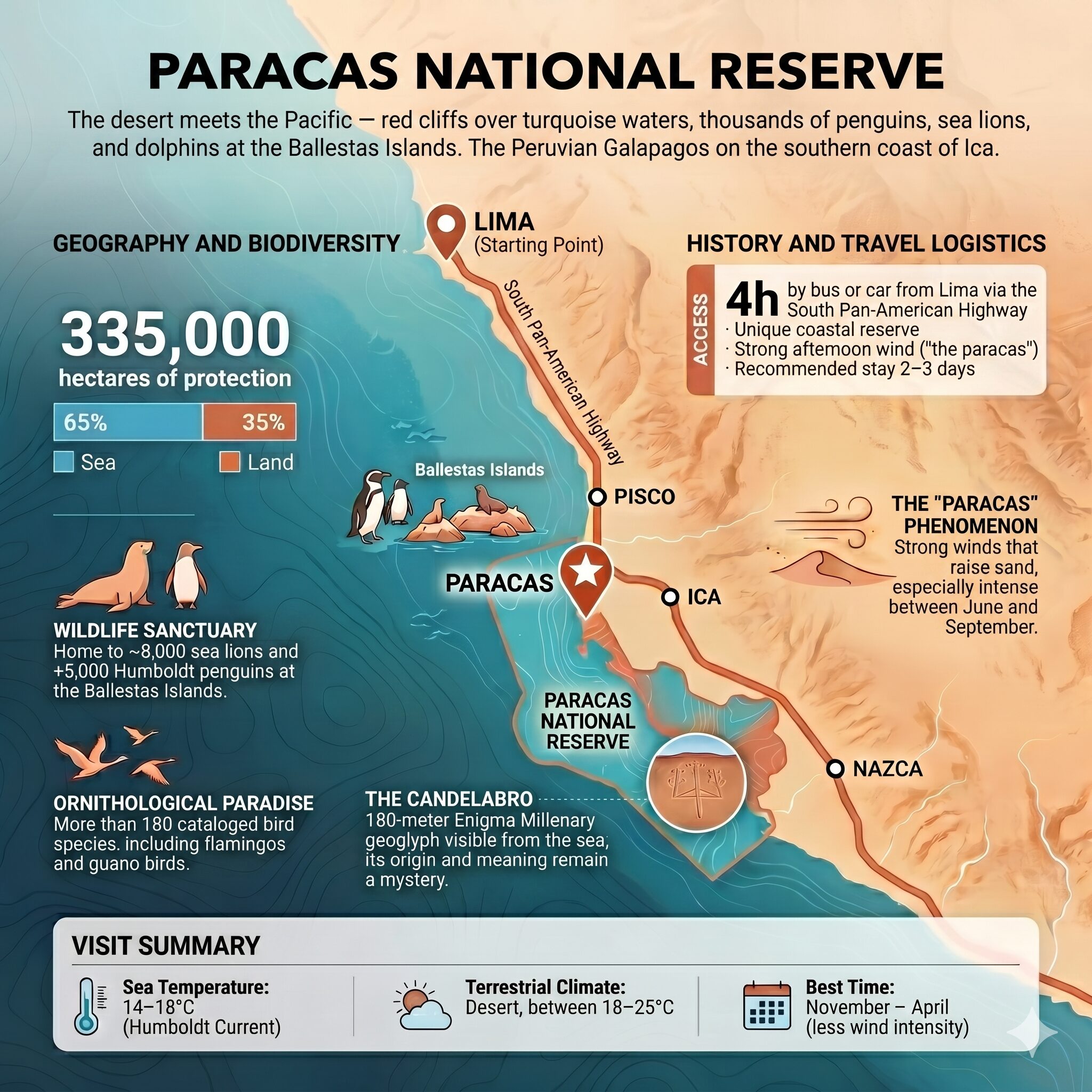
Paracas is the point where the Sechura Desert, the driest in South America, plunges into the Pacific. The Humboldt Current brings cold, nutrient-rich waters that sustain one of the most productive marine ecosystems on the planet.
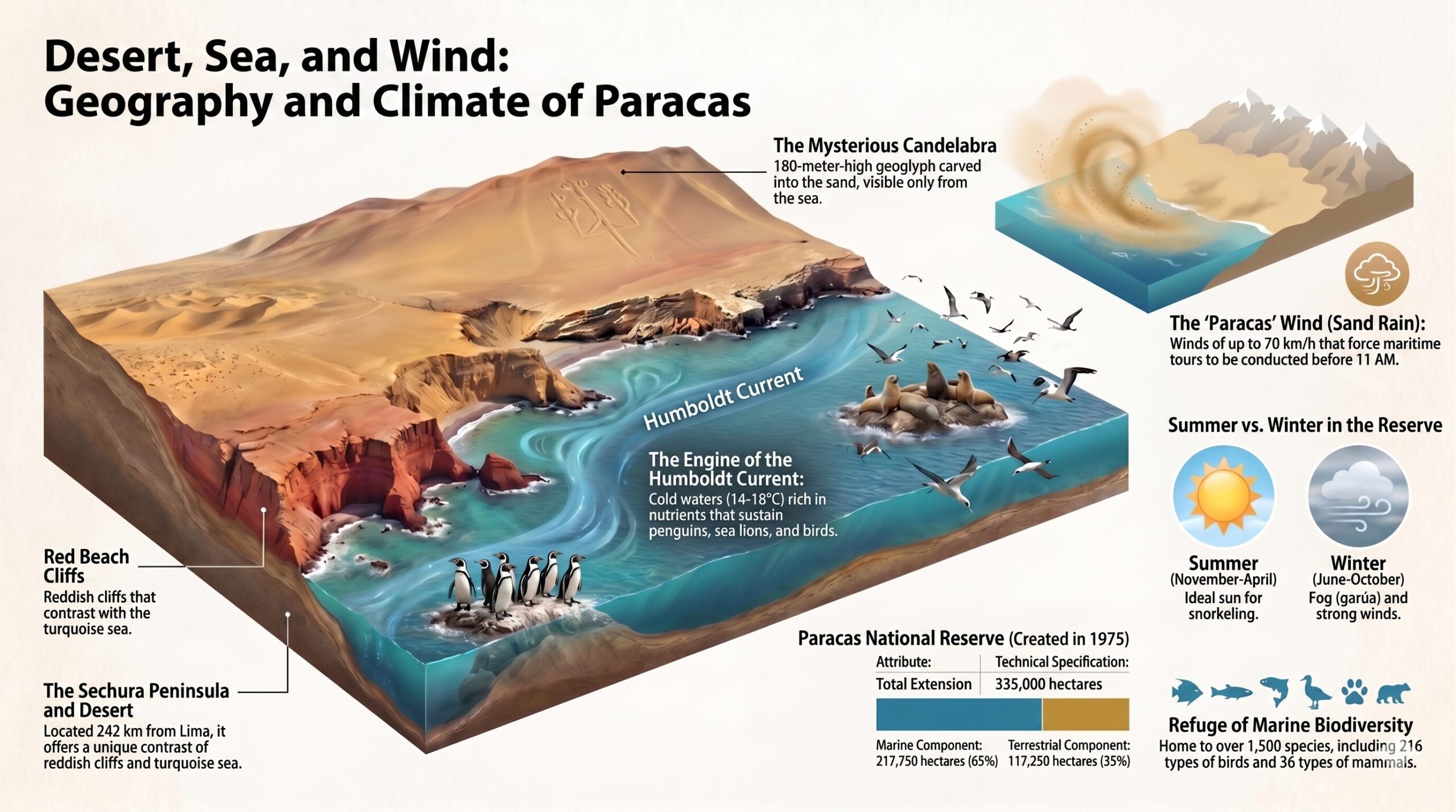
Desert peninsula · 242 km south of Lima
The Paracas Peninsula is a strip of desert land jutting into the Pacific, creating a sheltered bay of crystal-clear waters where the resort town sits. The visual contrast between the reddish cliffs (oxidised iron), the golden desert and the turquoise Pacific is unique in the world.
The engine of marine biodiversity
The Humboldt Current, cold Antarctic water rising along the Pacific, carries nutrients that feed phytoplankton, which in turn nourishes krill, fish and colonies of sea lions, penguins and seabirds. Without Humboldt there would be no Ballestas Islands and no reserve. It is also why the Peruvian Pacific sits at just 14–18°C even in summer.
The phenomenon that names the region
"Paracas" means "rain of sand" in Quechua, afternoons bring strong, warm winds that lift sand from the desert. Boat tours to the Ballestas Islands always depart in the morning (before 11 AM) to avoid the afternoon wind. Plan your activities accordingly: mornings for the sea, afternoons for the viewpoints.
November – April (Peruvian summer)
The coastal summer (November to April) has less wind and more intense sunshine, ideal for beaches and snorkelling. Winter (June to October) brings the garúa, coastal mist that covers the sky but rarely produces rain. For wildlife watching at the Ballestas, any season is good, the animals are present year-round.
Established in 1975, the Paracas National Reserve is Peru's only protected marine and coastal area. It protects 35% of its total area as sea, a zone of ancestral artisanal fishing and the habitat of the largest colonies of Humboldt penguins, sea lions and pink flamingos on the Peruvian coastline. The Ballestas Islands are the highest wildlife concentration area within the reserve.
Paracas gave its name to one of the most refined cultures of ancient Peru, the very people who created the most sophisticated textiles in the pre-Columbian world and carved the Candelabro geoglyph into the coastal cliff.
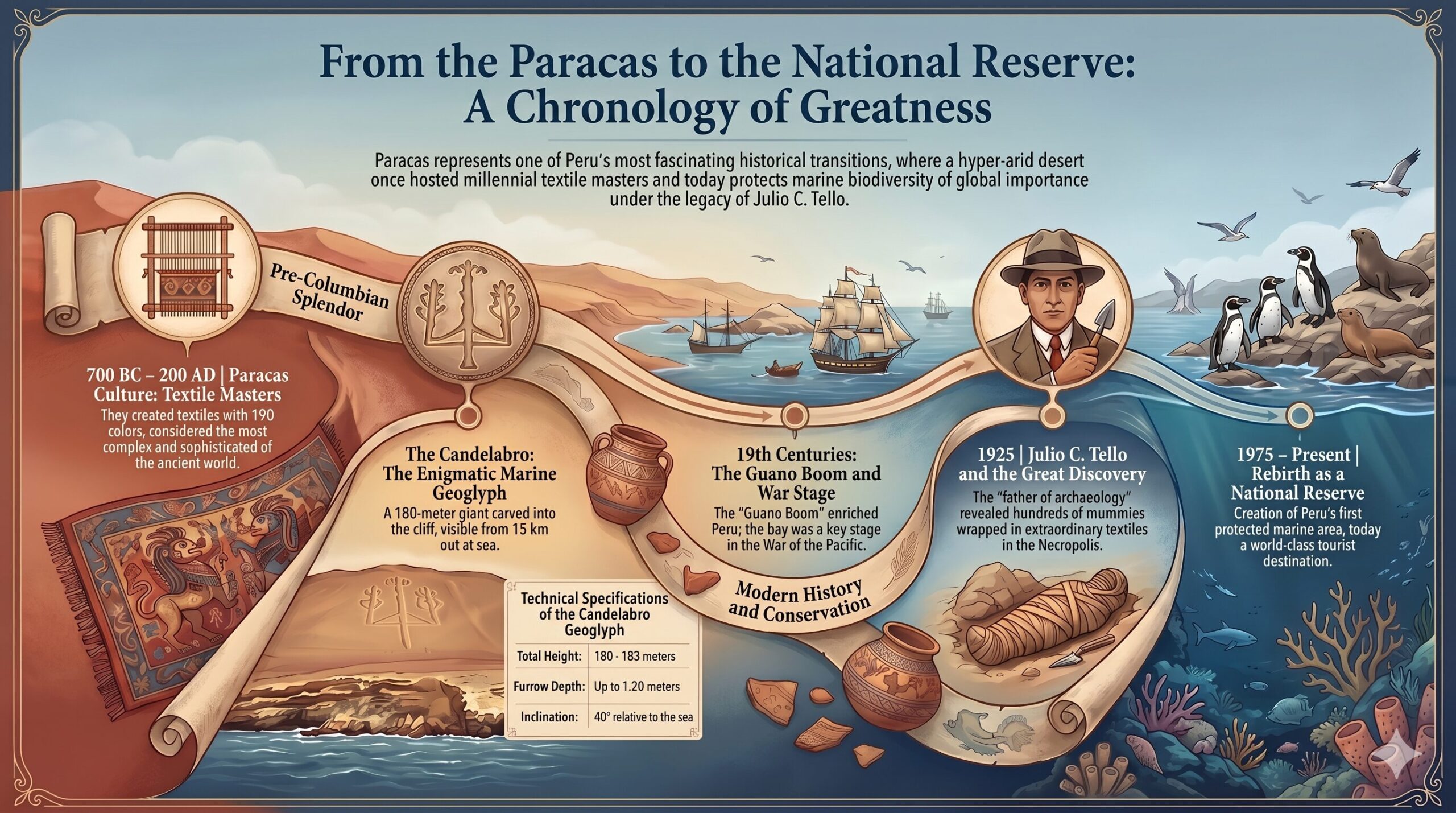
The Paracas culture (700 BC – 200 AD) was discovered by archaeologist Julio C. Tello in 1925 when he found the famous Paracas Necropolis, hundreds of mummies wrapped in layers of embroidered textiles depicting serpents, felines and winged deities. The Paracas Necropolis textiles, with camelid wool threads in 190 distinct colours, are considered the most sophisticated ever created in the pre-Columbian world. Their mummies preserved the longest hair recorded in any ancient culture, up to 2.8 metres.
On the northern cliff of the Paracas Peninsula, visible from the sea at 15 km distance, there is a geoglyph 180 metres tall, the Candelabro (also known as the Trident). Its creation is attributed to the Paracas culture although its exact date is uncertain. San Pedro cactus, ceremonial candelabras and navigational instruments are the main theories about its meaning. What is extraordinary is that it was carved into a cliff that can only be seen from the sea, either to guide sailors or to be seen by the gods.
The Ballestas Islands and the Paracas coast were exploited during the 19th century as a source of guano, the seabird droppings accumulated over centuries, one of the world's richest natural fertilisers. The "Guano Boom" (1840–1879) made Peru one of the wealthiest countries in Latin America for three decades. The Chincha Islands (visible from Paracas) were the world's largest guano deposit, tonnes exported to Europe and North America to fertilise agricultural fields.
Paracas Bay was the scene of operations during the War of the Pacific (Peru-Bolivia vs. Chile). Chilean troops landed on the Ica coast and occupied the region. The end of the conflict with the Treaty of Ancón (1884) marked the beginning of a long reconstruction period that delayed the development of the southern Peruvian coast for decades.
Peruvian archaeologist Julio C. Tello (the "father of Peruvian archaeology") discovered the Paracas Necropolis in 1925, hundreds of funerary bundles containing mummies wrapped in layers of extraordinary textiles. The discovery completely transformed the understanding of pre-Columbian coastal civilisations in Peru and placed the Paracas culture among the most advanced on the continent. The textiles are preserved today at the Museum of Archaeology in Lima and the Historical Regional Museum of Ica.
The Paracas National Reserve was created in 1975 as Peru's first natural protected area with a marine zone. In 2007, the magnitude 8.0 earthquake that struck the region destroyed part of the bay and the city, including the iconic rock formation "La Catedral". The reconstruction transformed Paracas into the luxury resort it is today, with the Libertador and the DoubleTree as anchors of a high-end tourism sector growing exponentially.
Paracas today is a blend of pre-Hispanic heritage, artisanal fishing tradition and the tourism boom, a unique coastal identity on the Peruvian littoral.
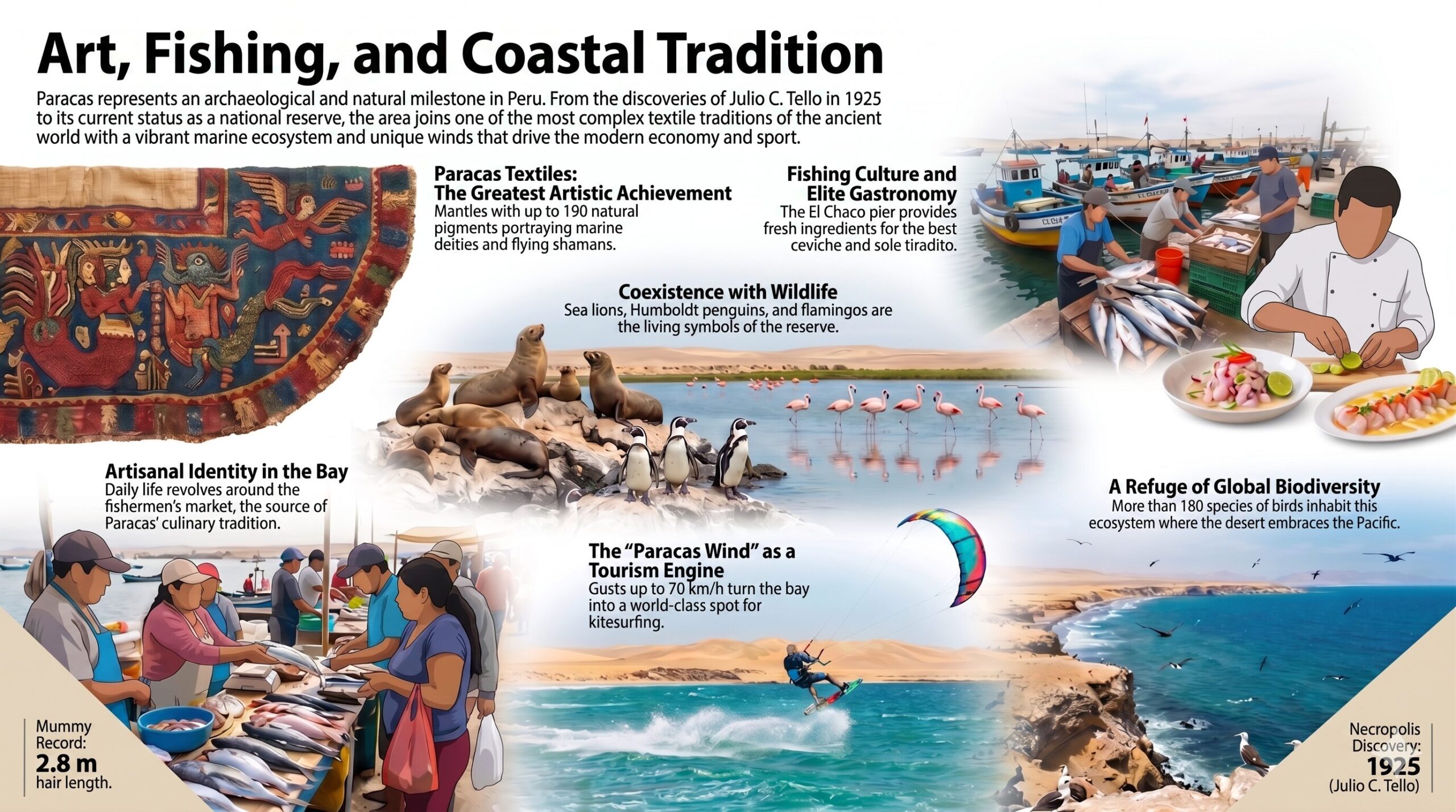
The textiles of the Paracas culture (700 BC – 200 AD) are woven from alpaca wool and cotton in up to 190 distinct colours of natural pigments. The Paracas Necropolis mantles, embroidered with flying shamans, mythological beings and marine deities, are the most refined pieces of textile art in the ancient world. Perfectly preserved by the desert climate, they are now held in museums in Lima, Ica and international collections.
Artisanal fishing is the historic economic base of Paracas, the city's pier gathers the fishermen's boats every morning bringing clams, squid, mahi-mahi and the legendary sea urchins. The fishermen's market next to the pier is the most lively and authentic spot in the bay, and the best source of the freshest ceviche in Peru.
The people of Paracas have lived alongside sea lions, flamingos and pelicans for generations. Local identity is deeply linked to the reserve's animals, the sea lion is the city's symbol, the pink flamingos at Laguna de la Máscara are part of everyday scenery, and pelicans compete with cats for fish at the market.
The Pacific off Paracas is one of the richest in the world, the Humboldt Current brings exceptional seafood. Paracas restaurants are now a national gastronomic reference: sole tiradito with pisco tiger's milk, clams à la chalaca, passion-fruit pisco sour. Paracas marine cuisine is the finest on the entire Peruvian coastline.
The "Paracas wind" that lashes the afternoons has become a tourism asset, the bay is one of the best kitesurfing and windsurfing spots on the South American Pacific coast. Kite schools have their high season between July and September when the wind is most regular and strong. A new identity that coexists with the historic fishing tradition.
Paracas celebrates marine life, pre-Hispanic heritage and the coastal identity of southern Peru, with the energy of the wind and the smell of the sea always present.
District Foundation
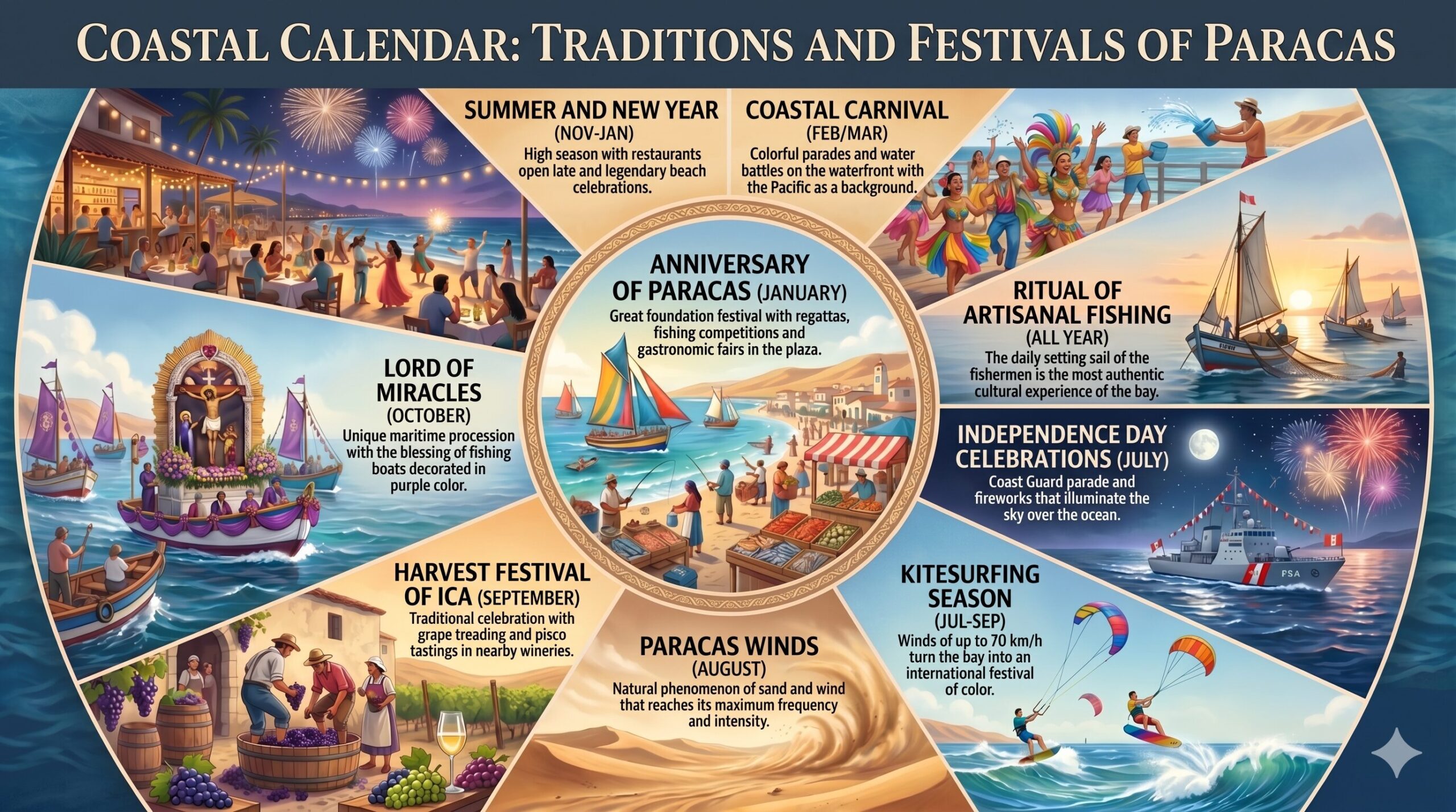
The anniversary of the Paracas district is celebrated with bay regattas, sport fishing competitions, craft exhibitions with textiles inspired by the Paracas culture and coastal food on the square. The most important event of local identity, fishermen display their skills and restaurants offer their finest dishes.
Pisco & Grape of the Region
Paracas participates in the Ica Vendimia (harvest festival), the region's most important celebration, with grape treading, election of the Harvest Queen and pisco tastings. Many visitors combine the Paracas bay with a trip to the Ica wineries (40 min by car) during the festival days.
The Paracas Wind as Festival
The characteristic Paracas wind turns the bay into a festival of colourful kitesurfers from July to September. International kite and windsurf competitions attract participants from across Latin America. Wind sport culture has fully integrated into the city's summer identity.
Coastal Procession
Devotion to the Lord of Miracles reaches the southern coast with special intensity, in Paracas the procession includes a blessing of the fishing boats at the pier, a tradition blending Catholic faith with seafarers' veneration of the sea's elements. Fishermen paint their boats purple during October.
Sea Water at Carnival
Paracas's carnival has its own flavour, water battles with the Pacific as backdrop, costume parades on the promenade, election of the Bay Carnival Queen and a week of celebration blending the coastal with the popular. The atmosphere is more relaxed than Lima's but equally colourful.
Dawn at the Pier
Paracas's most authentic tradition has no date on the calendar, every morning before dawn the fishermen set out from the pier and return between 7 and 9 AM. Witnessing the unloading of fresh fish, the haggling with buyers and watching sea lions and pelicans wait their turn is the most real cultural experience the destination offers.
28 July at Sea
National holidays in Paracas have a character of their own, artisanal boat regatta in the bay, Coast Guard parade, fireworks over the Pacific and the traditional coastal barbecue on the beach. The bay hotels organise the finest fireworks displays over the sea.
Paracas at Its Best
The Peruvian summer (November to March) is Paracas's golden season, Lima families, international tourists and a festive energy that transforms the quiet coastal city. Restaurants stay open late, tours multiply and the bay fills with boats. The New Year's celebration on the beach is legendary.
With the world's richest Pacific right at its doorstep, Paracas has Peru's finest seafood, sole, sea urchins, razor clams, mussels, squid and the freshest ceviche imaginable, marinated with local pisco.
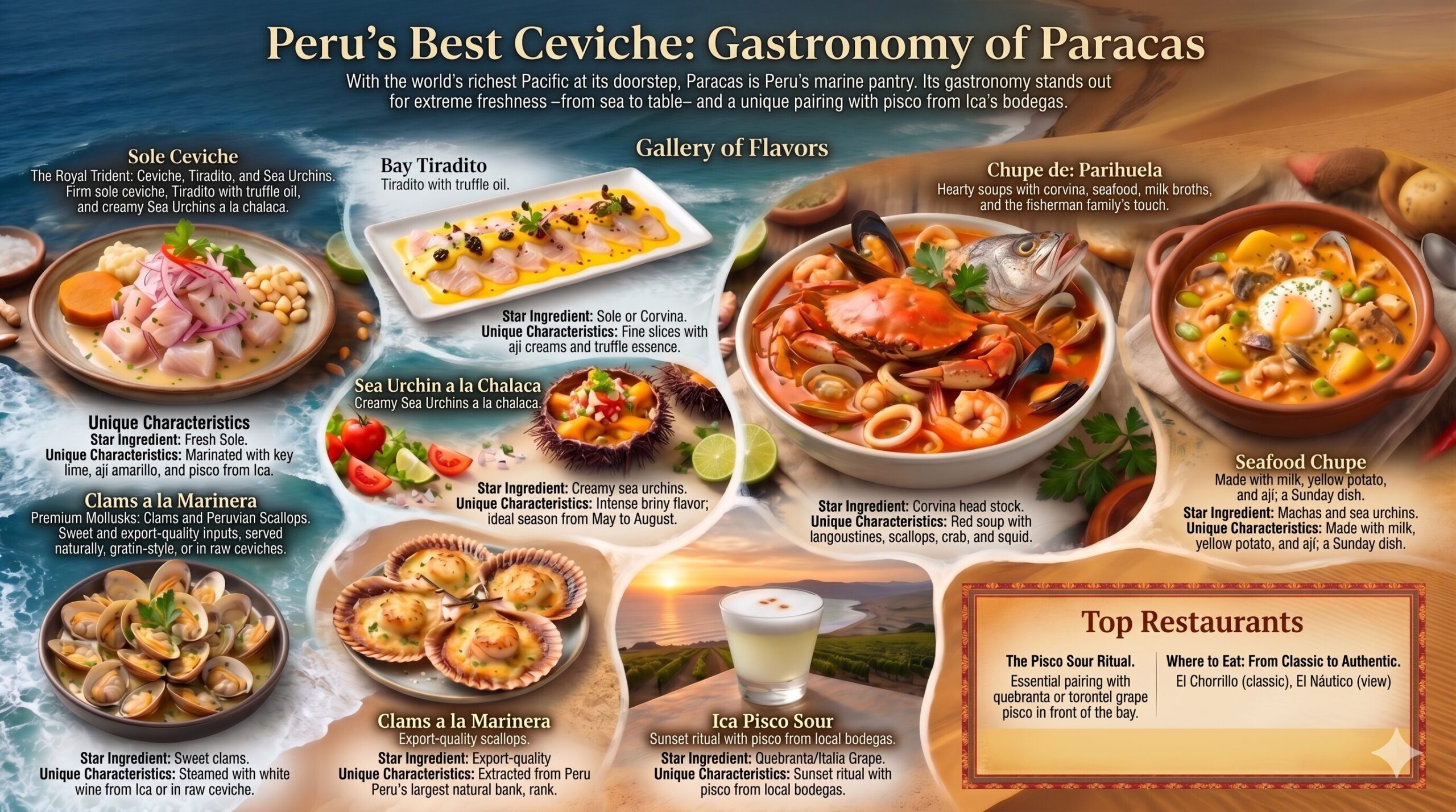
Paracas Pacific sole is the king of ceviche, firm, delicately flavoured, marinated with acidic coastal lime, fresh ají amarillo chilli and a touch of Ica pisco in the tiger's milk. Eating it facing the sea at one of the promenade restaurants is the most complete gastronomic experience on the Peruvian coast.
Peru's freshest cevicheThe tiradito, thin slices of fish bathed in tiger's milk without onion, is in Paracas a work of precision: sole or sea bass in 3 mm slices, with ají amarillo cream, rocoto chilli and a drop of truffle oil. The bay's restaurants compete for the best tiradito on the southern coast.
Marine RefinementThe sea urchins of the Paracas Pacific are the finest in Peru, large, creamy, intensely briny. Served à la chalaca (with red onion, tomato, lime and chilli) directly in the black shell. Only available during fishing season (May to August). A unique marine luxury.
Season May–AugThe clams from Paracas's beaches, small, sweet, tasting of clean sea, are prepared steamed with Ica white wine, garlic and parsley, or raw in ceviche with lime. The broth left behind is the finest seafood soup on the Peruvian coast. The fishermen's market stalls serve them from 8 AM.
Steamed or rawJust 40 minutes from Peru's finest pisco wineries, the pisco sour in Paracas uses quebranta, torontel or Italia grape pisco directly from local wineries, a quality Lima bars rarely match. A pisco sour at sunset facing the bay is the destination's most popular ritual.
Sunset EssentialThe parihuela, Peru's most hearty seafood soup, reaches its peak in Paracas: sea bass head, prawns, scallops, clams, crab and squid in a red broth of panca chilli, mirasol chilli and white chicha. The most sustaining and comforting dish in the entire Peruvian marine cuisine.
The most sustainingParacas bay is Peru's largest natural scallop (concha de abanico) bank, a delicate, sweet mollusc served raw with lime, gratinéed in the oven or in seafood ceviches. Paracas scallops are exported to the finest restaurants in Europe and Asia, eating them here, straight from the sea, is a privilege.
Export ProductParacas's seafood chupe (chowder) combines the coastal criolla tradition with the most generous Pacific ingredients, prawns, razor clams, sea urchins, mussels, milk, yellow potato and ají amarillo in a dense, deep-orange cream. The Sunday dish of fishing families who have lived in the bay for five generations.
Family TraditionThe Paracas promenade (malecón) concentrates the southern coast's finest seafood restaurants. El Chorrillo is the bay classic, a specialist in sole ceviche and scallops for decades. El Náutico and La Muelle offer the best view of the bay. For cheap and authentic eating, the fishermen's market opens from 7 AM to 1 PM with the day's finest ceviches served in plastic bowls at the pier, the most honest Paracas experience.
The Ballestas Islands are the main draw, but the National Reserve hides red-rock beaches, unique rock formations and the mysterious Candelabro geoglyph, a destination that blends nature, history and beauty within just a few square kilometres.
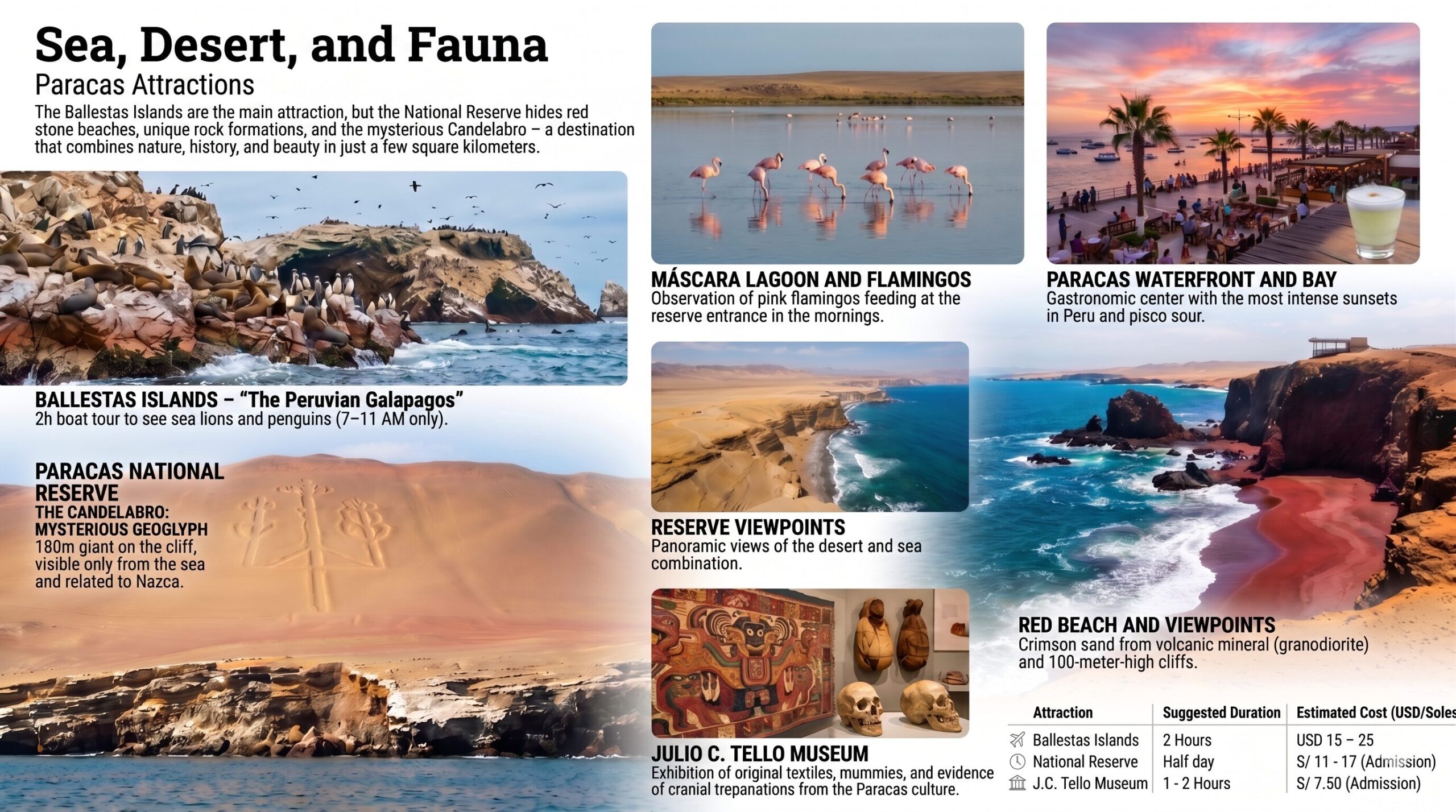
Thousands of sea lions, Humboldt penguins, Peruvian boobies, pelicans and dolphins just metres from the boat. The islands cannot be stepped on but are circled by speedboat, a wildlife experience that rivals any nature destination in the world.
335,000 hectares of coastal desert with Peru's most spectacular cliffs, Playa Roja (crimson sand from volcanic minerals), Bahía Lagunillas and viewpoints overlooking the Pacific. Tour by car or buggy across the desert pampa beside the sea.
A 180-metre geoglyph carved into the northern cliff of the peninsula, only visible from the sea. The boat to the Ballestas Islands passes right in front of it. Its origin and meaning are as mysterious as the Nazca Lines.
A beach of deep-red sand and pebbles, the volcanic mineral that stains the rocks creates an otherworldly landscape. Not suitable for swimming (strong surf) but the reserve's most photographed beach. Best at sunset when the sun intensifies the red.
A saltwater lagoon at the reserve entrance where dozens of pink flamingos (parihuanas) feed on algae. The name "Paracas" is linked to these birds, and they have been the reserve's symbol since its founding.
Paracas's malecón, with boutique hotels, restaurants and the tour-boat pier, offers Peru's most intense sunsets. Sea lions rest beneath the pier. Watching the sunset from the promenade with a pisco sour in hand is the perfect end to any day in Paracas.
The Mirador de los Flamencos and the Mirador de Los Lobos offer panoramic views of the Pacific from 100-metre cliffs, red desert to the left, turquoise sea to the right. Accessible by car, bike or buggy from the town.
The on-site museum inside the reserve displays the archaeological finds of the Paracas culture, original textiles, mummies, ceramics and the story of how Tello discovered the necropolis in 1925. The cultural context that completes a visit to the natural reserve.
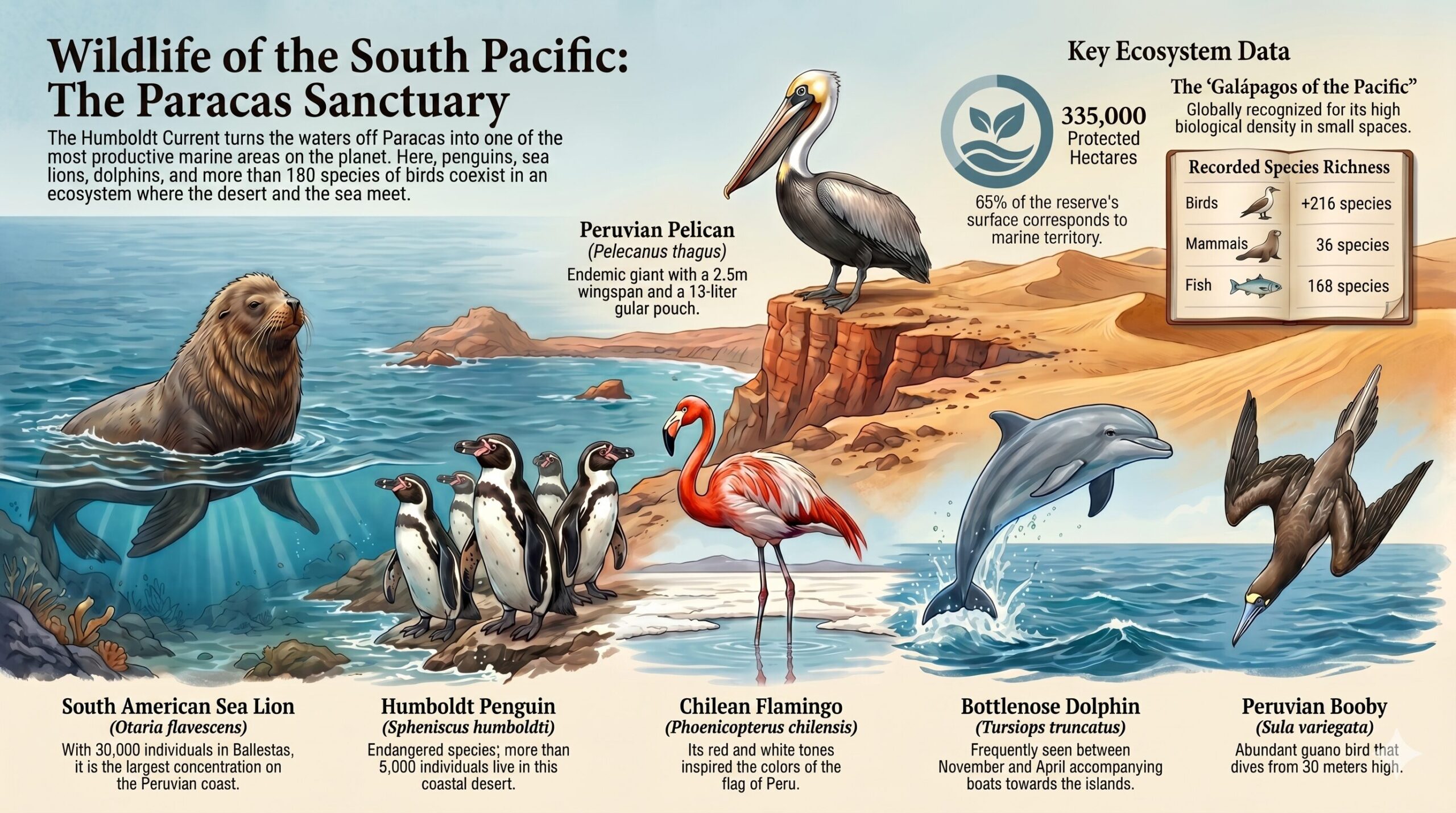
The Humboldt Current turns the waters off Paracas into one of the planet's most productive marine zones, penguins, sea lions, dolphins and more than 180 bird species all coexist within just a few kilometres.
Otaria flavescens
The Ballestas Islands colony exceeds 8,000 individuals, the largest concentration of sea lions on the Peruvian coastline. Alpha males can weigh 300 kg. You see them resting on rocks, swimming alongside the boats and competing for fresh fish at the Paracas pier every morning. The most charismatic and noisiest animals in the reserve.
Spheniscus humboldti, Endangered
More than 5,000 penguins nest in the caves and crevices of the Ballestas Islands, one of the largest breeding colonies of this endangered species. Unlike Antarctic penguins, these live in an arid coastal desert, feed on cold anchovies from the Humboldt Current and nest in centuries of accumulated guano. Seeing them is one of the main reasons to fly to Lima and take the bus to Paracas.
Phoenicopterus chilensis
Laguna de la Máscara at the entrance to the reserve shelters dozens of pink flamingos filtering algae with their inverted bill. The flamingos, called *parihuanas* in Quechua, have been the symbol of the reserve's coat of arms since its founding in 1975. Early mornings are the best time to see them.
Pelecanus thagus
The largest and most spectacular bird on the Peruvian coast, with a wingspan of up to 2.5 metres and a gular pouch that can hold up to 13 litres of water. Pelicans form clouds over the Ballestas Islands and actively compete with the cats at the fishermen's market for the day's catch. Endemic to the southern Pacific coast, it only exists here.
Tursiops truncatus
Groups of dolphins regularly accompany tourist boats heading to the Ballestas Islands, surfing the bow waves in the open bay stretch. Common dolphins (*Delphinus delphis*) are also spotted, and occasionally orca (*Orcinus orca*) during migration. Sighting is not guaranteed but is frequent during the summer months.
Sula variegata · Endemic
The Peruvian booby, the white-chested booby, is the most abundant bird on the Ballestas Islands alongside the guanay cormorant. Thousands nest on the rocks, dive from 30 metres to catch anchovies and produce the guano that made 19th-century Peru wealthy. Endemic to the Humboldt Current, it only exists on the coasts of Peru and Chile.
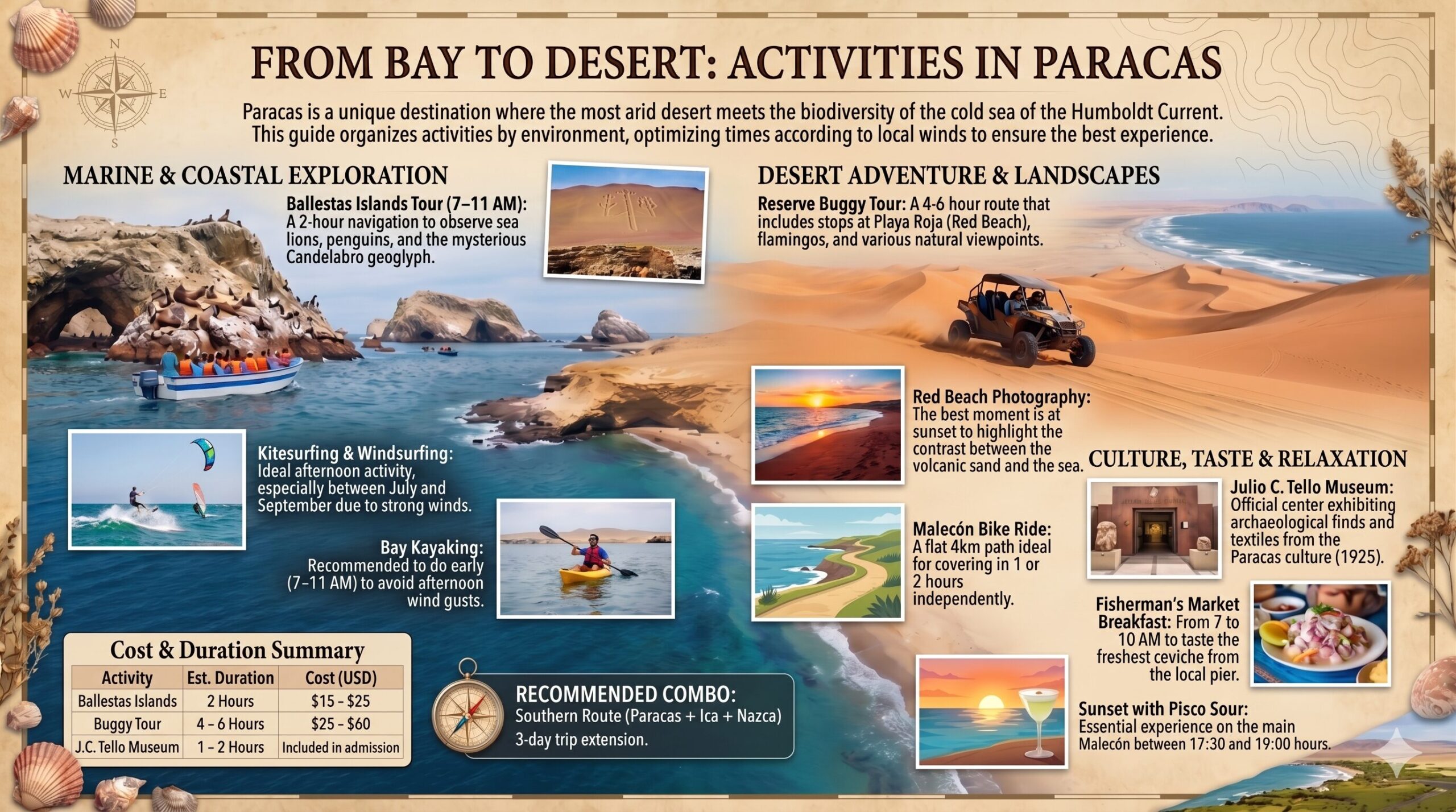
Paracas packs the best of sea, desert and wildlife into a 30-km radius, dawn boat tour, buggy through the reserve at midday, and a pisco sour sunset on the promenade. There is no time for boredom.
Paracas's essential classic, 2 hours by speedboat circling the islands among thousands of sea lions, penguins, pelicans and boobies. The boat passes in front of the Candelabro. Only available in the mornings (7–11 AM) before the afternoon wind raises the swell. Book ahead during high season.
Buggy or 4x4 ride across the desert plains of the National Reserve, Playa Roja, Flamingo Lagoon, Sea Lion Lookout, Lagunillas Bay. The most comfortable way to explore the 335,000-hectare interior without walking kilometres under the desert sun.
With binoculars from the promenade or the reserve's viewpoints, flamingos at Laguna de la Máscara at dawn, sea lions beneath the pier, pelicans gliding over the bay. The best wildlife photography session without needing a boat or a guide.
The afternoon wind transforms the bay into one of the best kite spots on the South American Pacific coast. Schools offer lessons for beginners and equipment rental. Peak season: July–September. For the experienced, Paracas wind is consistent, predictable and powerful. A world-class experience.
Playa Roja, volcanic crimson sand beside turquoise Pacific, is the most photogenic location in the entire reserve. Best at sunset when the raking light intensifies the red of the rocks. Not suitable for swimming (strong surf) but perfect for photo sessions with one of the most unique colour palettes on the Peruvian coast.
The on-site museum inside the reserve, original Paracas textiles, Necropolis mummies, ceramics and the story of the 1925 discovery. Archaeological context that transforms a visit to the natural reserve into a complete cultural experience. 22 km from town, included with the reserve entry.
The Paracas malecón can be explored by hired bicycle, from the fishermen's pier to the boutique hotels at the southern end of the bay. A flat 4-km route with Pacific views and tourist boats. Early mornings, before the wind picks up, the atmosphere is especially calm and the light perfect for photographing the bay.
Between 7 and 9 AM fishermen unload the morning's catch at the pier, squid, clams, sea urchins, sole. The market stalls serve breakfast ceviche with the freshest fish in all of Peru. Sea lions and pelicans wait for scraps just metres from the tables. The most authentic and affordable gastronomic experience in Paracas.
On calm mornings before the wind rises, Paracas Bay offers quiet waters perfect for kayaking, circling the fishing boats, exploring the rocky shoreline and spotting sea lions from water level. Some operators offer transparent glass-bottom kayaks to see marine life below. Book at least a day in advance.
45 minutes from Paracas, the Ica wineries produce Peru's finest pisco and wine. A half-day tour combining the coastal reserve with an afternoon in the country's pisco heartland, tastings of quebranta, Italia and albilla grape piscos, plus Peruvian wine from Tacama or Viña Ocucaje. A perfect complement to a day at sea.
The obligatory Paracas ritual, sitting on a promenade terrace with a passion-fruit or lime pisco sour as the sun drops over the Pacific, turning the bay orange and pink. The Libertador hotel and the seafront restaurants have the best views. The desert's clear sky produces Peru's most intense sunsets.
The perfect Southern Route, Day 1: Ballestas tour + reserve in Paracas. Day 2: Huacachina oasis + sandboarding in Ica. Day 3: Nazca Lines overflight. Three destinations that complement each other perfectly, forming Peru's most complete southern coast itinerary without a domestic flight.
Paracas is an easy destination, no flight, no altitude, no logistical headaches. Bus from Lima in 4 hours and in 24 hours you can see everything. Here is all you need to make the visit go perfectly.
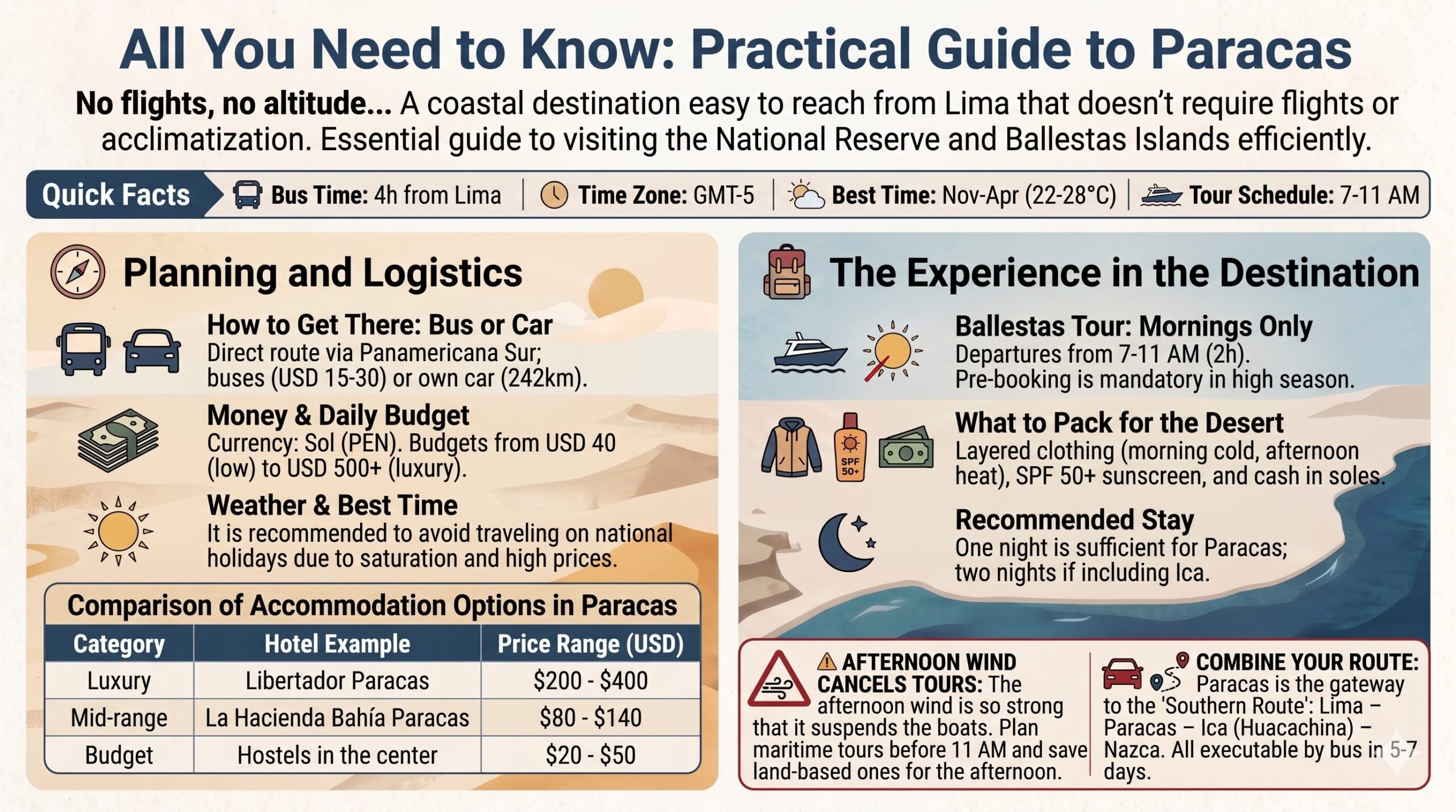
In Paracas the afternoon wind is strong enough to suspend boat tours and beach activities. Always plan maritime tours in the morning (before 11 AM) and save land-based and promenade activities for the afternoon.
Paracas is the perfect entry point to the Southern Route, Lima → Paracas (Ballestas) → Ica (Huacachina + pisco wineries) → Nazca (Lines overflight) → Arequipa. All by bus, no flight needed, in 5–7 days.