


An emerald lake surrounded by the tallest dunes in the Americas, in the heart of the Ica desert, where sandboarding and golden sunsets create impossible postcards.
Huacachina is one of the most iconic images in South America, an emerald-green lagoon, ringed by palm trees and white stucco hotels, enclosed within 100-metre sand dunes that look like golden mountains. Just 5 km from the city of Ica, in the heart of Peru's coastal desert.
The oasis exists thanks to groundwater filtering down from the Andes through the desert, the same system that fed the puquios of the Nazca culture 150 km to the south. The lagoon is shrinking due to urban growth and agricultural groundwater extraction, but it remains the most photographed destination in southern Peru and the Latin American capital of sandboarding.
The appeal is simple and powerful: in the morning, buggy tour across the dunes with sandboarding from the top (adrenaline guaranteed). In the afternoon, pisco sour on the terraces overlooking the lake and the orange-tinged dunes. At night, desert stars over the oasis. A 1–2 night destination that pairs perfectly with Paracas (to the north) and Nazca (to the south).
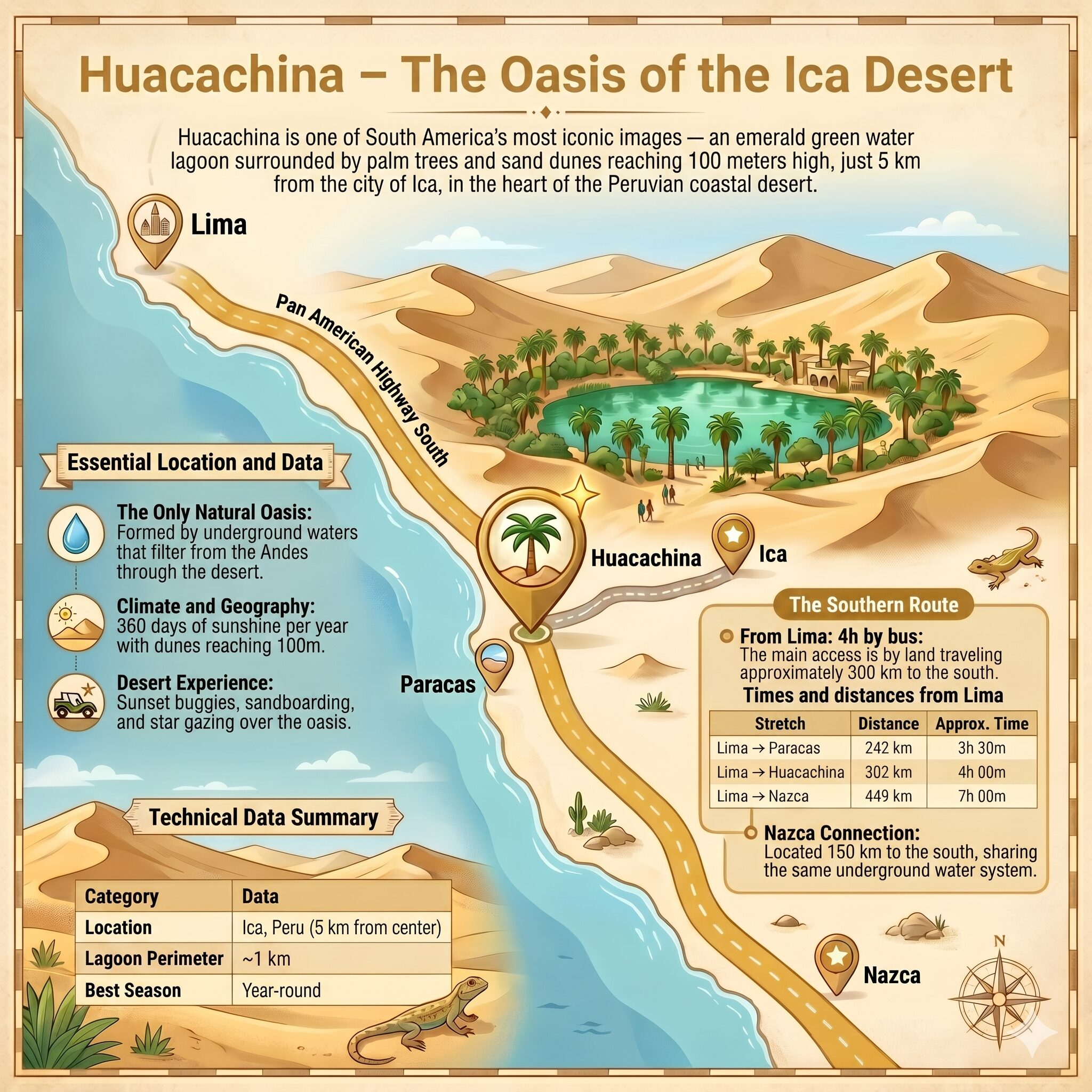
| Location | Ica, Peru, 5 km from the centre |
| Dunes | Up to 100 m high |
| Lagoon | ~1 km perimeter |
| Temperature | 18–30°C (year-round) |
| Climate | Desert, 360 sunny days/year |
| Best time | Year-round |
| From Lima | 4h by bus |
| Southern Route | Lima → Paracas → Ica → Nazca |
A geographical miracle, a natural oasis in the world's driest coastal desert, where Andean groundwater surfaces between 100-metre dunes creating one of the most surreal landscapes on the planet.
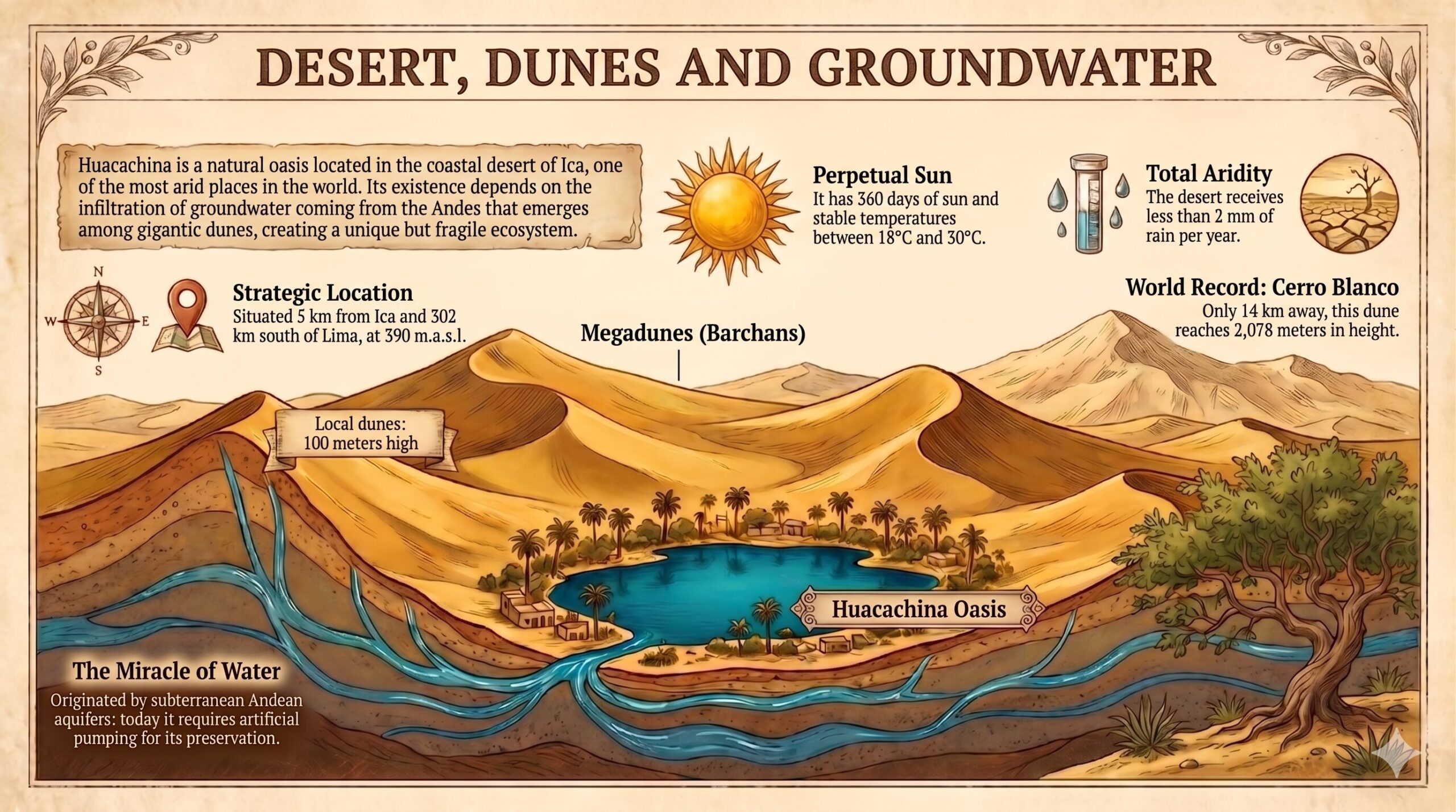
Huacachina is 5 km from the centre of Ica and 302 km south of Lima. It sits at 390 metres above sea level on the coastal plain of the Ica desert, between the Andean cordillera to the east and the Pacific to the west. The city of Ica (400,000 inhabitants) is the regional capital and gateway. The nearest airport with commercial flights is Lima (4h by bus).
The Ica desert is one of the most arid in the world, less than 2 mm of rain per year and virtually 360 days of sunshine. The Humboldt Current cools the Pacific and prevents cloud formation. The result: 18–30°C year-round, guaranteed blue skies and perfect conditions for sandboarding and buggying. There is no bad time to visit.
The Huacachina lagoon exists thanks to underground aquifers filtering from the Andes to the coastal desert. Water used to surface naturally forming the oasis. Today, agricultural and industrial water extraction in Ica has significantly reduced the lagoon's level, the water currently visible is partly pumped artificially to maintain the oasis. An active environmental debate.
The dunes surrounding Huacachina are barchan megadunes, created by Pacific winds over millions of years. They reach up to 100 metres in height and extend for tens of kilometres. They are the tallest dunes in South America. The most famous sandboarding dune (Cerro Blanco, 14 km away) reaches 2,078 metres, the tallest dune in the world. The sand is fine, pale and perfect for sliding.
The oasis is the central link of Peru's most popular southern coast route:
0 km · Starting point
4h by bus along the Panamericana Sur
242 km · Ballestas
1.5h to Ica
302 km · The Oasis
Buggy + sandboard + wineries
449 km · Lines
2h from Ica
From sacred Nazca lagoon to Lima elite resort to world sandboarding capital, the history of Huacachina is the story of an oasis that reinvented its identity with each passing century.
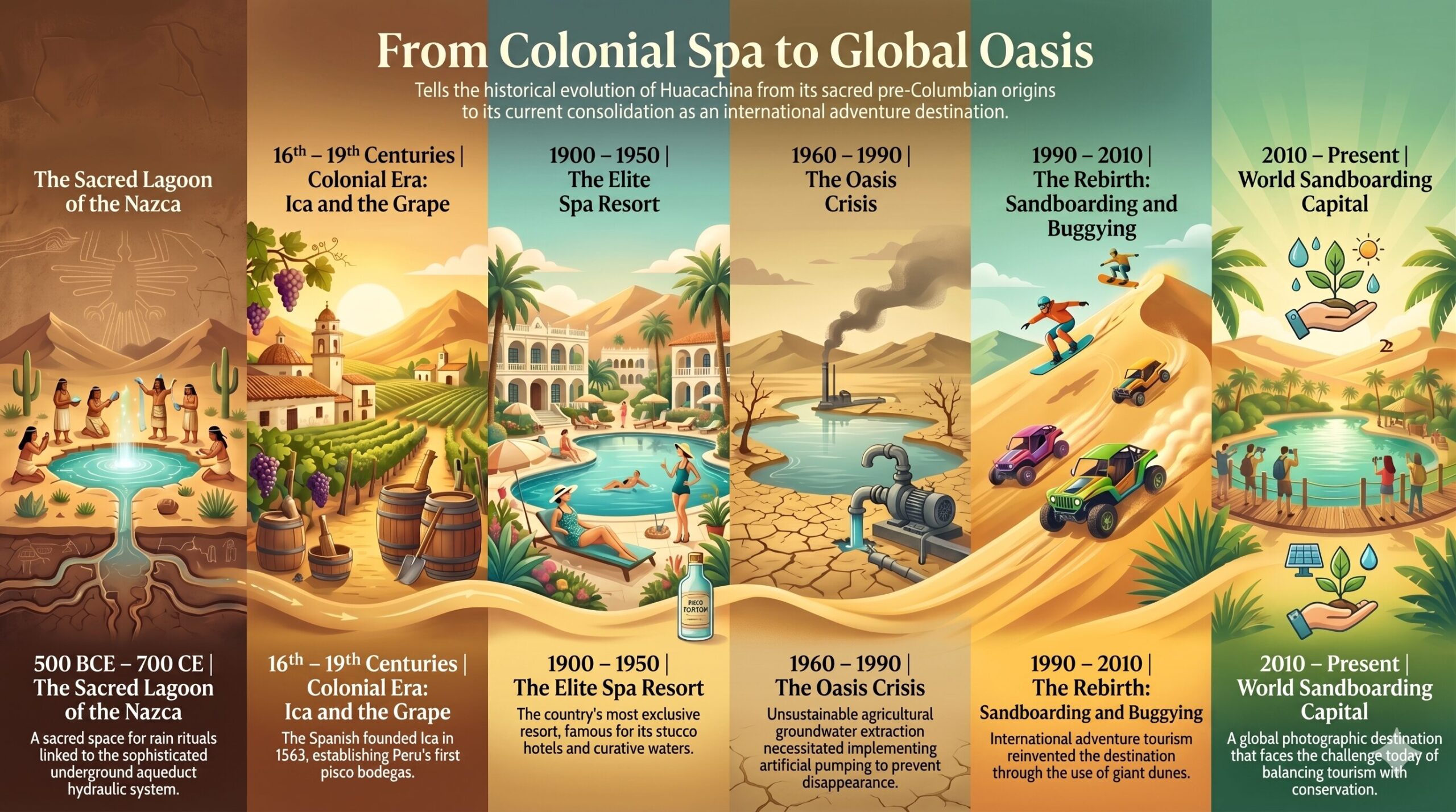
For the Nazca culture, water was the most precious resource in the desert, and the Huacachina lagoon was a sacred site associated with rain-petition rituals. The Cantalloc aqueducts 150 km away connected a hydraulic system that included the puquios (underground aquifers) drawing from the same source that feeds the lagoon. Nazca ceramics found on its banks confirm ritual use. Local legend holds that the lake was created by an Inca princess who turned into a mermaid when surprised bathing.
The Spanish conquest transformed Ica into an agricultural centre, the colonisers discovered that the Ica desert, with its underground aquifers, was perfectly suited to grape cultivation. Peru's first wineries were established in Ica during the 16th century and produced pisco, the brandy that would become Peru's national spirit. The Huacachina lagoon appears in colonial documents as a geographical reference but has no tourist significance yet.
In the early 20th century, Huacachina became Peru's most exclusive resort. Lima's elite arrived by railway to Ica and by carriage to the oasis, the white stucco hotels with palm trees built in that era (some still standing) are testament to the glamour of the time. Peru's presidents kept summer houses here. The supposed medicinal properties of the lagoon's waters (sulphates and bicarbonates) provided the excuse for European-style therapeutic baths. Huacachina was the most exclusive resort on the South American Pacific coast.
The growth of export agriculture in Ica (asparagus, grapes) and uncontrolled urban expansion began extracting the groundwater that fed the lagoon at an unsustainable rate. Between 1970 and 1990 the lagoon level dropped dramatically, from a navigable, deep lake to a lagoon requiring artificial pumping to survive. The oasis beaches became exposed, the grand hotels closed or fell into disrepair, and Huacachina temporarily lost its appeal.
International backpackers "rediscovered" Huacachina in the 1990s, not for the lagoon itself but for the giant dunes surrounding it, perfect for sandboarding. The sport, imported by Australian surfers travelling the Latin American backpacker trail, spread quickly. 4x4 buggies adapted for dune use made the experience accessible to all. By the 2000s, Huacachina had cemented itself as Peru's most iconic adrenaline and adventure destination.
Huacachina appears on "world's most photogenic places" lists and becomes one of South America's most viral destinations. Mass tourism has transformed the experience, dozens of buggy operators, hostels, restaurants and bars ring the lagoon. The current challenge is balancing tourism with oasis conservation, the regional government partially regulates water extraction and several projects seek to restore the lagoon's natural level.
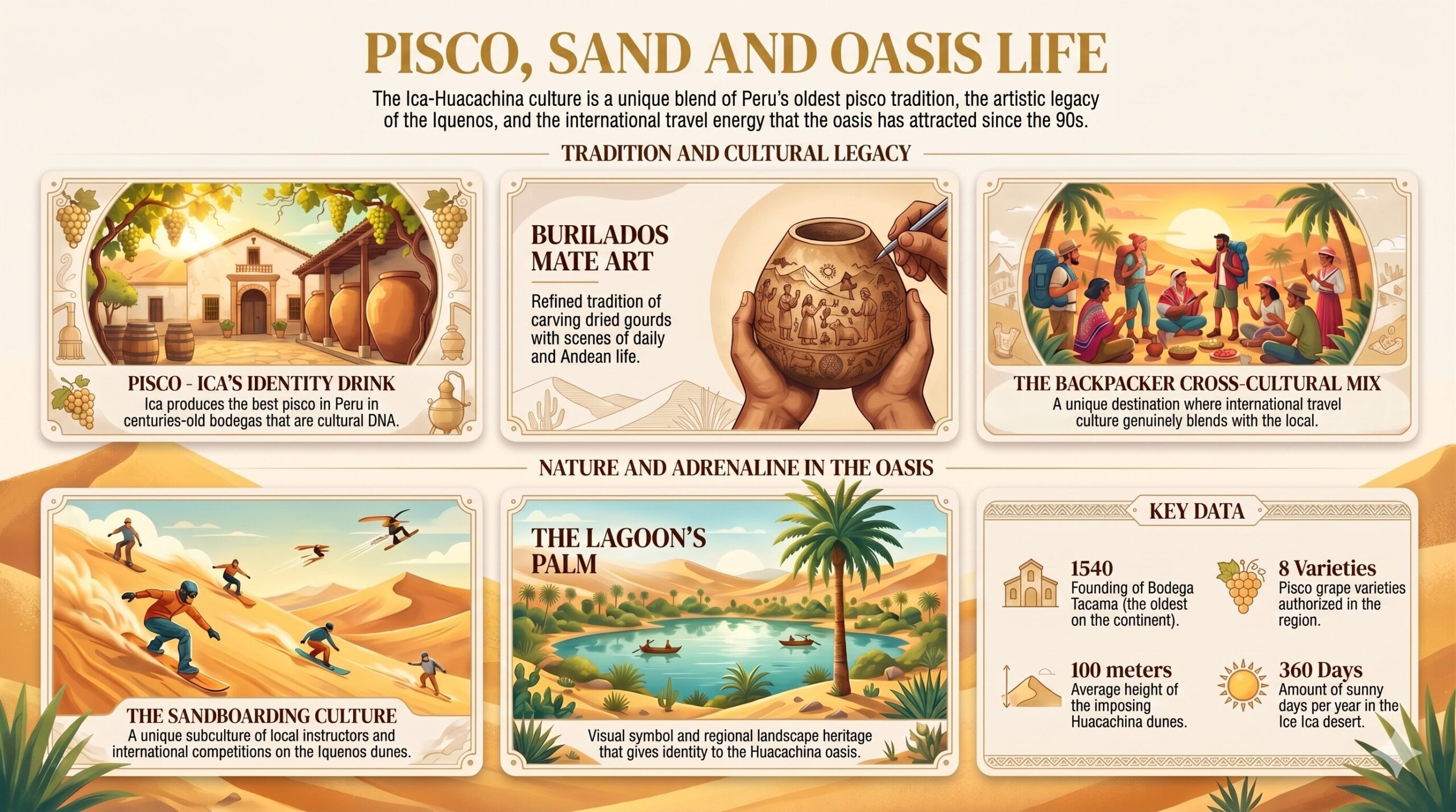
The culture of Ica-Huacachina is a unique blend of Peru's oldest pisco-making tradition, the artistic heritage of the people of Ica, and the international traveller energy the oasis has attracted since the 1990s.
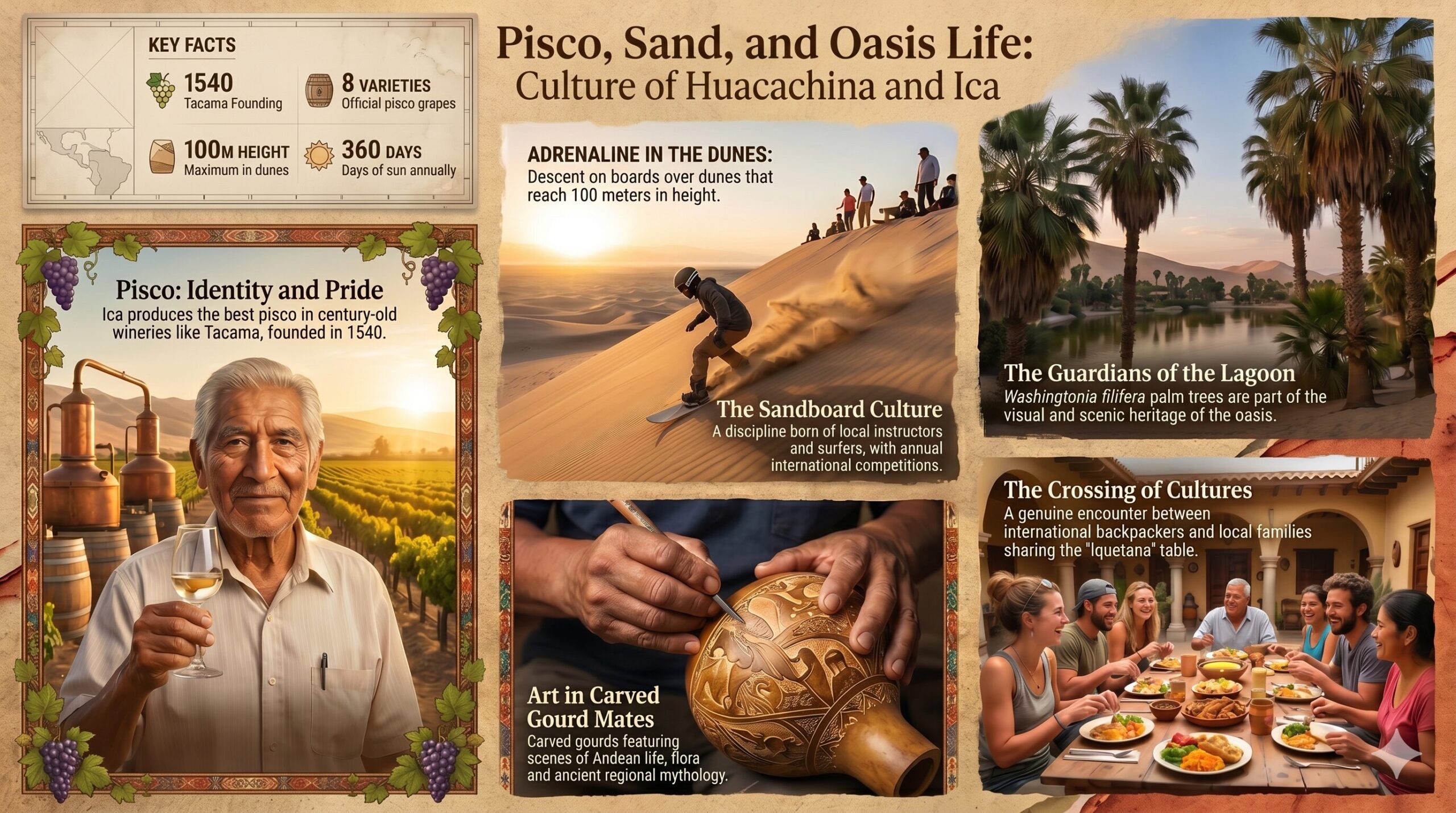
Ica produces Peru's finest pisco, the southern coast grapes, grown in the desert on groundwater, have a sugar concentration that cannot be replicated elsewhere. Centuries-old wineries like Tacama (1540, the oldest in the continent), Vista Alegre and El Catador are part of the region's cultural DNA. Pisco is not just a drink, it is identity, pride and the livelihood of thousands of Ica families.
Huacachina has created its own subculture around sandboarding and buggies, local instructors who learned from Australian surfers, annual international competitions, and an entire generation of young people from Ica who master the board on sand as well as surfers ride waves. Sandboarding in Huacachina is not a superficial tourist activity, it is a genuine cultural identity of the oasis.
The most representative craft of Ica is the mate burilado, dried gourds engraved with steel burins depicting scenes of Andean life, flora, fauna and mythology. Each gourd is unique and can take weeks to complete. Ica has one of Peru's oldest and most refined mate burilado traditions, they are sold in the Plaza de Armas of Ica and at the stalls around the Huacachina oasis.
The palm trees of Huacachina, Washingtonia filifera, the Californian desert palm introduced in the 19th century, are the visual symbol of the oasis and part of the cultural identity of the place. Locals call them "the guardians of the lagoon". They appear in every photograph, every postcard and every mural of Huacachina. The palm grove surrounding the lagoon is listed as regional landscape heritage.
Huacachina is one of the few destinations in Peru where international traveller culture genuinely mixes with local culture, the oasis hostels are meeting points between European, Australian, Israeli and Latin American backpackers who share tables with the Ica families running the restaurants. This blend has created a unique night scene around the oasis that combines Peruvian music with travellers from around the world.
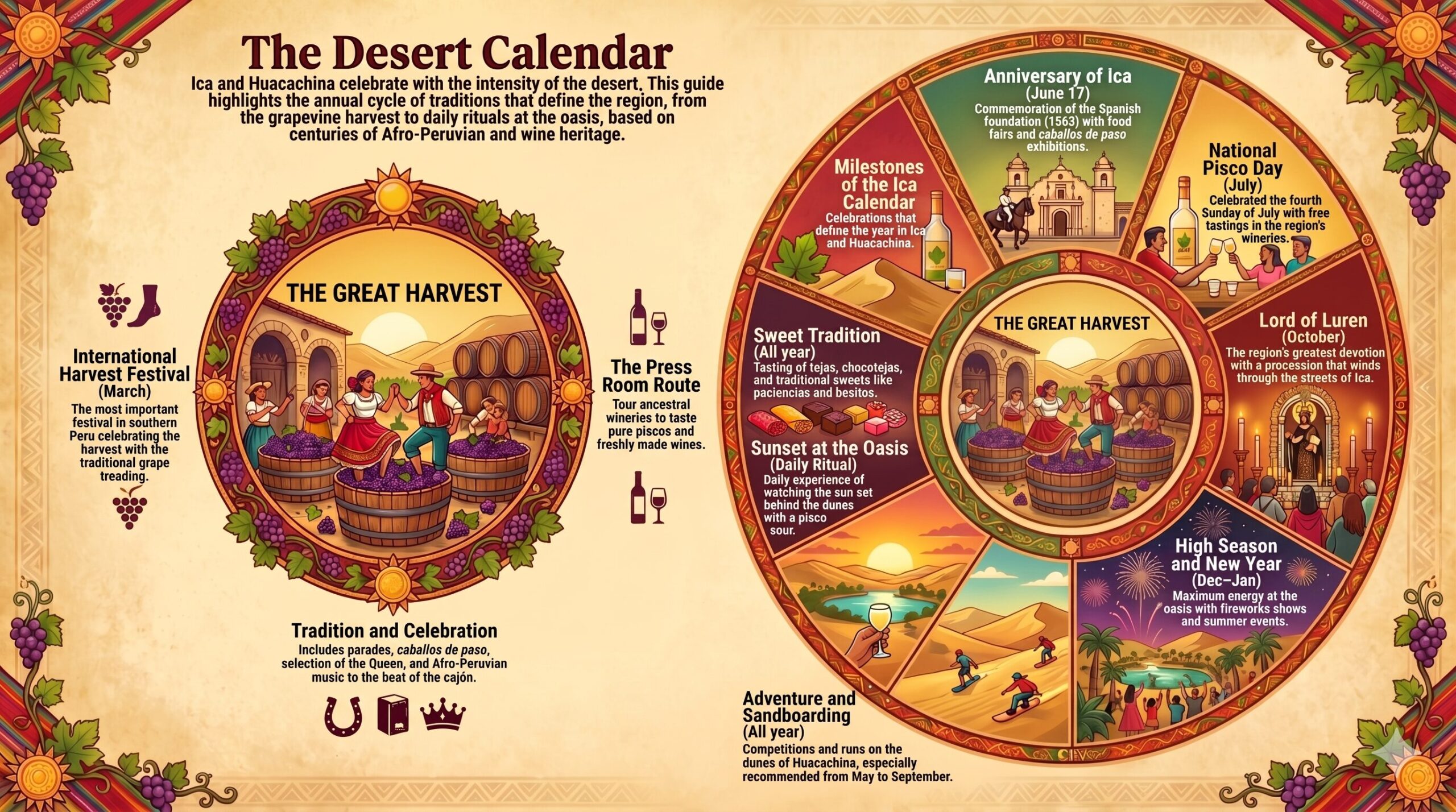
Ica and Huacachina celebrate with the intensity of the desert, Peru's largest Grape Harvest Festival, the International Sandboard Festival and the pisco celebrations that make the region the most festive on the southern coast.
The Pisco and Grape Celebration
The Ica Vendimia is the region's biggest festival and one of Peru's most important, a week of barefoot grape-treading in the lagares, election of the Harvest Queen, parades, new pisco tastings and performances by national artists. The wineries throw open their doors. December is harvest, but March is fiesta.
The Dunes World Cup
International sandboard competitions on the Huacachina dunes, downhill board, standing style and sled categories. Competitors from Argentina, Chile, Australia and Brazil. The event has put Huacachina on the world sand-sport map and attracts the southern hemisphere's finest riders.
Celebrations at the Wineries
The third Sunday of July is National Pisco Day in Peru, the Ica wineries (the country's largest producer) open with free tastings, cupping workshops, best Pisco Sour competitions and tours of the copper stills. The most authentic and participatory celebration of Peru's pisco tradition.
The South's Most Intense Devotion
The Señor de Luren, patron of Ica, has one of Peru's longest processions, up to 18 continuous hours of night-time procession on the Third Monday of October. Thousands of pilgrims from all along the southern coast come to Ica for this occasion. The popular faith of the people of Ica in the Señor de Luren is considered the most intense on the Peruvian coast.
The City of Eternal Spring
Ica's anniversary (17 January, Spanish foundation of 1563) is celebrated with a week of activities: burilado gourd craft exhibitions, Ica paso horse competitions, gastronomic fair with cachanga, tejas, feligresas and Peru's most famous Ica sweets.
Huacachina's Daily Ritual
Huacachina's most constant tradition is not on any calendar, it happens every afternoon. At 5 PM, local and international travellers gather on the oasis terraces to watch the sun drop behind the dunes. The cloudless desert sky produces deep orange and red sunsets that turn the sand to gold. A pisco sour in hand is non-negotiable.
The Oasis at Peak Energy
December–January is Huacachina's golden season, buggy operators run pre-dawn shifts, hostels are full of travellers from around the world and the night scene around the lake is unique. New Year's Eve on the dunes, with fireworks over the oasis, is the year's highest point.
The Desert's Culinary Tradition
Tejas (fondant sweets with walnut or lime), feligresas, peanut turrones and cachanga (fried bread with chancaca) are Ica's sweet culinary traditions, made in homes and sold on market corners for centuries. The obligatory gift to take back to Lima.
Ica's cuisine is the sweetest and most festive on the Peruvian coast, some of Peru's finest picarones, oasis ceviche with passion-fruit pisco sour, and the teja and feligresa sweets made only here.
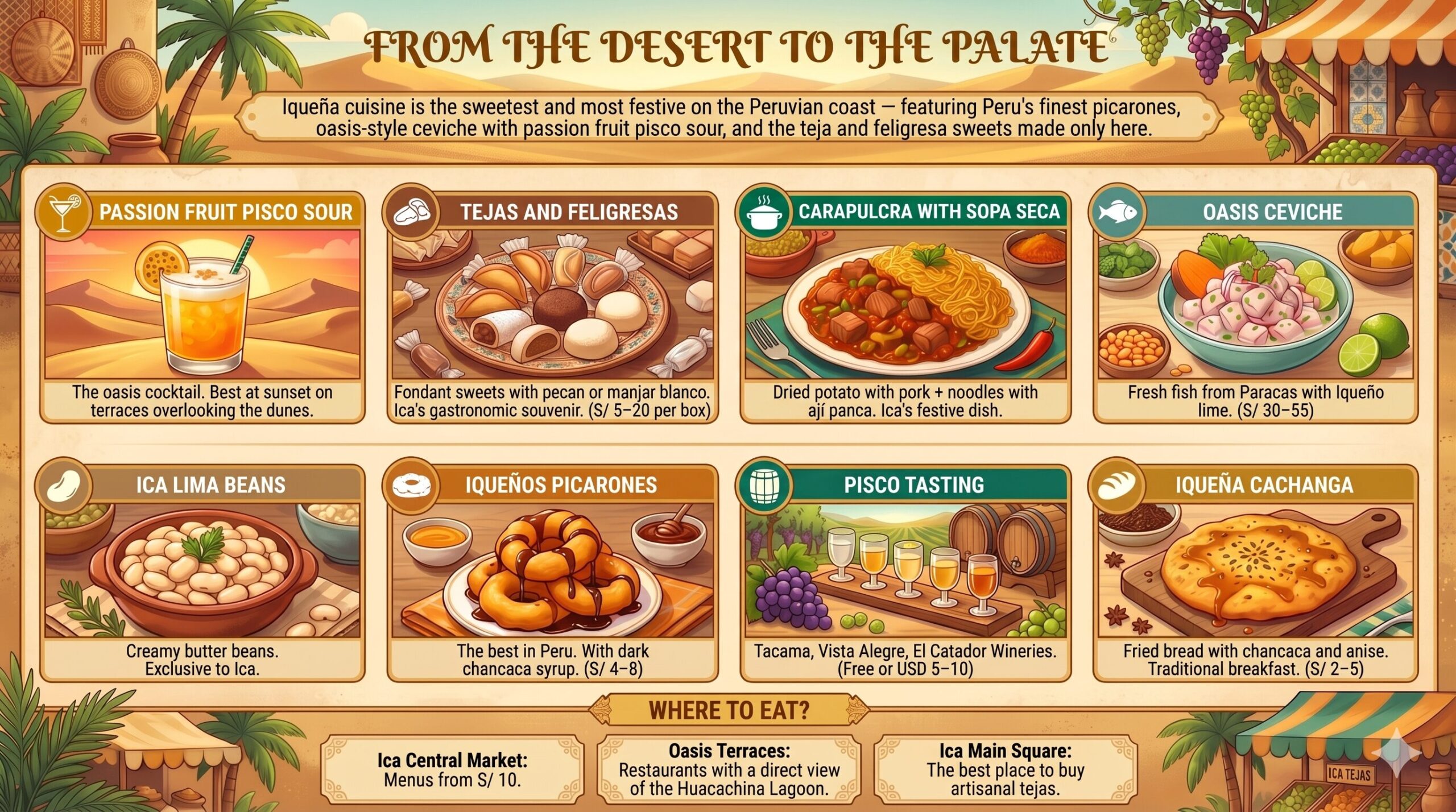
In Ica the pisco sour is made with pisco produced 5 km away, the freshness of Ica quebranta with the tropical acid of local passion fruit creates the most balanced version of Peru's national cocktail. On the oasis terraces, with the golden dunes behind you at sunset, it is absolutely impossible to drink without smiling.
Ica's most famous sweets, tejas are lime or orange fondant bonbons filled with walnut, pecan or caramel, and feligresas are chancaca honey glazed biscuits. A colonial Spanish recipe adapted with ingredients from the Ica desert. The obligatory gift you take back from Ica to Lima.
Ica's most representative festive dish, carapulcra (dried-potato and pork stew) served over sopa seca (noodles cooked with ají panca and coriander). The flavour combination is the most complex and satisfying in southern Creole cuisine. Eaten at celebrations, anniversaries and family Sundays.
Although Huacachina is in the desert, the Pacific is only 60 km away, fresh fish arrives from Paracas within hours. Sole or corvina ceviche with Ica lime (sharper than Lima's), yellow chilli, red onion and toasted corn is the perfect lunch before the afternoon buggy tour.
Ica's pallares (butter beans) are unique, grown in the irrigated desert on groundwater, they have a creaminess and size unmatched elsewhere. Prepared in a Creole stew with pork, ají panca and herbs. They are the classic side dish to carapulcra and the most quintessentially Ica comfort food there is.
Ica's picarones (pumpkin and sweet potato doughnuts) are considered Peru's finest, fluffier, with a darker and more spiced chancaca syrup. The picaroneras in Ica's markets work from 6 PM to midnight. With orange and clove syrup, they are the most addictive street dessert on the southern coast.
Ica's wineries, Tacama, Vista Alegre, El Catador, offer tours with tasting of 4–6 different piscos: quebranta, Italia, torontel, albilla, negra criolla and acholado. Each grape produces a different character. Vista Alegre produces internationally award-winning pisco. The best gastronomic complement to the morning buggy.
Bread fried in lard with chancaca and anise, Ica's traditional breakfast since colonial times. Crispy on the outside, fluffy inside, with the sweet flavour of chancaca and the aroma of desert anise. In Ica's Central Market it is sold hot from 6 AM with black coffee. The most authentic way to begin the day at the oasis.
The promenade restaurants have views but tourist prices. For good food at good value: Ica's Central Market (15 min by mototaxi) with full set menus from S/ 10. For quality pisco sour with lake views: the terrace bars at Hotel Mossone or Desert Nights. For tejas: only at the specialist shops in Ica's Plaza de Armas, never at the oasis stalls (those are tourist-oriented).
The dawn buggy ride on the dunes, the oasis at sunset, the pisco wineries and a desert hiding one of the most spectacular dune fields on the planet, all within a 20-km radius.
Huacachina's absolute classic, adapted 4x4 vehicle climbing and descending 100-metre dunes at impossible speeds, with stops for sandboarding on the longest slopes. The adrenaline of sliding down an 80-metre dune on a wooden board is an experience you never forget. Peru's finest sunsets happen from the top of these dunes.
Walking around the lagoon (1 km perimeter) among palm trees, stucco hotels and lakeside terraces, the Huacachina ritual. The emerald-green water contrasts with the 100-metre golden dunes enclosing it on all sides. The sunrise over the oasis, when raking light illuminates the sand before the tourists arrive, is one of Peru's most photogenic moments.
Tacama (1540, the oldest in the Americas), Vista Alegre and El Catador offer tours of their desert vineyards, copper stills and centuries-old cellars. Tasting of 4–6 types of pisco and Peruvian wine included. 15 minutes from Huacachina by mototaxi.
14 km from Huacachina, the world's tallest dune at 2,078 metres (measured from the desert base). The climb on foot takes 2–3 hours. The descent by sandboard or sand-ski down its northern face is the desert's extreme experience. Not for beginners, requires good fitness and specialist equipment. The view from the top is absolutely worth everything.
5 km from Huacachina, natural lagoons with water birds in the heart of the desert. Flamingos, desert ducks and herons feed in waters fed by the same aquifers that created Huacachina. The contrast of green in the arid desert is surreal. Accessible by bicycle from the oasis.
The city of Ica, 5 km from the oasis, the Plaza de Armas with its baroque cathedral, the Ica Regional Museum (Paracas and Nazca mummies and ceramics), the Central Market with Peru's finest picarones and cachangas, and the teja and feligresa shops on Jr. Lima. A half-day well spent.
The region's finest museum, with pieces from the Paracas cultures (textiles, mummies), Nazca (polychrome ceramics, line models) and Inca. The Nazca ceramics collection is the most complete outside Lima. Perfect cultural context for travellers coming from Paracas and heading to Nazca. Affordable entry, very helpful staff.
Huacachina's most photogenic experience, walk to the top of the nearest dune (20 min) and watch the sun set over the oasis. The green lagoon turns orange, the palm trees become silhouettes and the dunes glow like gold. With the pisco sour you carried up in a neoprene flask, this is the epitome of the southern coast journey.
The Ica desert looks empty, but it harbours a surprising biodiversity adapted to one of the most extreme environments on Earth. Flamingos in the desert, sand foxes and birds that never drink water directly.
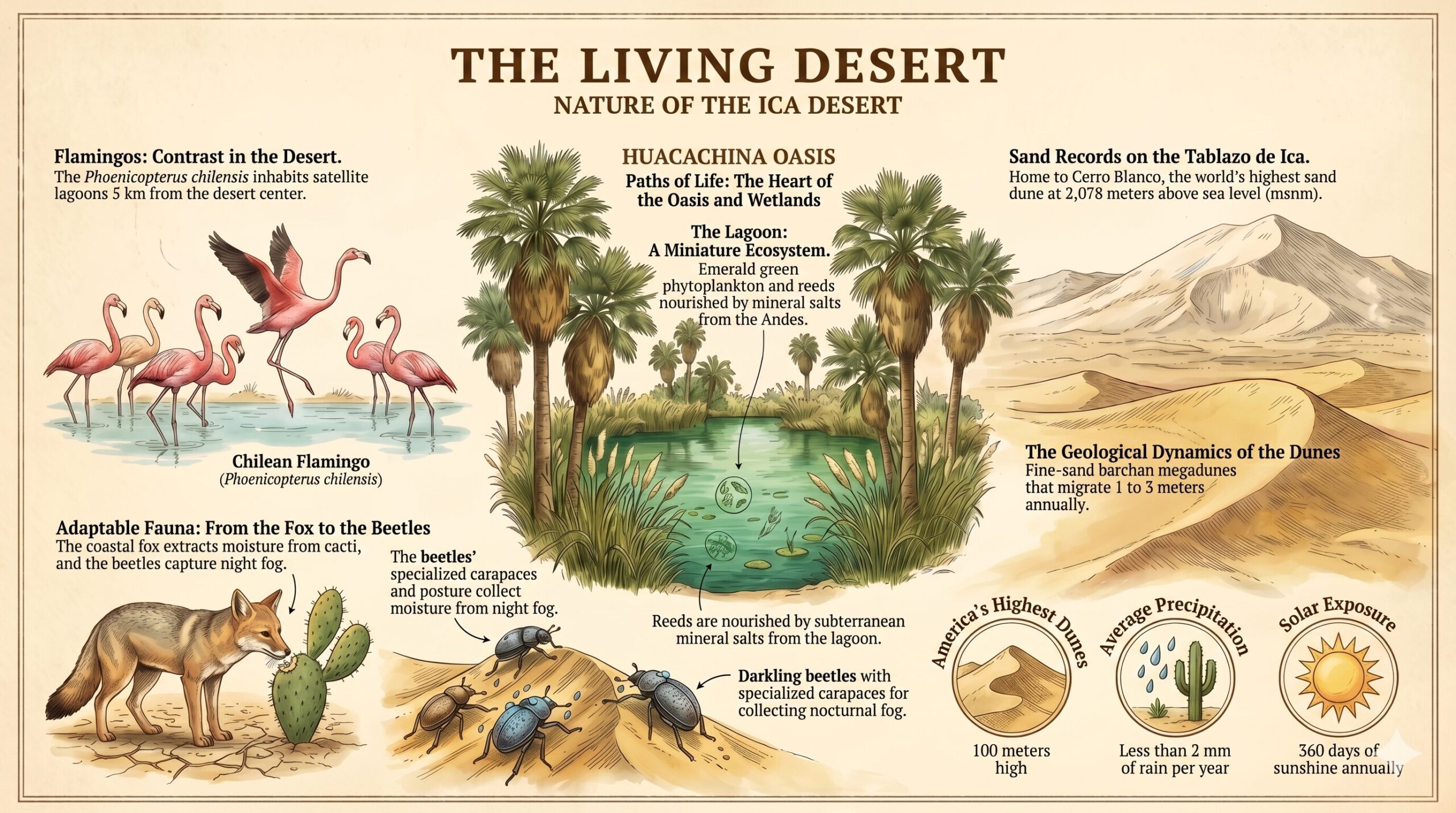
The Huacachina lagoon, though small (~1 km perimeter), has its own aquatic ecosystem, phytoplankton that turns it emerald green, algae filtering the water, wild ducks, egrets and reeds at the edges. The water, rich in mineral salts and Andean sulphates, has mineral properties that attract coastal birds deep into the desert interior.
The Lycalopex sechurae (Sechura desert fox) inhabits the Ica dunes, occasionally spotted at dawn and dusk at the edges of dunes far from the oasis. It has unique desert adaptations: it extracts moisture from cacti and the invertebrates it hunts, and can go days without drinking water. The most emblematic wild mammal of the Ica desert.
5 km from Huacachina, the satellite lagoons of the Ica Nature Reserve host colonies of Chilean flamingos (Phoenicopterus chilensis) that migrate from the altiplano. Seeing pink flamingos in the heart of the desert, with sand dunes in the background, is one of the most surreal natural contrasts in Peru. A cycle ride from the oasis takes 20 minutes.
The palm trees of Huacachina are Washingtonia filifera, the Californian desert palm introduced in the 19th century. Their roots reach the underground water table several metres down and their filamentous fronds distinguish them from tropical palms. They are the visual symbol of the oasis, listed as regional landscape heritage and protected from felling.
Living in the Pacific coastal dunes are beetles that collect water from the night fog, they tilt their abdomen at dawn so condensation droplets run towards their mouth. This survival mechanism in the world's driest desert has inspired atmospheric water-capture technology. They can be spotted on the dunes early in the morning before the sand heats up.
The dunes of Huacachina are not static, they move between 1 and 3 metres per year pushed by Pacific winds. They are barchan megadunes formed over tens of thousands of years of aeolian deposition. The golden-white sand, fine and rounded from erosion, is perfect for sandboarding but also for lungs (use a scarf when the wind lifts dust).
Buggy across the dunes at dawn, sandboarding at sunset, pisco at centuries-old wineries at midday, and the most silent, star-filled night in Peru. Huacachina fits perfectly into 1–2 days.
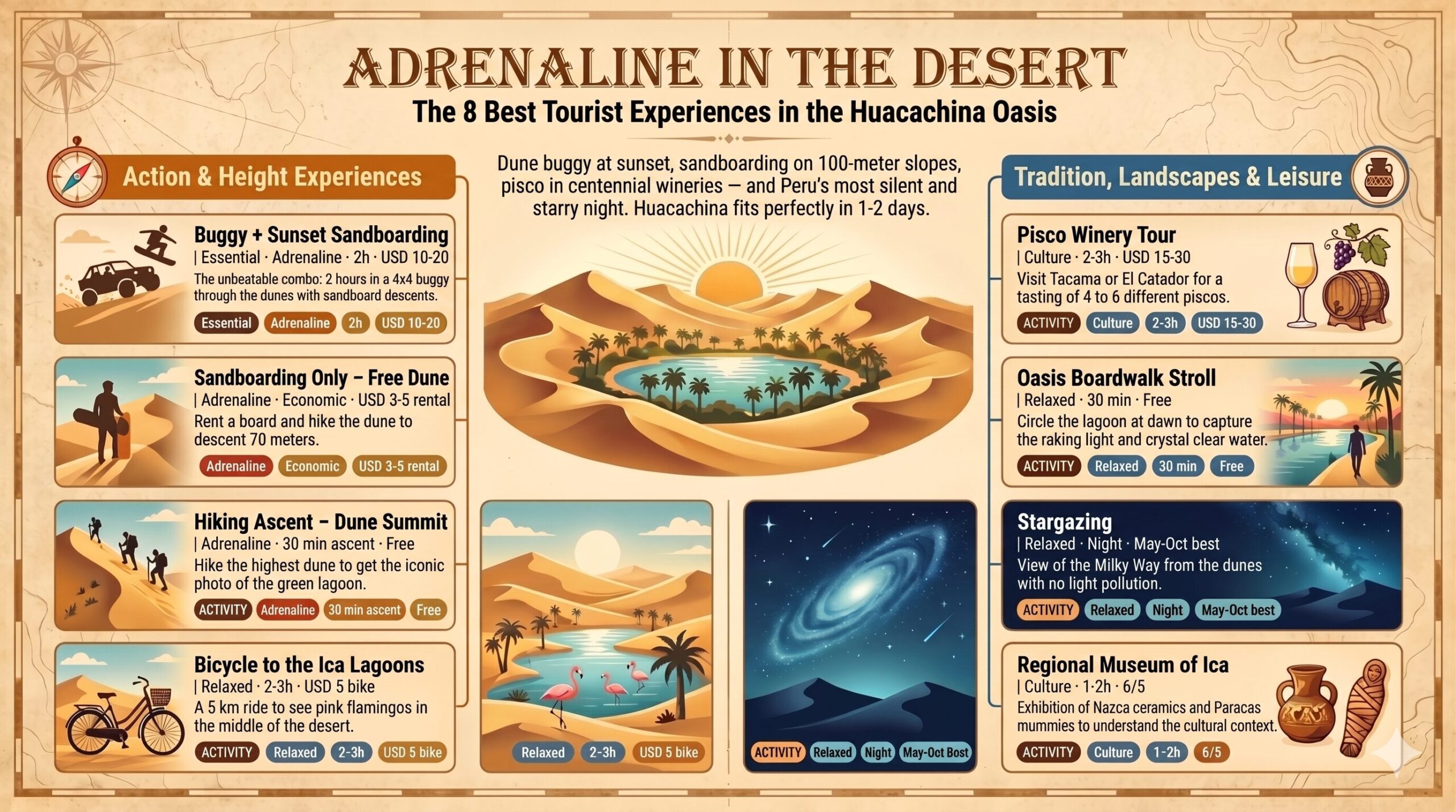
The unbeatable combo, 2 hours in a 4x4 buggy climbing and descending the largest dunes in the Americas, with stops on the longest slopes for sandboarding. The sunset tour (4–6 PM) ends with the sun sinking behind the dunes and turning the sand orange. The most memorable activity on the entire Southern Route.
Hire a board (USD 3–5) and climb the nearest dune on foot to slide down at your own pace, no buggy, no guide, on your own terms. The dune 10 minutes' walk from the oasis has 60–70 metres. Climb, slide, repeat. The best local riders practise their tricks here. The most affordable and most authentic option.
Visit Tacama, Vista Alegre or El Catador, tour of the desert vineyards, fermentation process and 19th-century copper stills. Tasting of 4–6 different piscos (quebranta, Italia, torontel, albilla). Combinable with the afternoon buggy: mornings at the wineries, afternoons on the dunes.
Walking the lagoon perimeter (1 km) among palm trees, restaurant terraces and craft stalls, Huacachina's relaxed ritual. Best at dawn before 8 AM when the oasis is empty, the raking light illuminates the dunes and the water reflects the sky. Bring a camera and take your time.
No buggy, the free climb to the highest dune adjacent to the oasis (20–30 min) to see the complete oasis from above. The view of the green lagoon surrounded by white sand from the summit is the Huacachina photograph. Bring sunscreen, water and closed shoes (the sand is very hot and the slope deceptively steep).
The Ica desert has zero light pollution outside the towns, from the dune tops at night, the Milky Way is so dense it looks like a cloud. Best months: May–October (no full moon). Some hostels organise dune stargazing nights with telescopes. The quietest and most profound experience the oasis offers.
5 km from the oasis, the natural lagoons of the Ica Reserve have flamingos and desert ducks. By bicycle along the desert road (flat, no traffic) you reach them in 20 minutes. Seeing pink flamingos in the middle of the desert is a unique photographic moment. Bicycle hire at the oasis hostels.
The best cultural context for understanding the region, Nazca ceramics collection (the most complete outside Lima), Paracas textiles and mummies, Inca pieces and colonial ceramics. 5 km from the oasis. Essential for travellers coming from Paracas heading to Nazca, it visually connects the archaeology of the entire southern coast.
Huacachina is the easiest and most straightforward destination on the southern coast, no altitude, no complications, 4 hours from Lima. The only hard decision is whether to stay 1 night or 2.
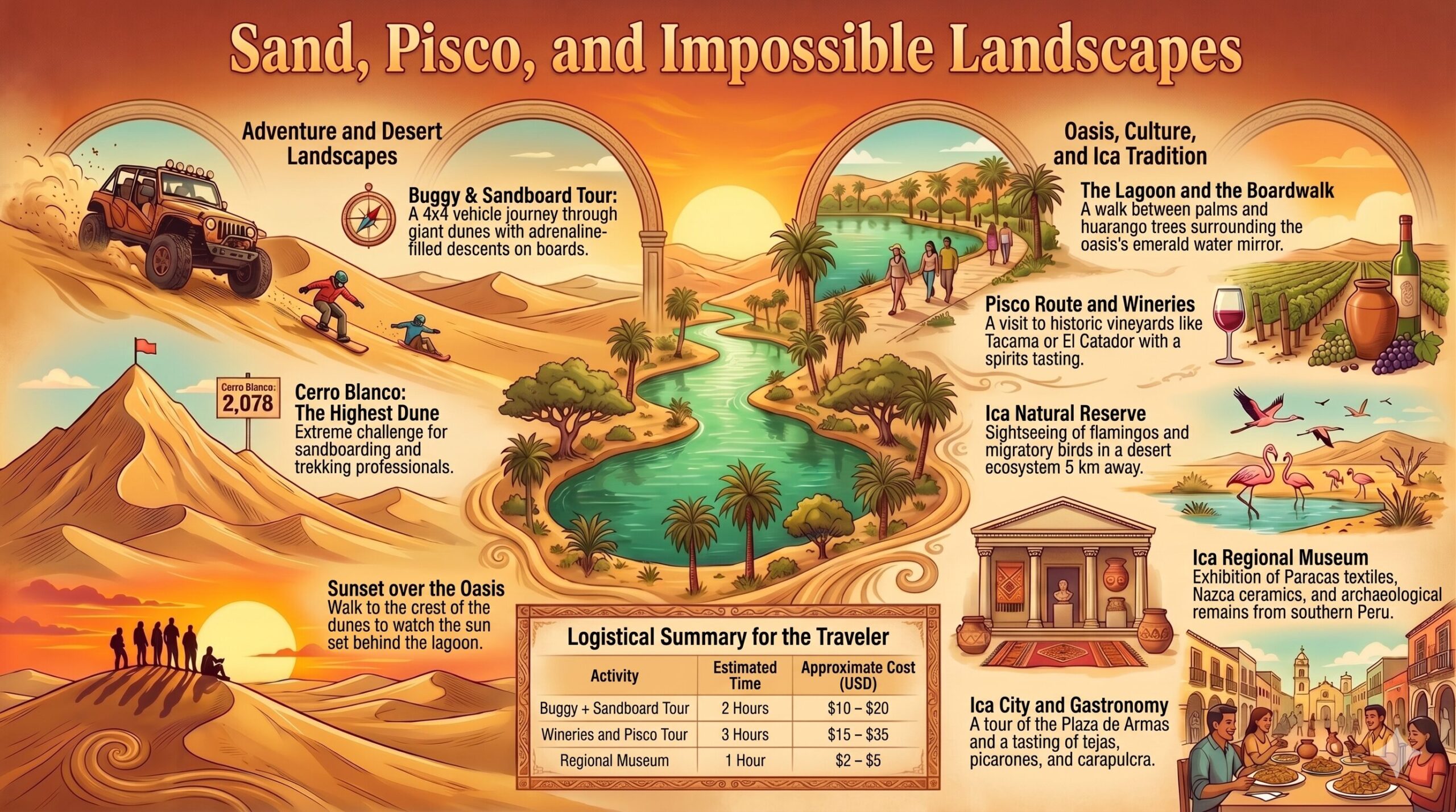
Lima → Paracas (Day 1: Ballestas + Reserve) → Huacachina / Ica (Day 2: wineries AM + buggy PM + sunset) → Nazca (Day 3: Lines overflight). All by bus, no flight, 3 nights, the most efficient and thrilling circuit on Peru's southern coast.
Huacachina's sand is very fine and penetrates cameras, phones, bags and clothing. Pack electronic devices in sealed bags before the buggy. The best oasis photographers use UV-protected lenses and clean their equipment every night.