

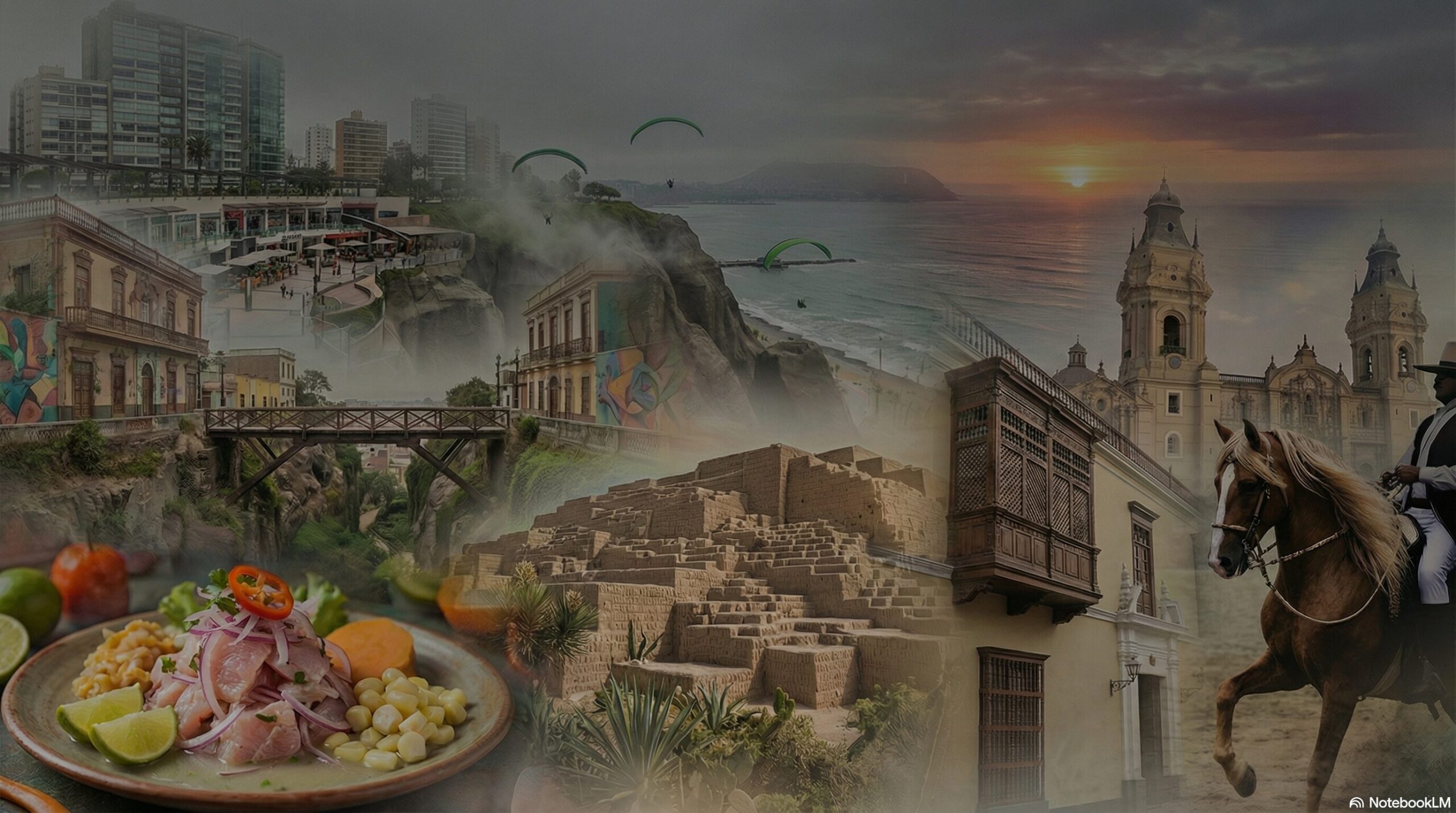
Where Pacific cliffs merge with modern skyscrapers, colonial history coexists with avant-garde art, and the best cuisine in Latin America is served on every corner.
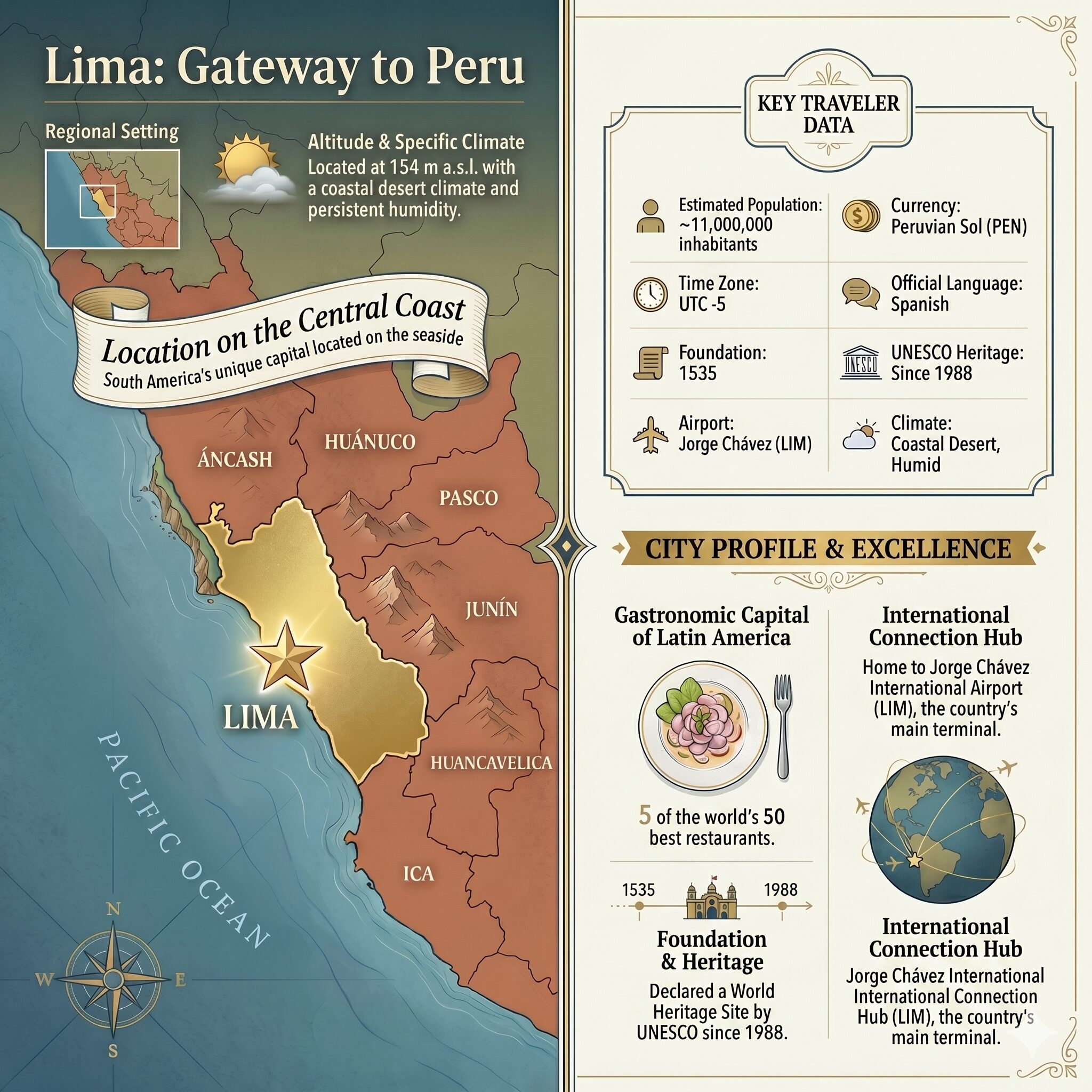
Lima, founded in 1535 by Francisco Pizarro and christened City of Kings, is today a vibrant metropolis of more than 11 million people perched above the Pacific Ocean on the cliffs of the Costa Verde. Capital of Peru and the gateway to the country for the majority of international visitors.
In Lima, centuries of colonial history coexist alongside ultra-modern neighborhoods, pre-Inca huacas stand between glass buildings, and a gastronomic scene that has conquered the entire world. This is the city where ceviche was elevated to an art form, where world-renowned chefs and market cooks share the same passion for flavor.
For the traveler en route to Cusco or Machu Picchu, Lima deserves far more than one night in transit. Its world-class museums, neighborhoods with their own soul, and its unrivaled cuisine make every hour here a discovery.
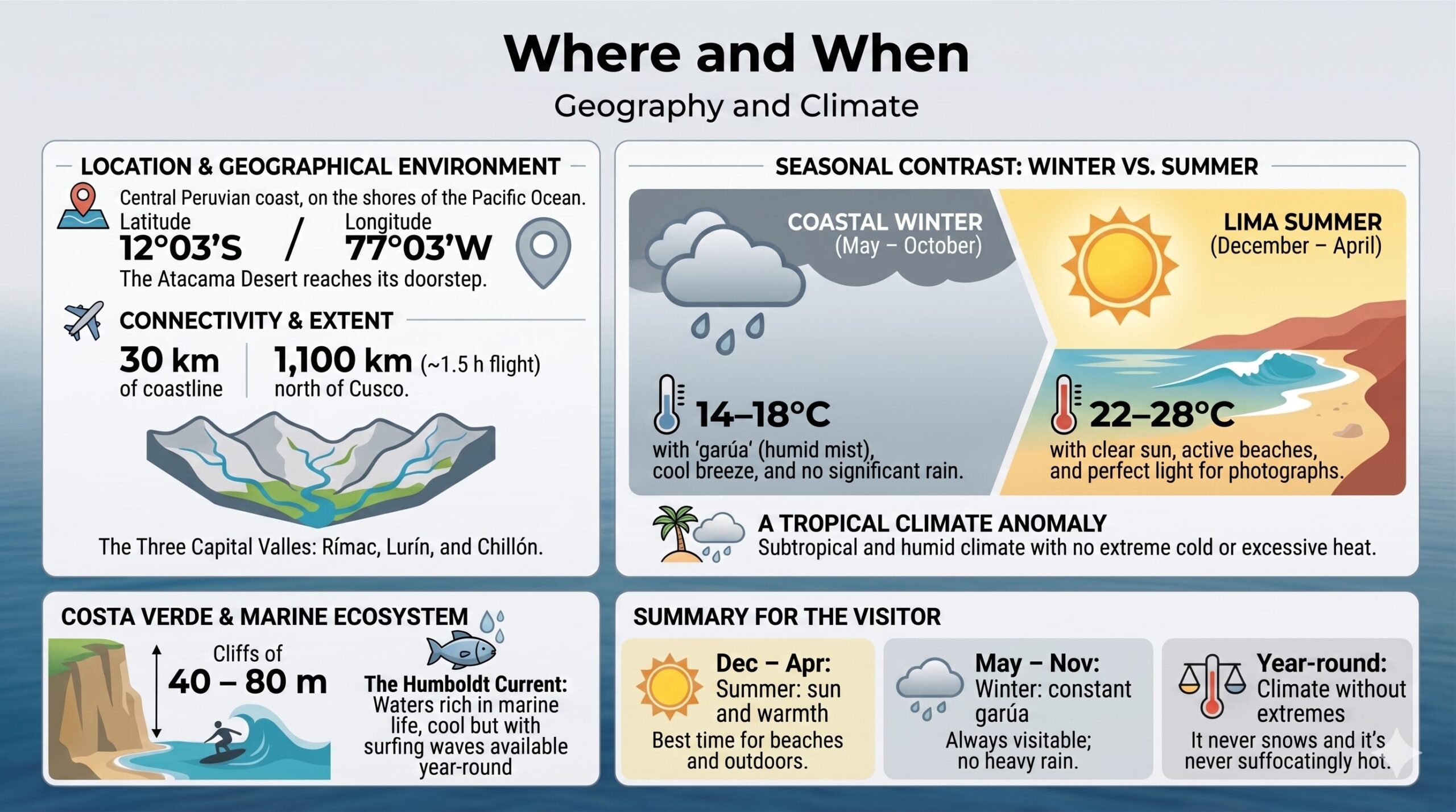
Lima stretches along the desert Pacific coast, crossed by three rivers and flanked by cliffs up to 80 metres above the sea, a city that faces the ocean horizon all year round.
Central coast of Peru, on the shores of the Pacific Ocean. Latitude 12°03′S, Longitude 77°03′W. The Atacama Desert reaches to its doorstep.
The famous garúa, a damp, persistent sea mist covers the city. No real rainfall but grey skies throughout the day. Cool and constant temperatures.
From December to April the sun clears the mist. Pleasant heat, active beaches, the Miraflores seafront in full life. The most photogenic Lima.
The Humboldt Current cools the Pacific off Lima year-round, creating waters rich in marine life but cold, perfect for surfing, not for swimming.
From pre-Inca civilisations to the capital of the most powerful Viceroyalty in the New World, Lima carries 5,000 years of accumulated history in its streets and huacas.
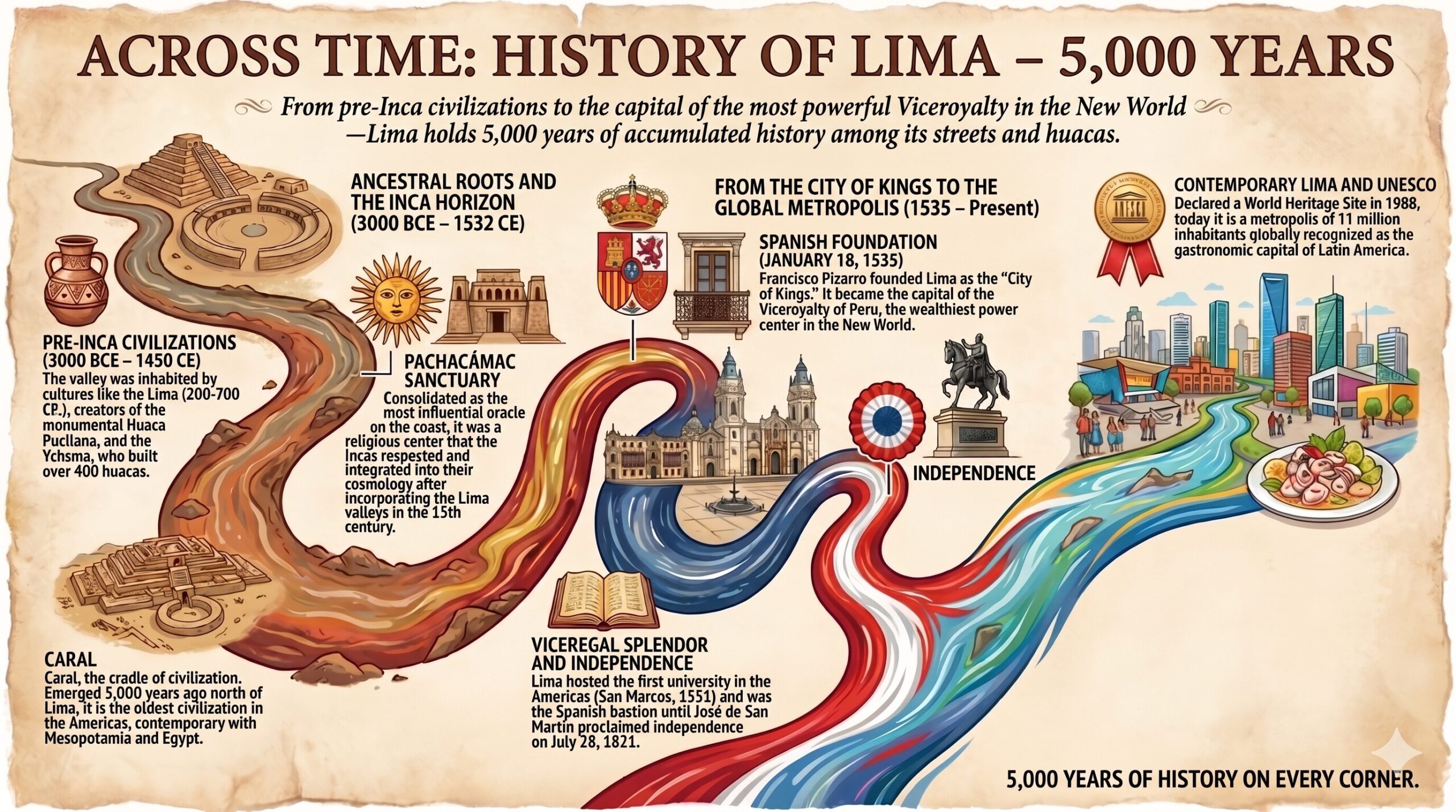
The Rímac Valley was inhabited by diverse cultures for millennia. The Lima culture (200–700 AD) built the monumental Huaca Pucllana, an adobe pyramid that can still be visited in the heart of Miraflores. Later, the Ychsma people controlled the valley, building hundreds of huacas along the coast.
The Inca Empire incorporated Lima's coastal valleys in the mid-15th century. The sanctuary of Pachacamac, 30 km to the south, was the most important religious centre on the coast, an oracle revered by all Andean and coastal peoples alike. The Incas respected its power and integrated it into their cosmology.
Francisco Pizarro founded Lima on 18 January 1535, naming it Ciudad de los Reyes (City of Kings) in honour of the Three Wise Men. He chose this coastal valley for its access to the Pacific and its mild climate. Within a few years it became the capital of the Viceroyalty of Peru, the richest and most powerful in the New World.
Lima shone as the jewel of the Spanish Empire in the Americas. Its Plaza Mayor, baroque palaces, monumental convents and University, the first in the Americas (1551), established it as the cultural, political and economic centre of the western hemisphere. The silver of Potosí passed through Lima on its way to Seville.
General José de San Martín proclaimed the independence of Peru from Lima on 28 July 1821. The city became the capital of the new Republic. Two years later, the Battle of Ayacucho (1823) sealed the definitive independence of all of South America.
Lima's Historic Centre was declared a UNESCO World Heritage Site in 1988. Today the city is a metropolis of 11 million that combines the modernity of San Isidro with the art of Barranco and 400 years of history in the Centre. Its gastronomy has catapulted it onto the world culinary map, with restaurants ranked among the best on the planet.
Lima is Peru's great melting pot, Andean, Creole, Afro-Peruvian, Asian and European communities coexist in a blend that exists nowhere else in the world.
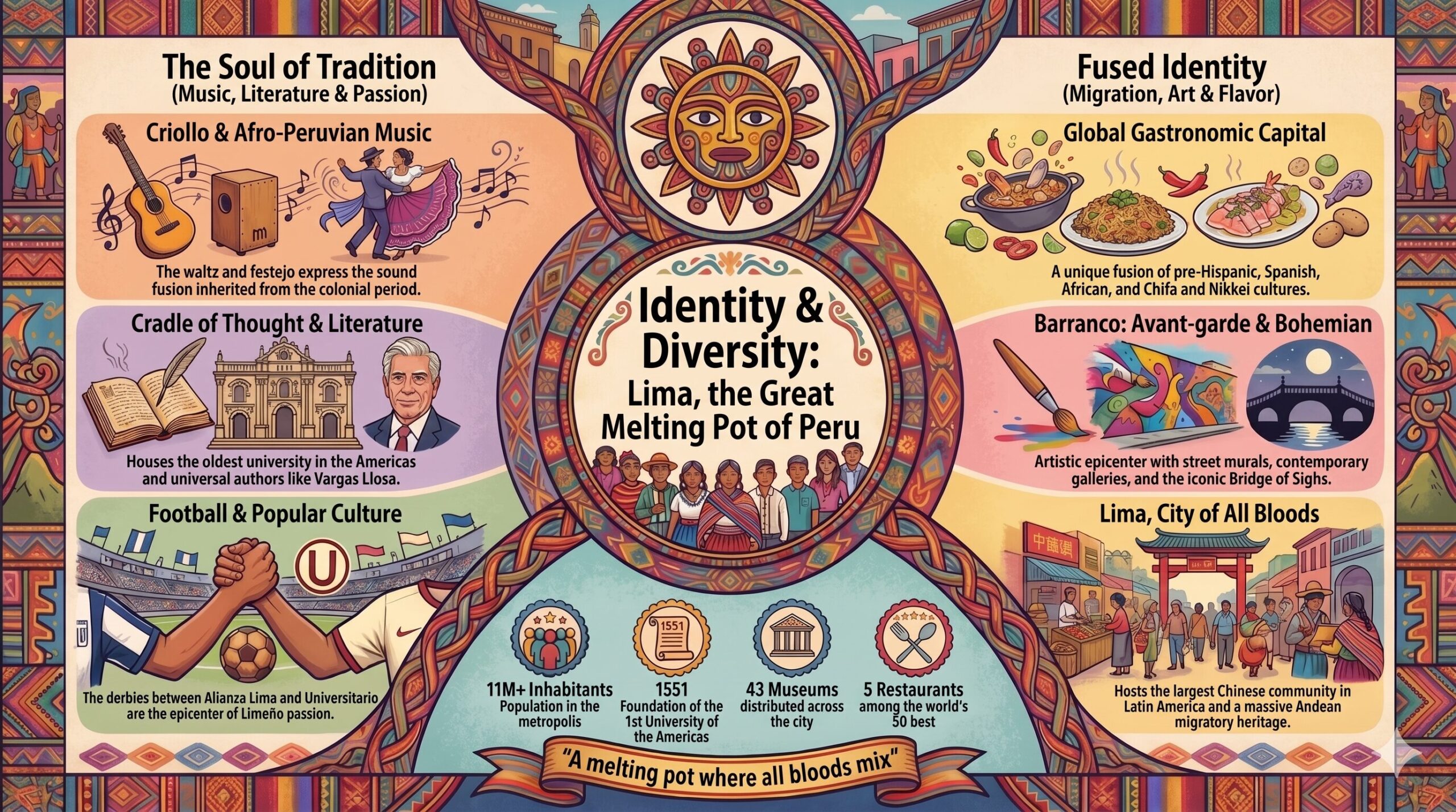
The Creole waltz, the marinera and the Afro-Peruvian festejo are Lima's most deeply rooted musical expressions. The peñas, music taverns in the centre, bring families together every night to sing and dance these traditions inherited from colonial mestizaje.
The Barranco district is Lima's artistic epicentre, galleries, street murals, independent theatres and artists' studios. The contemporary Lima scene is in dialogue with the pre-Columbian art that fills museums just a few kilometres away.
Lima is the birthplace of world-class writers: Mario Vargas Llosa (Nobel Prize in Literature 2010) set much of his work here. The city has a literary and journalistic tradition stretching back to the Viceroyalty and the first university in the Americas, founded in 1551.
Lima is home to the largest Japanese community in South America and a large Chinese community (the chifas, Chinese-Peruvian restaurants, number in the thousands), as well as Italian and Spanish communities and massive internal Andean migration that continuously transforms the city.
Football is Lima's popular religion. The Estadio Nacional, the derbies between Alianza Lima and Universitario, and the collective passion that brings the city to a standstill on weekends are a privileged window into the most authentic identity of the limeño.
Lima celebrates its colonial roots, Afro-Peruvian heritage and republican festivities with equal intensity, a non-stop cultural calendar throughout the year.
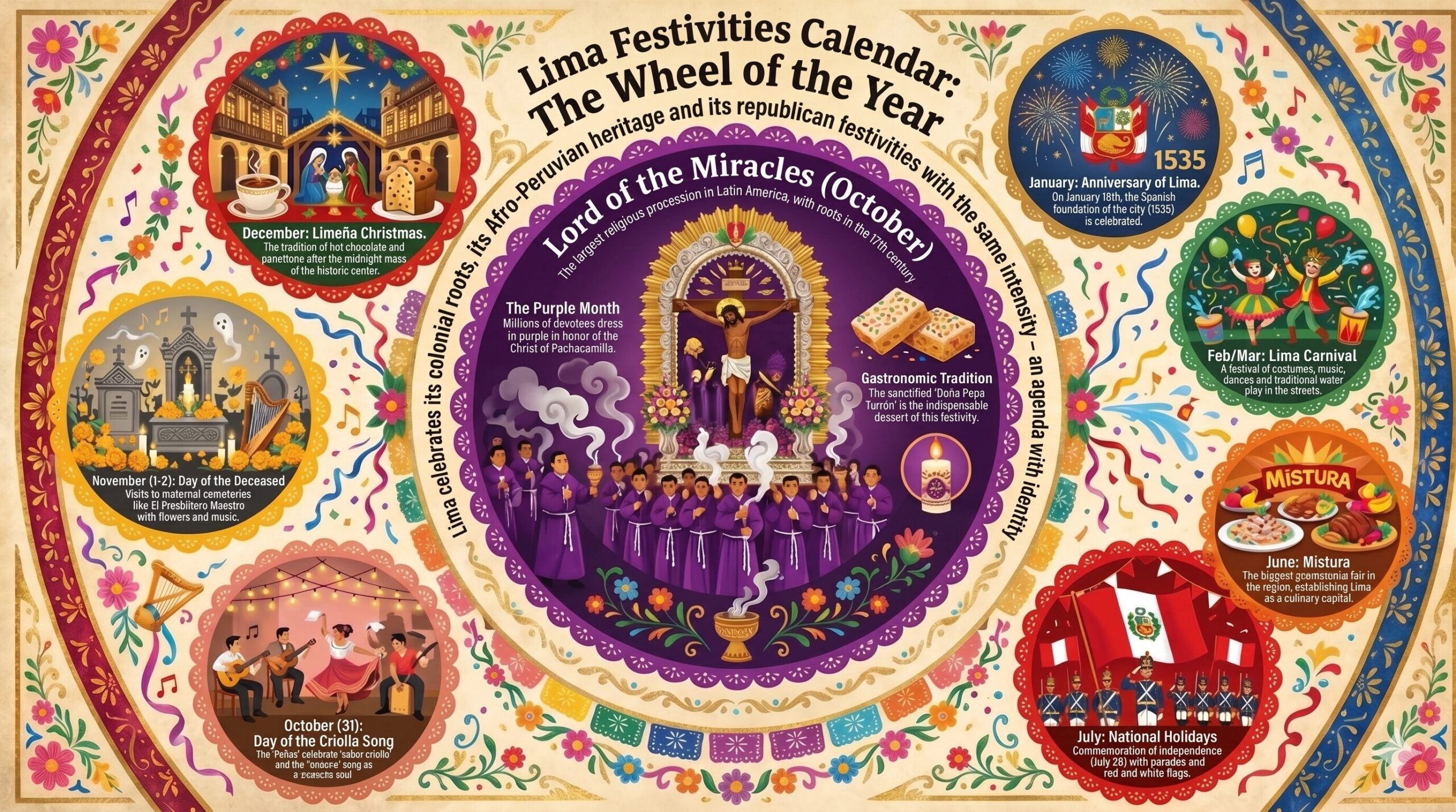
Foundation of the Ciudad de los Reyes
On 18 January 1535 Pizarro founded Lima. Each year the city celebrates with free concerts in the Plaza Mayor, fireworks over the Pacific, historical parades and a craft fair in the Historic Centre.
Peruvian Independence
The country's greatest national holiday. The Grand Military Parade marches through Lima for hours. Families from across Peru travel to the capital, restaurants offer special menus and the Plaza Mayor is dressed in red and white.
The Purple Procession
The largest religious procession in Latin America. Millions of devotees dressed in purple accompany the image of the Christ of Pachacamilla through the streets of the Centre throughout October. An uninterrupted tradition since the 17th century.
Creole Song Month: 31 October
The Creole waltz and the marinera are the musical heartbeat of Lima. On 31 October, Creole Song Day is celebrated with packed peñas across the country. The northern marinera holds its national competition in Trujillo each January.
Water & Dance in the Neighbourhoods
Lima's carnival blends Spanish tradition with Afro-Peruvian festejo. Barranco is especially lively, carnival groups, live music and the traditional games with water and flour in the streets.
Gastronomic Capital of the World
Latin America's largest food fair brings together the best chefs from Peru and the world alongside local producers. Over 400,000 visitors in 10 days sample everything from a market ceviche to cutting-edge cuisine.
Cemeteries & Flowers
Lima's cemeteries, especially the Presbítero Maestro, one of the most beautiful in the Americas, fill with flowers, music and families honouring their dead in a ritual that blends colonial and Andean customs.
Chocolate & Panettone
Lima Christmas has its own flavour: panettone with hot chocolate is the Christmas Eve dinner in almost every home. The Historic Centre is spectacularly illuminated and Miraflores' Parque Kennedy fills with cats and Christmas stalls.
Lima is the gastronomic capital of Latin America, 5 of its restaurants appear among the world's 50 best, and in every market a nameless cook makes the finest ceviche you will ever taste.
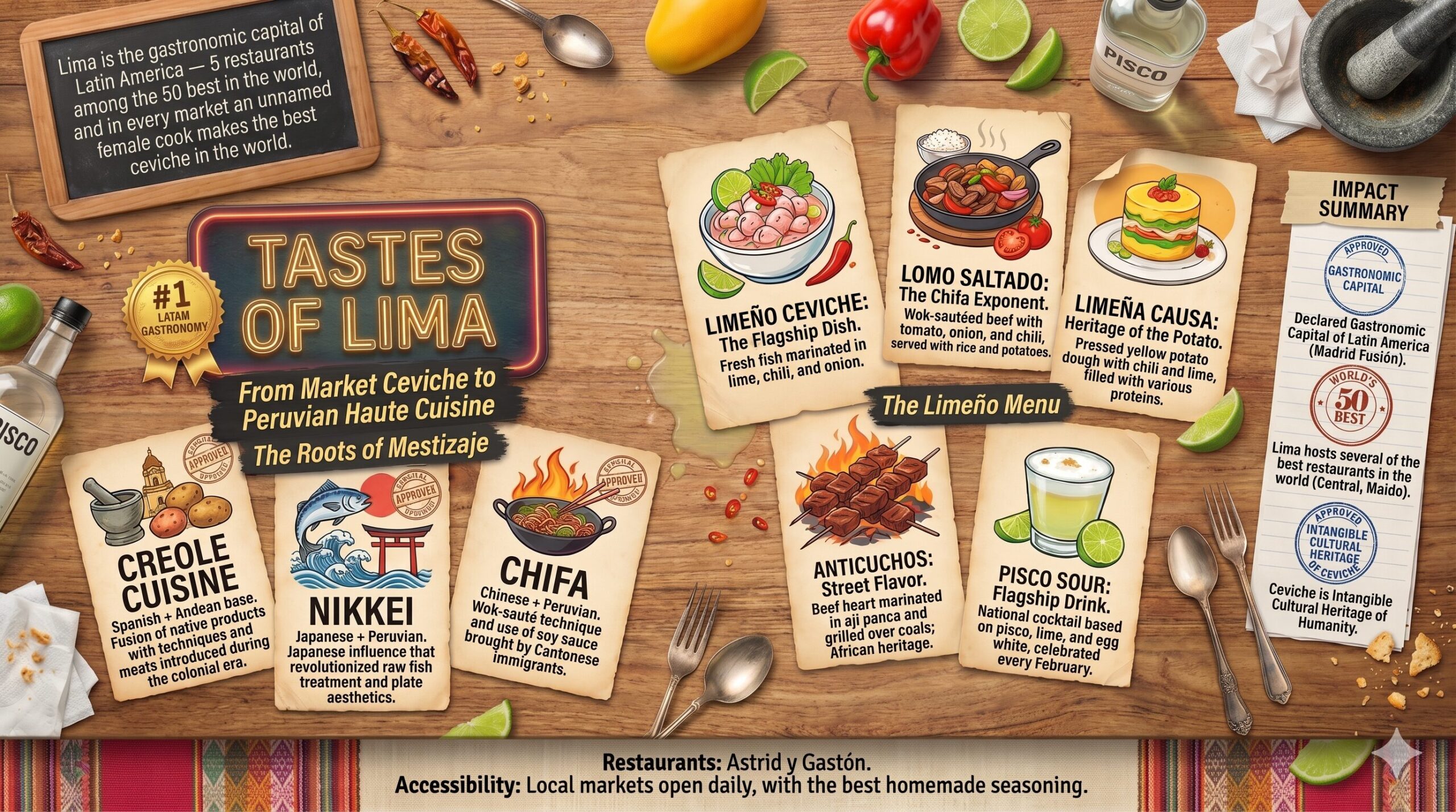
Peru's national dish, fresh fish marinated in leche de tigre (lime juice, chilli and onion), served with corn and sweet potato. Lima invented the "a la minuta" ceviche, prepared in seconds.
National DishThe great Peruvian stir-fry, beef tenderloin with tomato, onion and yellow chilli in a wok, served with rice and chips. The most popular chifa-creole dish in the country.
Must TryYellow potato kneaded with yellow chilli and lime, filled with chicken, tuna or seafood. A symbol of Lima's Creole cuisine combining the Andean tuber with coastal freshness.
CreoleShredded chicken in a creamy yellow chilli sauce with bread, walnuts and milk. Served on rice with olives and egg. Lima's ultimate comfort food.
Comfort FoodBeef heart skewers marinated in panca chilli and chicha, grilled over charcoal. An Afro-Peruvian tradition enjoyed at street stalls after dark, with corn and potato.
Street FoodPeru's national cocktail, quebranta grape pisco, lime, gum syrup, egg white and Angostura bitters. Its National Day is celebrated on the first Saturday of February.
National CocktailThe Peruvian-Japanese offspring of ceviche, thin slices of raw fish with yellow chilli or rocoto sauce, without onion. The Nikkei cuisine born in Lima that conquered the world.
NikkeiLima's most beloved Creole dessert, egg yolk manjar blanco with condensed milk, topped with Italian meringue scented with port and cinnamon. Pure Lima.
DessertCentral, Maido, Astrid y Gastón, La Mar and Kjolle feature among the world's best restaurants. The Surquillo Market and the Central Market offer the same culinary richness at S/. 15 a plate. Lima is the only place where haute cuisine and street food compete on equal terms.
Five thousand years of history concentrated in one city, from pre-Hispanic pyramids to world-class museums and Pacific cliffs.
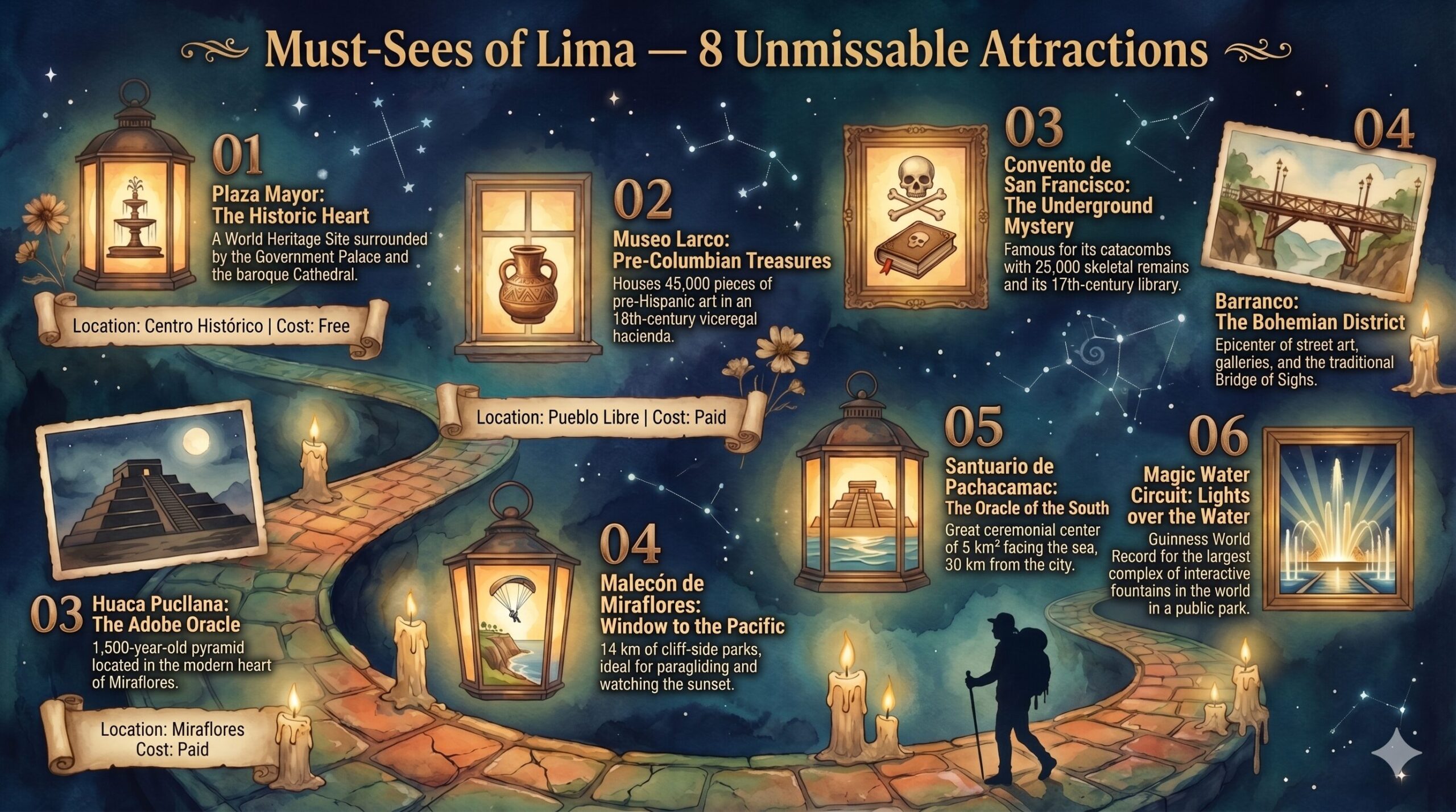
The colonial heart of Lima, the 1651 bronze fountain, the Government Palace, the Cathedral and the Municipal Palace in perfect baroque harmony.
The world's largest pre-Columbian art collection, 45,000 pieces of ceramics, textiles and jewellery in an 18th-century hacienda with a colonial garden.
A 1,500-year-old adobe pyramid in the heart of Miraflores, a pre-Inca oracle illuminated at night with views of the modern skyline.
14 km of clifftop parks above the Pacific, Lima's most iconic spot for watching the sunset and paragliding.
A jewel of colonial baroque, famous for its catacombs holding 25,000 remains and its impressive library with 17th-century manuscripts.
Lima's most bohemian district, street murals, the Bridge of Sighs, art galleries and the city's best bar scene.
The most venerated oracle on the coast, 5 km² of pyramids and temples 30 km from Lima with views of the Pacific.
13 interactive fountains in Parque de la Reserva, a Guinness World Record. The nightly light-and-water show is one of the largest in the world.
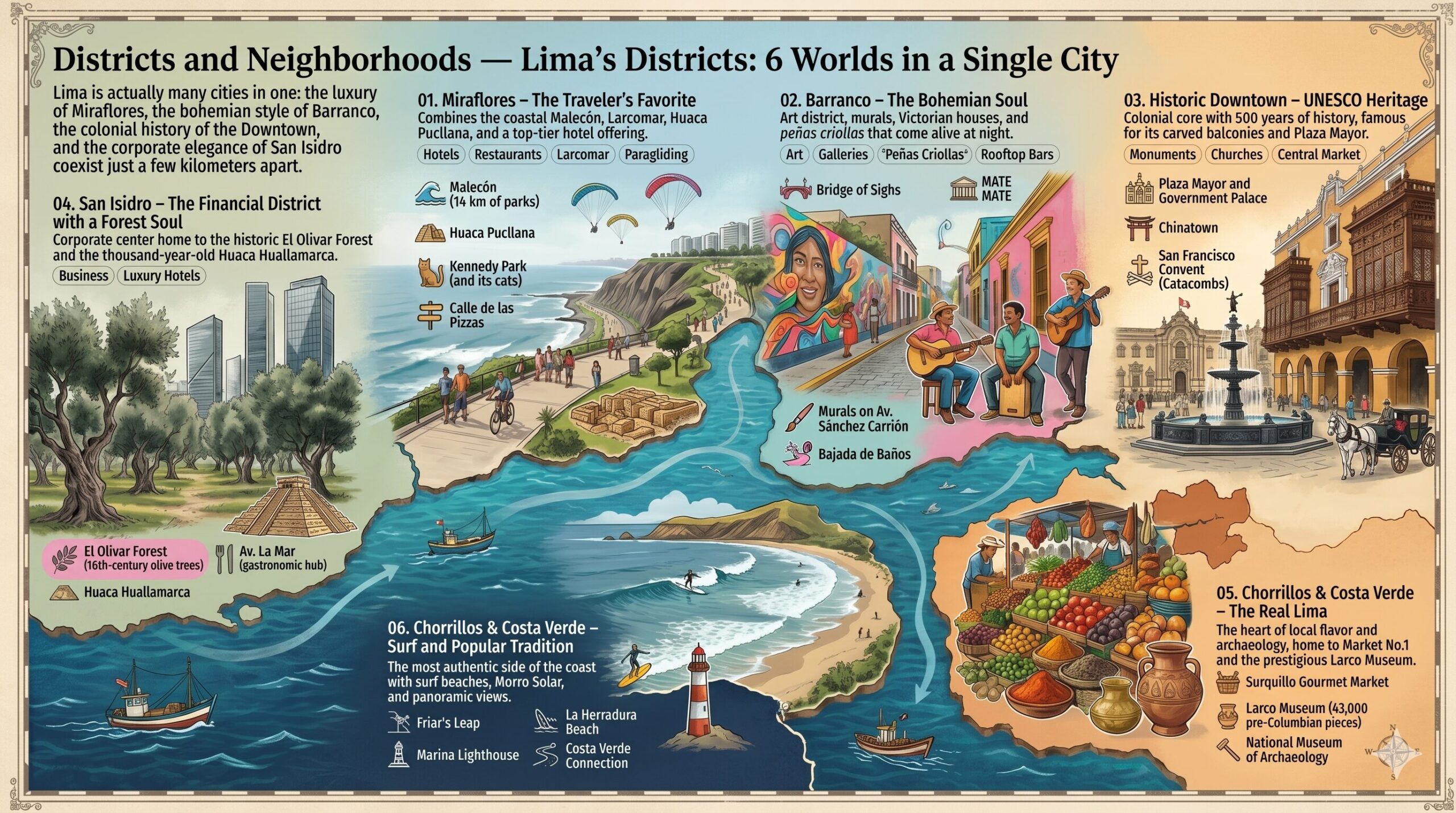
Lima is much more than museums and monuments, paragliding over the Pacific, food tours through legendary markets, surfing on the Costa Verde and dining at the world's best restaurants.
Surquillo Market N°1 and the Central Market are the pantries of the world's best chefs. A guided tour takes you through stalls selling chicha morada, quick causas, spoon ceviche and 300 varieties of Peruvian potato.
Take off from Miraflores' cliffs and fly over the Pacific with Lima's skyline as a backdrop. Tandem flights of 10–15 minutes run throughout the day with no experience required, one of Lima's most iconic activities.
Learn to prepare ceviche, leche de tigre, pisco sour and lomo saltado with local chefs. Cooking schools in Miraflores and Barranco offer classes in English and Spanish with a market visit included. One of the tastiest memories you'll take home from Lima.
Visit the Plaza Mayor, Government Palace, Basilica Cathedral, the San Francisco Convent with its catacombs and Chinatown on a half-day tour. Most depart from Miraflores with a bilingual guide and transport included.
Lima has waves year-round, especially from December to March. La Herradura, Punta Roquitas and La Pampilla are the most popular spots. Surf schools in Miraflores offer beginner lessons from USD 30 with equipment included.
A full day dedicated to art and history: Larco Museum (morning), Huaca Pucllana at sunset, Lima Art Museum (MALI) and the National Archaeology Museum in Pueblo Libre. The Lima Museum Pass tourist card gives reduced-price access to all.
Lima has some of the world's best pisco bars. Start at Bodega Queirolo (Pueblo Libre), Lima's oldest, continue through Barranco's bars and end at a Creole peña with live waltz and marinera. The most complete cultural experience of Lima's nightlife.
Barranco has one of the most active street art scenes in Latin America. Artists like Entes, Pésimo and the Fugaz collective have turned its walls into an open-air gallery. Two-hour walking tours blend the bohemian neighbourhood's history with contemporary artistic interpretation.
30 km south of Lima, the pre-Inca sanctuary of Pachacamac was the most powerful oracle in the Andes. A half-day tour includes the Pachacamac Site Museum, adobe pyramids and the Temple of the Sun with Pacific views, perfect paired with a seafood lunch in Lurín.
The 1,500-year-old pyramid in the heart of Miraflores opens at night with special illumination, a unique experience where pre-Inca and modern Lima coexist. The Huaca Pucllana restaurant inside the complex is one of the city's most special spots for dinner with a view of the lit pyramid.
Lima has 5 restaurants among the world's 50 best. Central (#1 in the world 2023), Maido (Nikkei cuisine), Kjolle, La Mar and Astrid y Gastón are unique gastronomic experiences. Book weeks in advance, these are the reason many travellers include Lima in their itinerary.
Sunset over the Pacific from Miraflores' cliffs is one of Lima's most beautiful natural spectacles. The Malecón Cisneros → Larcomar → Malecón Balta circuit can be walked in 2 hours with stops at viewpoints while paragliders soar overhead. Completely free.
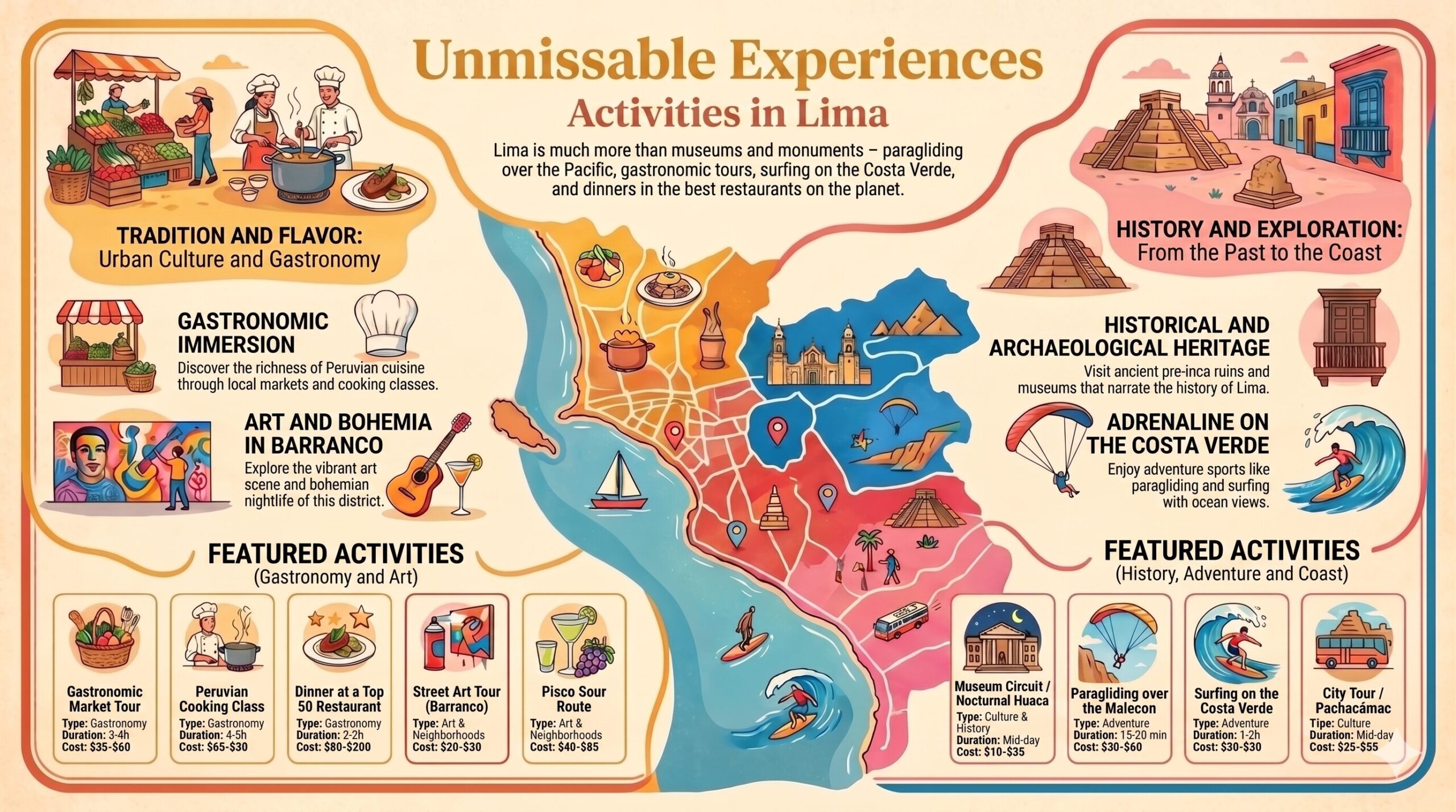
Lima is a coastal city just 154 metres above sea level, no altitude issues, direct flights from around the world and an urban transport network in constant expansion.
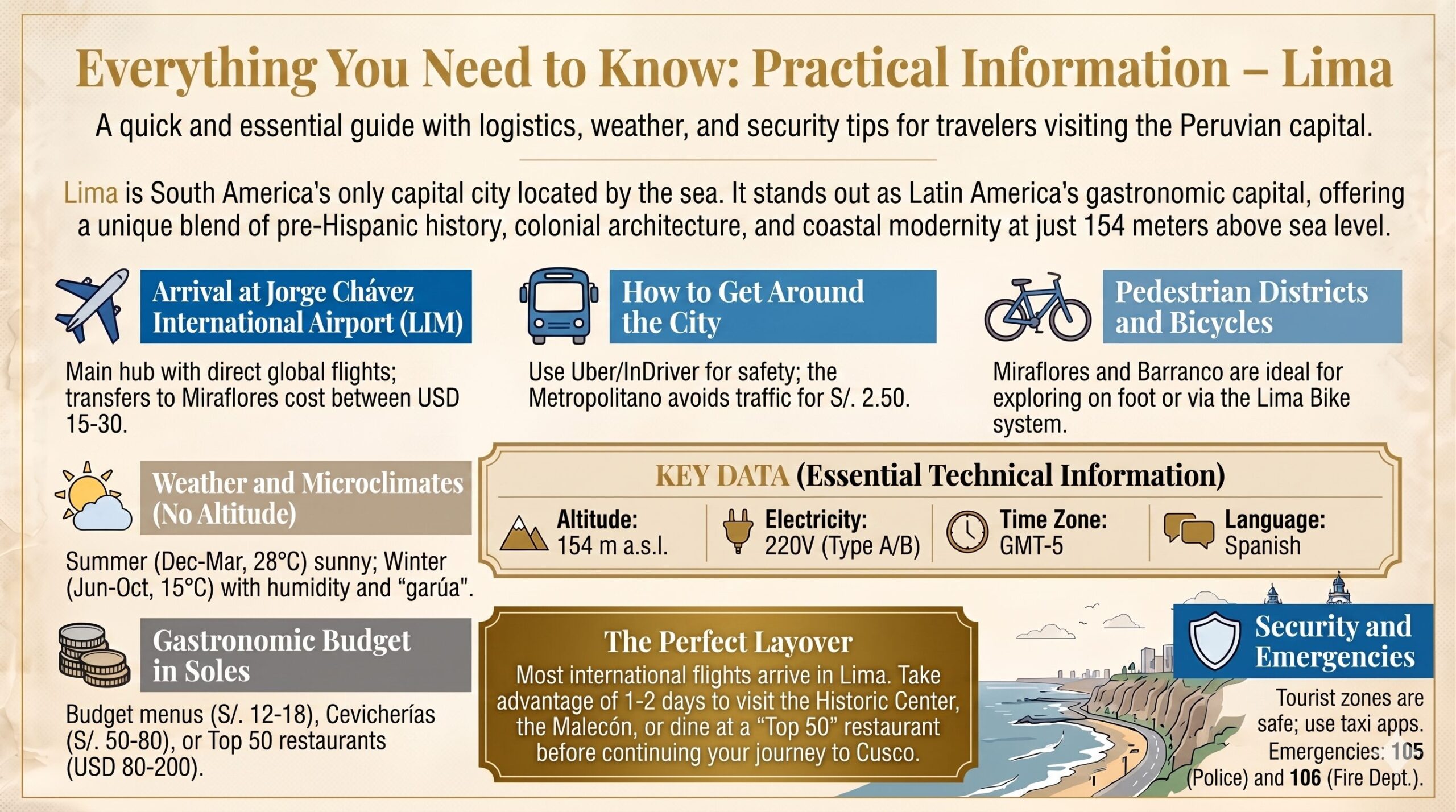
Most international flights to Peru arrive in Lima. Take the opportunity to spend a night and visit the Historic Centre, the Malecón or dine at one of the world's best restaurants before continuing to Cusco, Arequipa or Iquitos. 1–2 days in Lima are never enough.
Central, Maido and Kjolle are among the most booked restaurants in the world. If you want to dine at one of the global Top 50, reserve at least 4–6 weeks in advance through their official websites or OpenTable. For popular ceviche bars like La Mar, arrive before 1 PM or expect up to a one-hour wait.